Order too little stone veneer and your project stalls while you wait weeks for a top-up shipment. Order too much and you absorb dead inventory cost plus wasted freight. For distributors and builders placing container-load orders from China, getting the stone veneer quantity calculation right on the first attempt is not optional — it directly affects your timeline, landed cost, and margin.
This guide walks through the exact formulas professional buyers use to determine how much stone veneer they need. Every section includes worked examples with real numbers, panel coverage rates for standard product sizes, and container-load planning math so you can move from wall measurements to a purchase order with confidence.
Step 1: Measure the Wall Area (Gross Square Meters)
The starting point for any stone veneer quantity calculation is gross wall area. Measure every surface you plan to clad — height times width — and sum the results.
Formula:
Gross Area = (Wall 1: H × W) + (Wall 2: H × W) + (Wall 3: H × W) + …
Worked Example: A commercial building has three exterior walls designated for stacked stone cladding.
- Wall A: 3.0 m high × 8.0 m wide = 24.0 m²
- Wall B: 3.0 m high × 5.5 m wide = 16.5 m²
- Wall C: 3.0 m high × 6.0 m wide = 18.0 m²
Gross Area = 24.0 + 16.5 + 18.0 = 58.5 m²
Use a laser distance meter for large commercial facades. For residential projects or fireplace surrounds, a steel tape measure is sufficient. Always measure to the nearest centimeter and record each wall separately — you will need individual dimensions when planning panel layout and cuts.
Step 2: Subtract Openings (Windows, Doors, Vents)
Any opening that will not receive stone cladding must be deducted. This is where many first-time buyers lose accuracy.
Formula:
Net Wall Area = Gross Area − (Sum of All Opening Areas)
Continuing the example: Wall A has one window (1.2 m × 1.5 m) and one door (1.0 m × 2.1 m). Wall C has two windows (each 1.0 m × 1.2 m).
- Window on Wall A: 1.2 × 1.5 = 1.8 m²
- Door on Wall A: 1.0 × 2.1 = 2.1 m²
- Two windows on Wall C: 2 × (1.0 × 1.2) = 2.4 m²
Total openings = 1.8 + 2.1 + 2.4 = 6.3 m²
Net Wall Area = 58.5 − 6.3 = 52.2 m²
Pro tip: For large garage doors or storefront glazing, double-check measurements from architectural drawings rather than field measurements. A 10 cm error on a 4-meter-wide opening adds up to 0.4 m² of phantom area.
Step 3: Apply the Stone Veneer Waste Factor
Stone veneer quantity calculation is not complete without a waste factor. Every installation generates offcuts — at corners, around outlets, and where partial panels are needed at edges. The waste factor compensates for this material loss.
Standard waste factors:
| Wall Complexity | Waste Factor | Typical Scenario |
|---|---|---|
| Simple flat wall | 5% | Long, unbroken wall with few openings |
| Moderate complexity | 8–10% | Multiple windows, some external corners |
| High complexity | 10–15% | Many corners, arches, irregular shapes, columns |
Formula:
Order Area = Net Wall Area × (1 + Waste Factor)
Continuing the example: Our three walls have moderate complexity (several openings, two external corners). Using a 10% waste factor:
Order Area = 52.2 × 1.10 = 57.42 m²
Round up to 58 m² for ordering purposes.
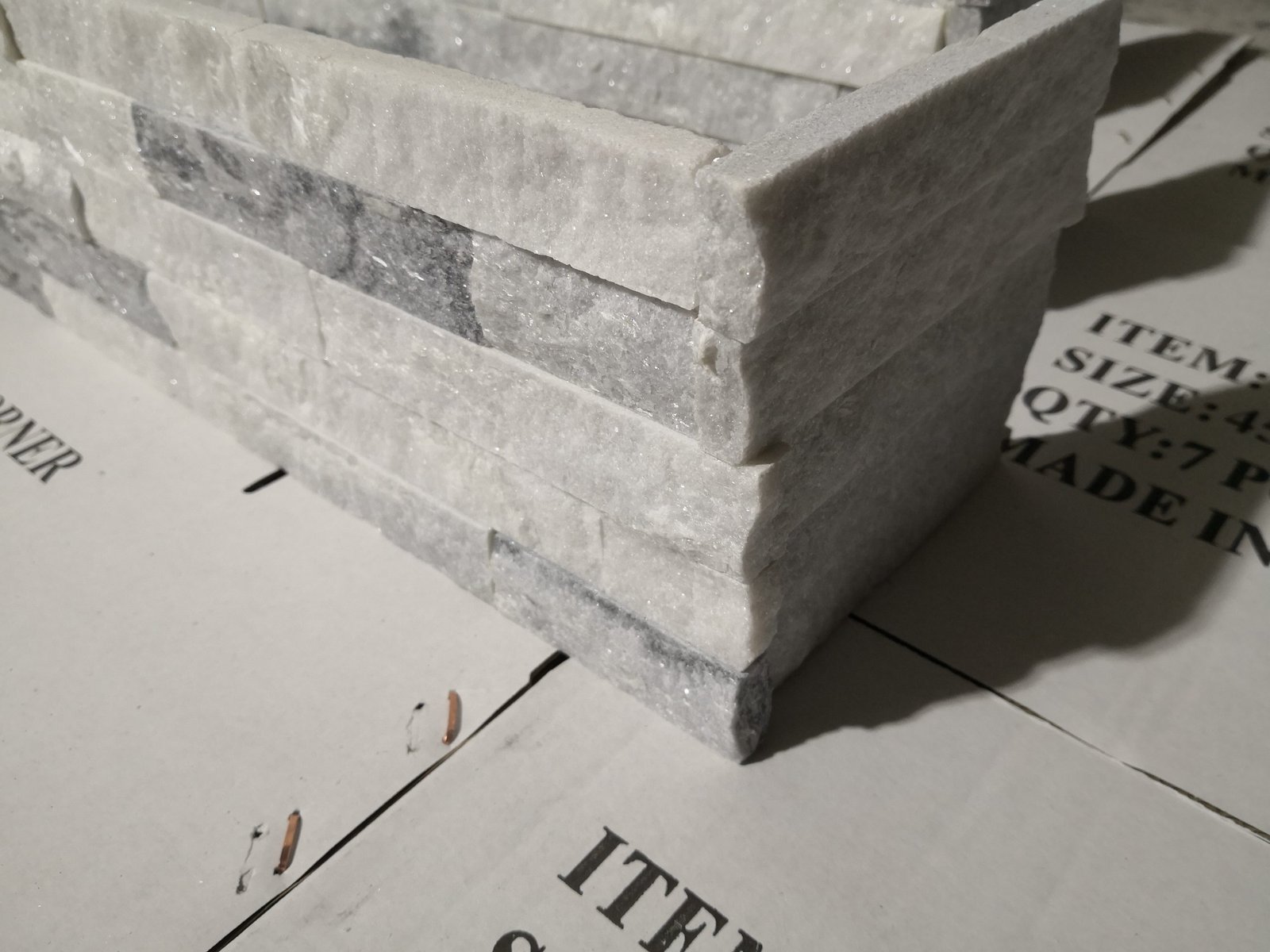
One factor that reduces waste significantly: using pre-made corner pieces. Proper installation technique with factory-cut L-corners eliminates the need for 45-degree miter cuts on site, which are the single biggest source of breakage waste during installation.
Step 4: Calculate Corner Pieces Separately
External corners require dedicated L-corner pieces that wrap around the 90-degree turn. These are measured in linear meters, not square meters, and ordered as separate line items.
Formula:
Corner Pieces Needed = Total External Corner Height (linear meters) ÷ Coverage per L-Corner
Each standard L-corner from Top Stone Panels covers approximately 0.15 linear meters (one course height). To determine how many you need:
- Measure the total linear meters of all external corners (sum of corner heights).
- Divide by 0.15 m per L-corner piece.
- Round up to the nearest whole number.
Worked Example: The building has two external corners, each 3.0 m tall.
- Total corner length = 3.0 + 3.0 = 6.0 linear meters
- Corner pieces needed = 6.0 ÷ 0.15 = 40 L-corner pieces
When you factor in a small buffer, order 42–44 corner pieces. L-corners are lightweight and nest inside carton packaging, so they add minimal shipping cost. Running short on corners, however, forces installers to make site-cut miters — which look inferior and generate waste.
Panel Coverage Calculator: Quick-Reference Table
Once you know your total order area, the next step in the stone veneer quantity calculation is converting that area into panel counts. The table below shows coverage rates for the most common stone veneer panel types available from Top Stone Panels.
| Product | Panel Size (cm) | Area per Panel (m²) | Panels per m² | Product Page |
|---|---|---|---|---|
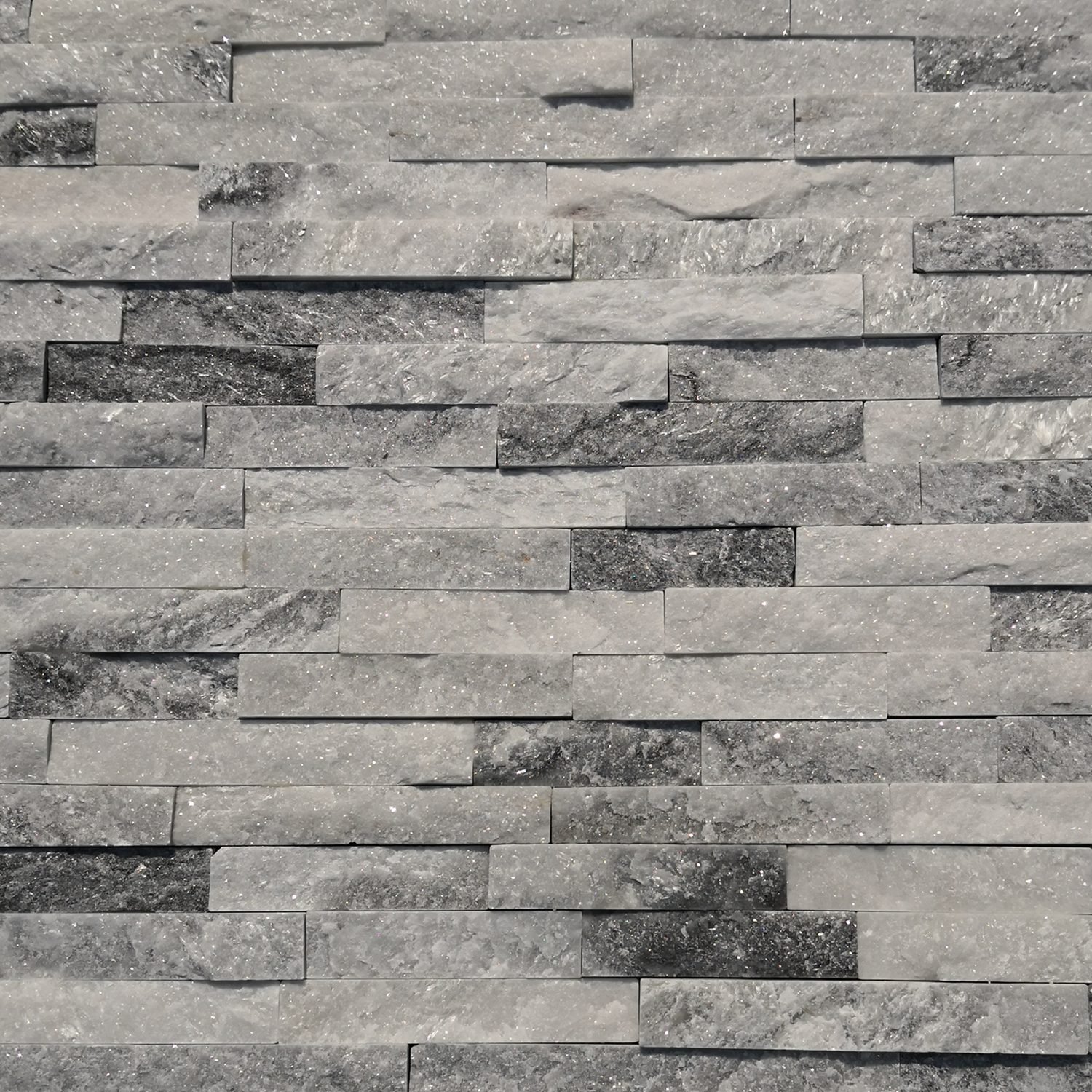
| Stacked Stone (Standard) | 15 × 60 | 0.090 | 11.1 | View |
| Stacked Stone (Alt) | 15 × 55 | 0.0825 | 12.1 | View |
| Thin Ledgestone (Ultra-Thin) | 36 × 10 | 0.036 | 27.8 | View |
| Z-Panels (Standard) | 20 × 55 | 0.110 | 9.1 | View |
| Z-Panels (Alt) | 15.2 × 61 | 0.0927 | 10.8 | View |
| Thin Stone Veneer | Random strip | Varies | By quote | View |
| Flagstone (Mesh Sheets) | Random geometric | Varies | By quote | View |
Worked Example (panel count): For our 58 m² order using 15×60 cm stacked stone:
- Panel count = 58 ÷ 0.09 = 644 panels
For the same area using 15×55 cm panels:
- Panel count = 58 ÷ 0.0825 = 703 panels
Step 5: Convert to Container Loads for Ordering
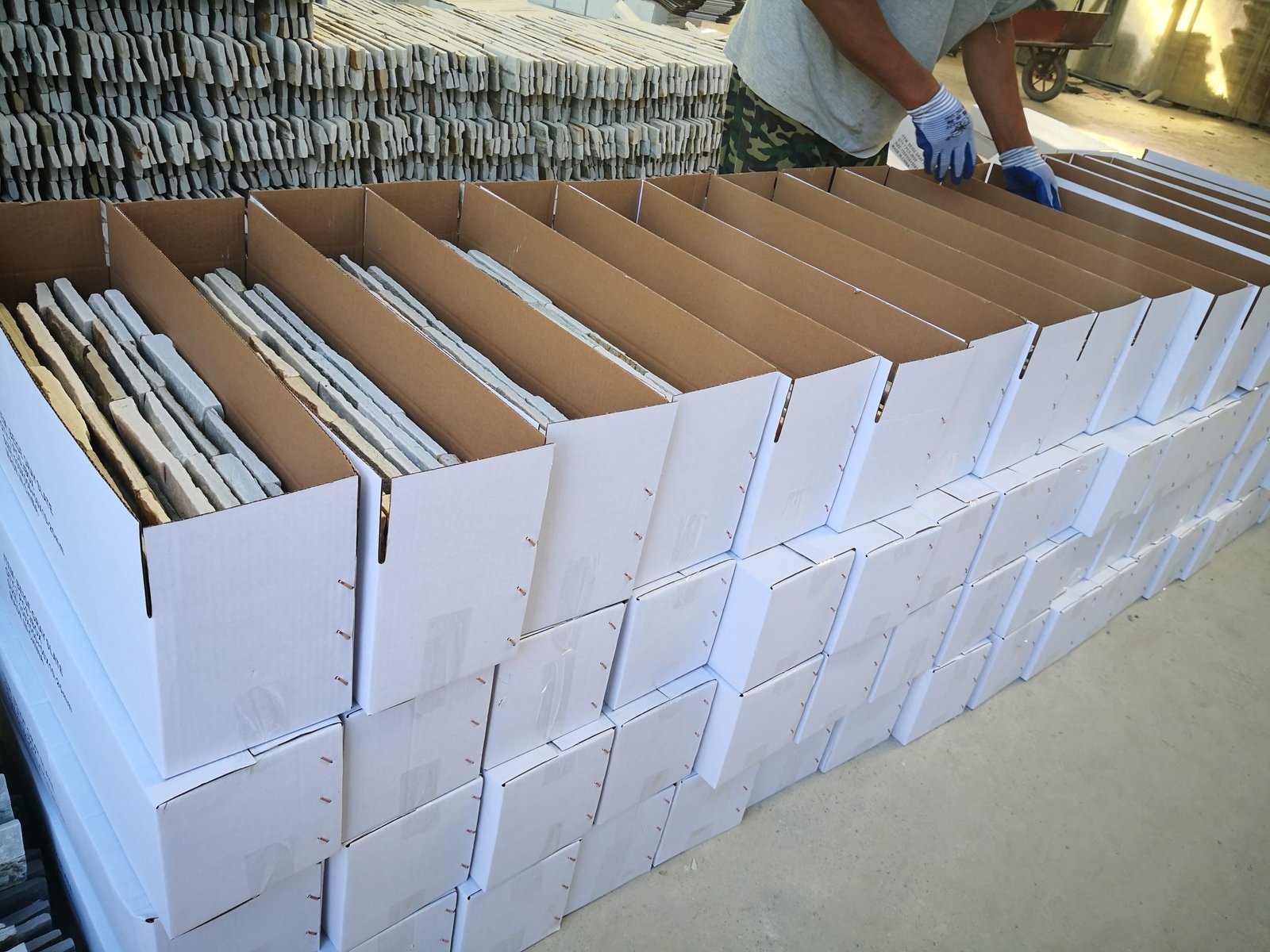
When sourcing stone cladding from China, the commercial unit of order is the 20-foot general-purpose (20GP) shipping container. Knowing how many square meters fit in one container lets you plan cost-efficient shipments.
Key container capacity figures:
- Stacked stone panels (15×60 cm): ~550–600 m² per 20GP container
- Minimum order quantity (MOQ): 1 × 20GP container per product type
How to calculate containers needed:
Containers = Order Area ÷ Container Capacity (round up to nearest whole container)
Worked Example: A distributor needs 1,400 m² of stacked stone for a multi-building residential development.
- Containers = 1,400 ÷ 575 (midpoint) = 2.43
- Round up to 3 containers
Ordering in full container loads gives you the best FOB pricing. Partial containers still incur full-container freight charges for unused space. When your calculation lands between two container loads, compare the cost of the extra inventory against the per-m² savings of a full load — in most cases, the full container wins.
For a detailed breakdown of trade terms like FOB, CIF, and DDP, see our Incoterms guide for stone exports.
Step 6: Factor in Weight for Shipping Cost
Natural stone is heavy. Understanding weight per square meter is essential for accurate landed cost calculations and for verifying that wall substrates can support the cladding.
Standard weight reference:
- Stacked stone panels: ~25–30 kg/m² (varies by stone density)
- Thin ledgestone (ultra-thin): ~15–18 kg/m²
- Z-panels with cement backing: ~30–35 kg/m²
Weight calculation for our example:
- 58 m² × 27 kg/m² (average) = 1,566 kg (1.57 metric tonnes)
A fully loaded 20GP container of stacked stone weighs approximately 15–16 metric tonnes gross. This sits well within the standard 20GP payload limit of ~21–22 tonnes, but it does affect inland trucking costs at the destination port. Always confirm weight limits with your freight forwarder, especially for projects in areas with road weight restrictions.
Unit Conversion: Square Meters to Square Feet (and Back)
North American buyers typically work in square feet, while Chinese manufacturers quote in square meters. Here is the conversion formula you need:
m² → sq ft: multiply by 10.764
sq ft → m²: divide by 10.764
Quick conversion table:
| Square Meters (m²) | Square Feet (sq ft) |
|---|---|
| 50 | 538 |
| 100 | 1,076 |
| 250 | 2,691 |
| 500 | 5,382 |
| 600 (≈ 1 container) | 6,458 |
Worked Example: A builder in Texas has measured a feature wall at 640 sq ft. To convert:
- 640 ÷ 10.764 = 59.5 m²
- Add 10% waste: 59.5 × 1.10 = 65.4 m²
- Round to 66 m² for ordering
How Much Stone Veneer Do I Need? Complete Calculation Summary
Here is the full stone veneer quantity calculation sequence in one place, using our running example:
| Step | Calculation | Result |
|---|---|---|
| 1. Gross wall area | (3×8) + (3×5.5) + (3×6) | 58.5 m² |
| 2. Subtract openings | 58.5 − 6.3 | 52.2 m² |
| 3. Apply waste factor (10%) | 52.2 × 1.10 | 57.4 m² |
| 4. Round up for ordering | 57.4 → | 58 m² |
| 5. Panel count (15×60) | 58 ÷ 0.09 | 644 panels |
| 6. Corner pieces | 6.0 lm ÷ 0.15 + buffer | ~42 L-corners |
| 7. Estimated weight | 58 × 27 kg/m² | 1,566 kg |
| 8. Container loads | 58 ÷ 575 | Fits in 1 container |
This 58 m² order fits comfortably in a single 20GP container (capacity ~550–600 m²), which means the container would not be full. If you are a distributor stocking inventory, it makes financial sense to increase the order to fill the container — bringing your effective per-m² cost down. See our guide on container loading and zero-breakage packaging for details on how shipments are secured.
Special Considerations for Different Product Types
Not all stone veneer products calculate the same way. Here are adjustments for specific product categories:
Z-Panels for Large Commercial Facades
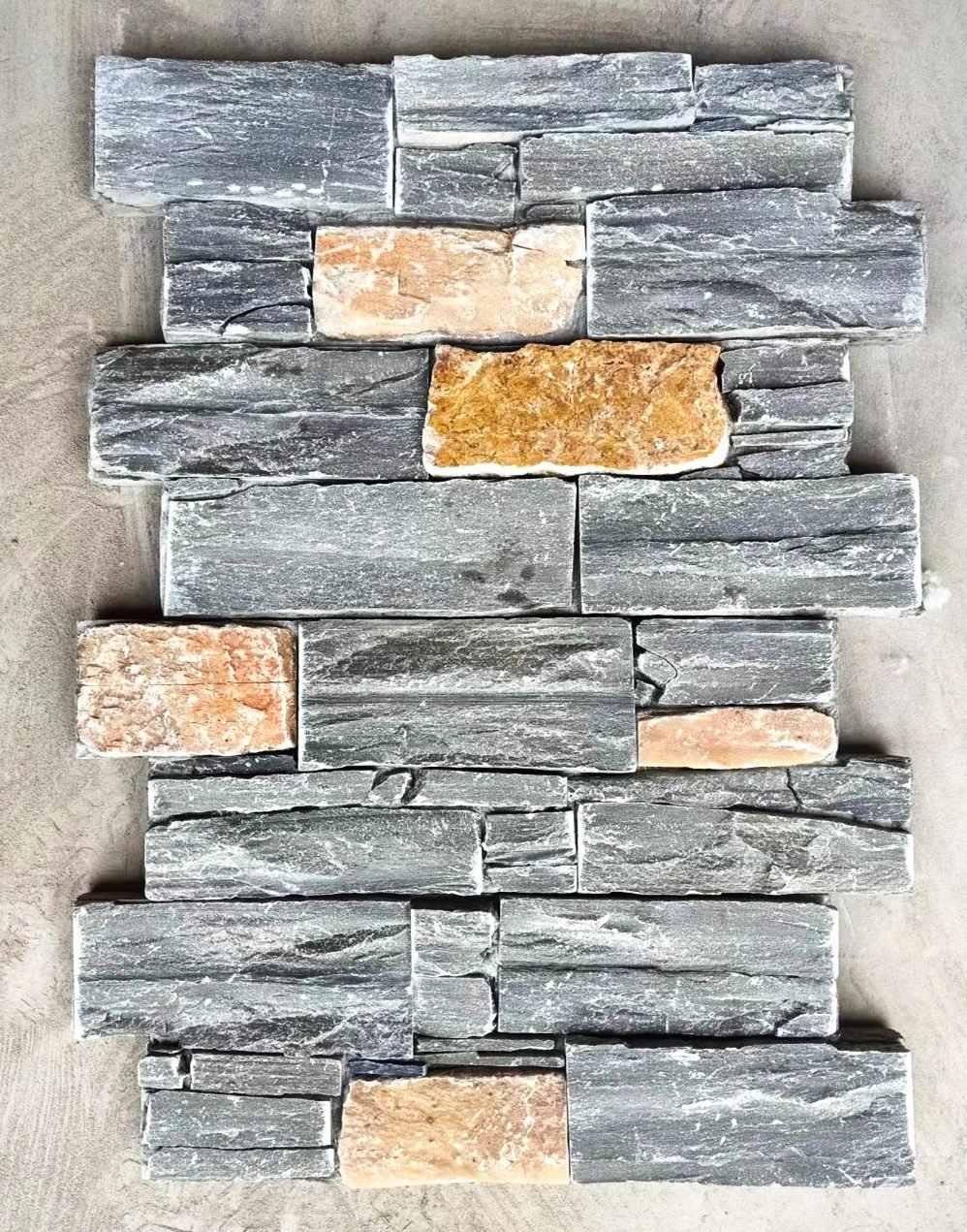
Z-panels use an interlocking male-female edge connection that speeds installation on large, flat walls. Because Z-panels cover more area per piece (0.093–0.11 m² depending on size), panel counts are lower. However, the cement or mesh backing adds weight, which affects shipping density — expect roughly 450–500 m² per container for Z-panels.
Thin Stone Veneer (Random Strip)
Thin stone veneer in random strip format does not have uniform panel dimensions. Coverage is quoted per crate or pallet rather than per panel. Request a coverage-per-ton figure from your supplier and calculate accordingly.
Flagstone for Patios and Floors
Flagstone is sold in mesh-backed sheets with random geometric patterns. Coverage depends on the sheet size and grout joint width. For flagstone patio layouts, calculate total floor area the same way as wall area (length × width) and add 8–12% waste for cuts at edges and around drains.
Stone Columns
Stone columns are measured differently: by the number of column sections needed, with standard cross-sections of 40×40 cm or 50×50 cm. Calculate the perimeter of the column and height, then match to the column kit specification.
Common Calculation Mistakes and How to Avoid Them
After 18 years of quarry-to-export experience, Top Stone Panels has seen recurring calculation errors from first-time buyers. Avoid these:
- Forgetting the waste factor entirely. Even the simplest wall needs 5% extra. Natural stone cannot be returned to the quarry once cut.
- Mixing up net and gross area. Always subtract openings before applying waste — applying waste to gross area overestimates by 1–3 m² on typical residential projects.
- Ignoring corner pieces. Flat-area calculations do not account for external corners. Measure these separately.
- Not accounting for batch consistency. Natural stone color varies between quarry batches. If you order a second shipment weeks later, the color may not match. Always order enough in the first batch to cover the entire visible area, plus 3–5% reserve stock for future repairs.
- Overlooking substrate preparation. Thin stone veneer products are lighter, but standard stacked stone at 25–30 kg/m² requires a structurally sound substrate. Confirm wall load capacity with your structural engineer before finalizing the order.
From Calculation to Purchase Order: The Ordering Process
Once your stone veneer quantity calculation is complete, here is the typical order workflow with Top Stone Panels:
- Submit inquiry with your calculated area (m²), product type, and color preference.
- Receive quotation based on full container loads (FOB Xingang/Tianjin or CIF/DDP to your port).
- Confirm color box — first orders include a custom color box approval step (adds ~5 days to the standard 20–25 working day lead time).
- Pay 30% T/T deposit to start production.
- Review container loading video and layout photo before the 70% balance payment.
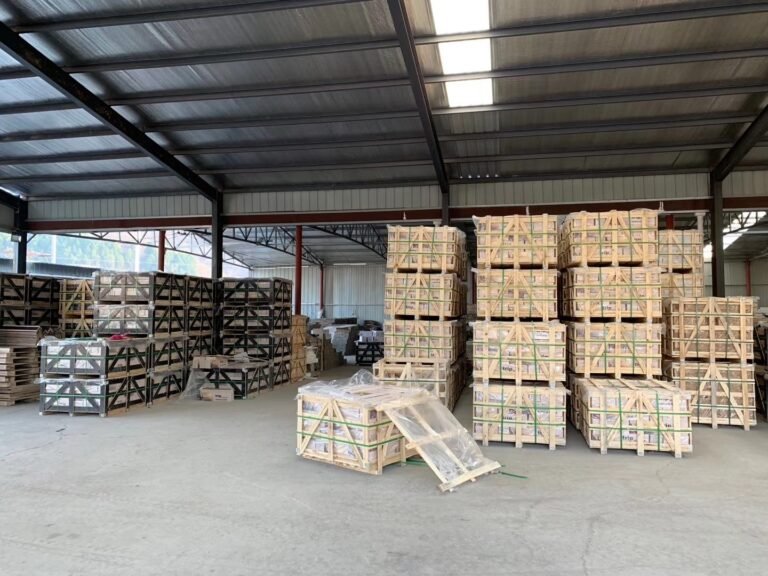
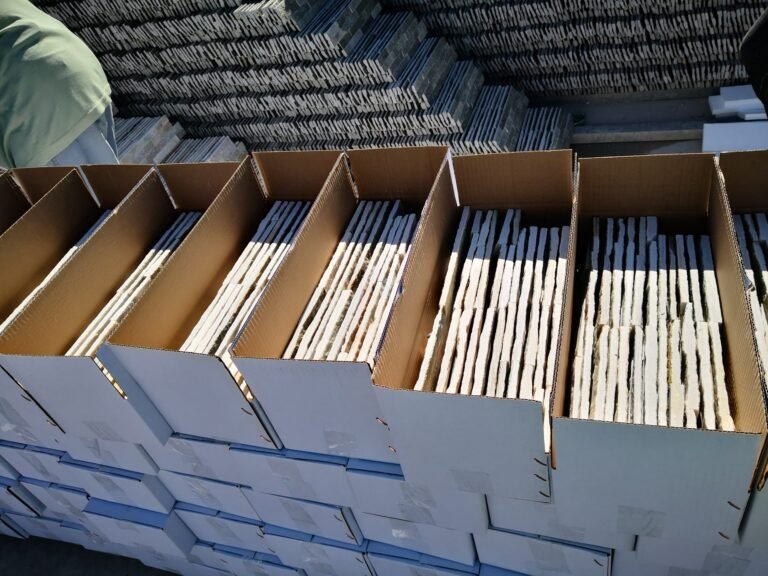
- Receive shipment with zero-breakage packaging: 3–5 layer corrugated cartons, fumigation-free pallets, 4–6 steel bands, and industrial airbags.
The MOQ is one 20GP container per product. If your project requires multiple stone types — say, stacked stone for walls and flagstone for a patio — you can mix products in a single container as long as each product meets its individual MOQ threshold. Contact the Top Stone Panels team to discuss mixed-container configurations.
Frequently Asked Questions
How do I calculate how much stone veneer I need?
Multiply wall height by width to get total area, subtract all openings (windows, doors), then add a waste factor of 5–10% for flat walls or 10–15% for complex shapes. The result is the net square meters of stone veneer to order.
How many stone veneer panels cover one square meter?
For standard 15×60 cm stacked stone panels, each panel covers 0.09 m², so you need approximately 11.1 panels per square meter. For 15×55 cm panels covering 0.0825 m² each, you need about 12.1 panels per square meter.
What waste factor should I add when ordering stone veneer?
Add 5–10% waste for straightforward flat walls with few cuts. Add 10–15% for walls with many corners, openings, or irregular shapes. Using factory-made L-corner kits reduces on-site cutting waste on external corners.
How many square meters of stone veneer fit in a 20ft container?
A standard 20GP container holds approximately 550–600 m² of stacked stone panels, depending on panel thickness and packaging configuration. This is the minimum order unit for most FOB shipments from China.
How do I convert stone veneer quantities between square meters and square feet?
Multiply square meters by 10.764 to get square feet. Divide square feet by 10.764 to get square meters. For example, 100 m² equals 1,076.4 sq ft.
Final Thoughts
Accurate stone veneer quantity calculation comes down to five steps: measure gross area, subtract openings, apply waste, convert to panel counts, and plan container loads. Getting each step right protects your project timeline and your bottom line.
Top Stone Panels has supported distributors and builders across North America and Europe since 2005, shipping from Yi County, Hebei with a monthly capacity of 80,000 m² of stacked stone alone. Whether you need one container or twenty, the calculation method above gives you a reliable foundation for your purchase order.
Ready to get a quote? Calculate your area using the formulas above, then reach out to the Top Stone Panels team with your numbers. We will confirm panel counts, container loads, and lead time within one business day.
Once quantities are settled, the stone panel weight calculator turns the square-meter order into the shipping weight your forwarder needs.