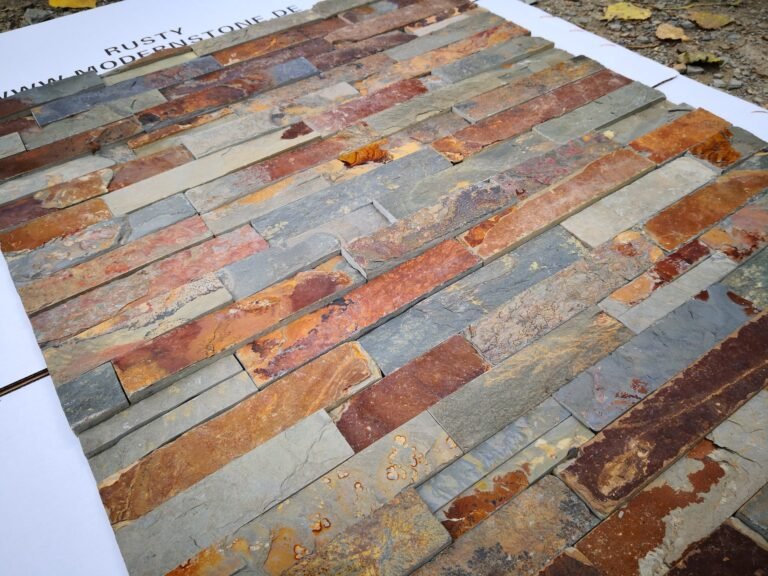
When a distributor or architect specifies natural stone panels for a project, the face of the stone gets all the attention — the color, the texture, the split-face profile. Yet the construction method hiding behind those stones determines whether the panel holds together for five years or fifty. The two dominant approaches in the industry today are marine-grade epoxy bond and cement-based backing, and each carries distinct implications for structural performance, climate suitability, and installed cost.
This comparison is not academic. If you are sourcing stone panels from a factory and need to decide which construction to specify for a commercial facade in Minnesota, a pool surround in Florida, or a retail fit-out in London, the backing method affects your shipping weight, your installation timeline, and your callback rate. We manufacture both types at our facility in Hebei, China, and we test them under the same conditions. Here is what the data actually shows.
What Is Epoxy Bond Stone Panel Construction?
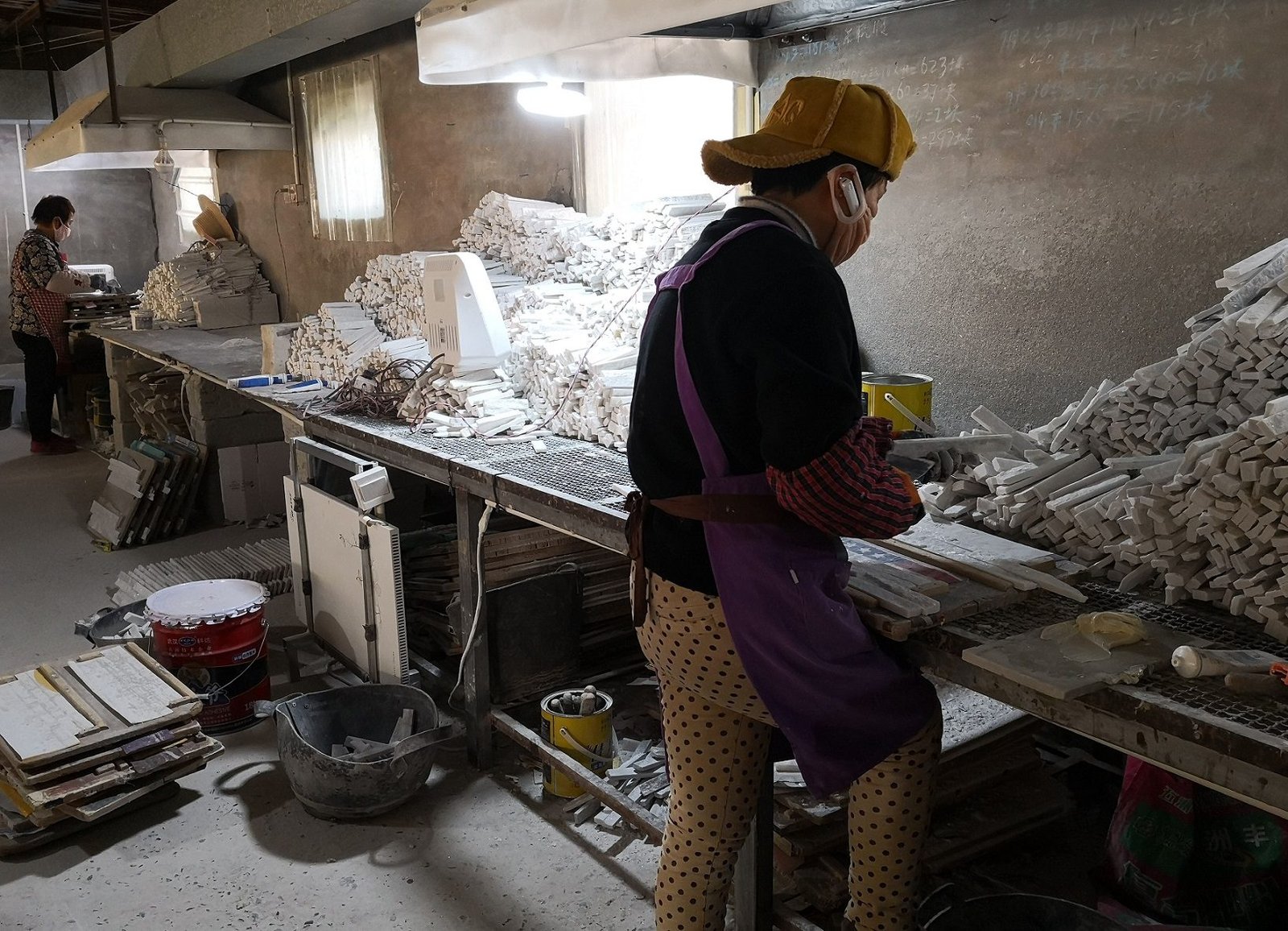
Epoxy bond construction uses a two-component marine-grade epoxy resin to adhere individual stone pieces to a reinforcing substrate — typically a fiberglass mesh or a thin cement-fiber board. The epoxy penetrates the stone’s natural pore structure on one side and chemically bonds to the substrate on the other, creating a monolithic panel that behaves as a single unit under stress.
At Top Stone Panels, we use marine-grade epoxy across our stacked stone panel line. The standard panel formats — 15×60 cm and 15×55 cm — are assembled by hand on epoxy-coated mesh, then cured under controlled temperature for 24 hours before quality inspection. The resulting panel is rigid enough to handle during transport yet flexible enough to absorb the thermal expansion and contraction that occurs on an exterior wall.
The key advantage of this method is the adhesive strength itself. Marine-grade epoxy achieves tensile adhesion values in the range of 3–5 MPa on natural slate and quartzite surfaces. For context, that is roughly two to three times the bond strength of a standard Portland cement mortar applied to the same stone. The epoxy also remains slightly flexible after curing — it does not become brittle the way cement does over time — which matters enormously when a panel experiences vibration from wind loads or thermal shock from rapid temperature drops.
What Is Cement-Backed Stone Panel Construction?
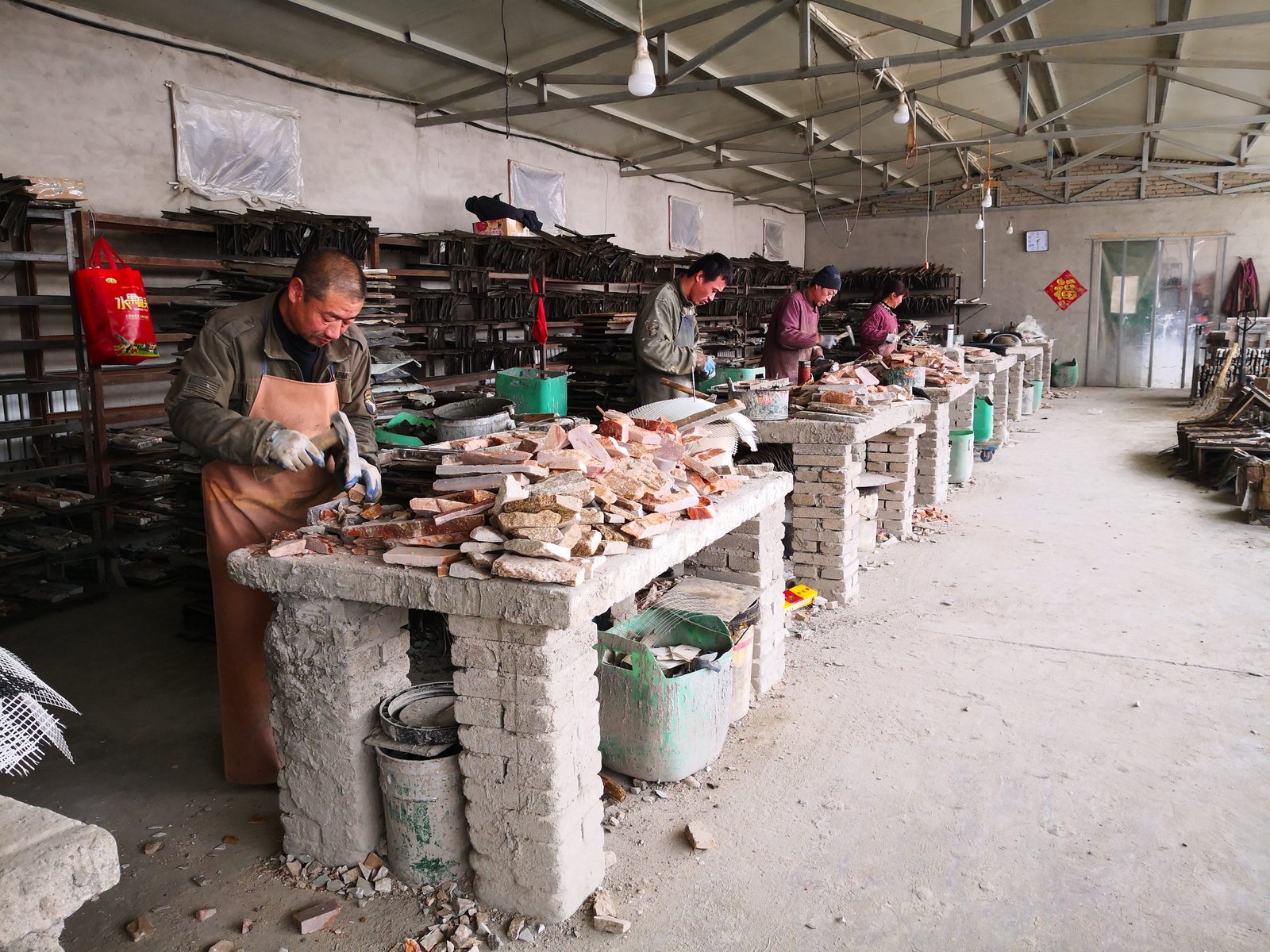
Cement-backed panels take a different engineering approach. Individual stone pieces are embedded into a Portland cement mortar bed, typically 8–12 mm thick, which is troweled onto a reinforcing layer of wire mesh or expanded metal lath. The cement cures into a rigid, rock-like mass that locks the stones in place through mechanical friction and chemical adhesion.
This is the construction method used for most interlocking Z-panel systems. Our Z-panels, available in 20×55 cm and 15.2×61 cm formats, use a polymer-modified cement mortar that improves adhesion and reduces the brittleness associated with plain Portland cement. The cement backing adds mass to the panel — typically 3–5 kg/m² more than an equivalent epoxy-bonded panel — which provides a sense of solidity but also increases the dead load on the building structure.
The rigidity of cement backing is an advantage in certain applications. On a large commercial facade where the substrate is flat, stable, and unlikely to move, a rigid panel resists deformation and maintains a perfectly flat plane across hundreds of square meters. The interlocking male-female edges of the Z-panel system further reinforce this planar stability, making cement backing a logical choice for high-rise cladding and large-format retail facades.
Side-by-Side Comparison: Six Performance Criteria
The choice between epoxy bond and cement backing is not a matter of one being universally superior. Each method has structural trade-offs that make it better suited to specific project conditions. Here is how the two approaches compare across the six criteria that matter most to specifiers and installers.
Adhesion Strength and Impact Resistance
Epoxy bond wins on raw adhesion numbers. The 3–5 MPa tensile bond strength of marine-grade epoxy significantly outperforms the 1–2 MPa typical of polymer-modified cement mortar on natural stone surfaces. In practical terms, this means an epoxy-bonded panel can withstand harder impacts — a shopping cart backing into a retail wall, a hailstorm with 2 cm diameter stones, or accidental contact during furniture moves — without individual stones dislodging from the backing.
Cement backing, while weaker in tensile adhesion, offers greater compressive strength. If a panel is subjected to sustained compressive loads (for example, stacked storage or a panel near a structural joint that experiences constant pressure), the rigid cement bed distributes that load more evenly. In our quality control process, we test both panel types under standardized load conditions to ensure consistency.
Flexibility and Crack Resistance
This is where the construction methods diverge most sharply. Epoxy retains a degree of elastic flexibility after curing — it can bend slightly without breaking. This property is critical on exterior walls in climates with wide daily temperature swings. A south-facing wall in Denver might experience a 40°C temperature differential between dawn and midday. The panel expands and contracts, and the epoxy bond flexes with it.
Cement, by contrast, is inherently rigid. When the substrate or the stone itself expands and contracts at a different rate than the cement bed (and different materials always expand at different rates), stress accumulates at the stone-cement interface. Over hundreds of thermal cycles, this can lead to hairline cracks in the mortar bed. Polymer-modified cement reduces this risk but does not eliminate it. In freeze-thaw climates where the panel must endure hundreds of sub-zero cycles per year, the flexibility advantage of epoxy becomes more pronounced.
Weather and Moisture Resistance
Both construction methods can handle exterior exposure when manufactured correctly. Marine-grade epoxy is, by definition, formulated for wet environments — it is the same class of adhesive used in boatbuilding. The cured epoxy layer is impervious to water penetration, which means moisture cannot migrate through the adhesive layer to reach the substrate behind the stone.
Cement backing is permeable. Water can penetrate through micro-pores in the mortar bed, especially if the panel is installed in a high-moisture environment without adequate waterproofing behind it. This is not necessarily a problem — many successful exterior installations use cement-backed panels with a proper drainage plane and waterproofing membrane — but it does mean that the wall assembly design must account for moisture management. With epoxy bond, the panel itself acts as a secondary moisture barrier.
Weight and Structural Load
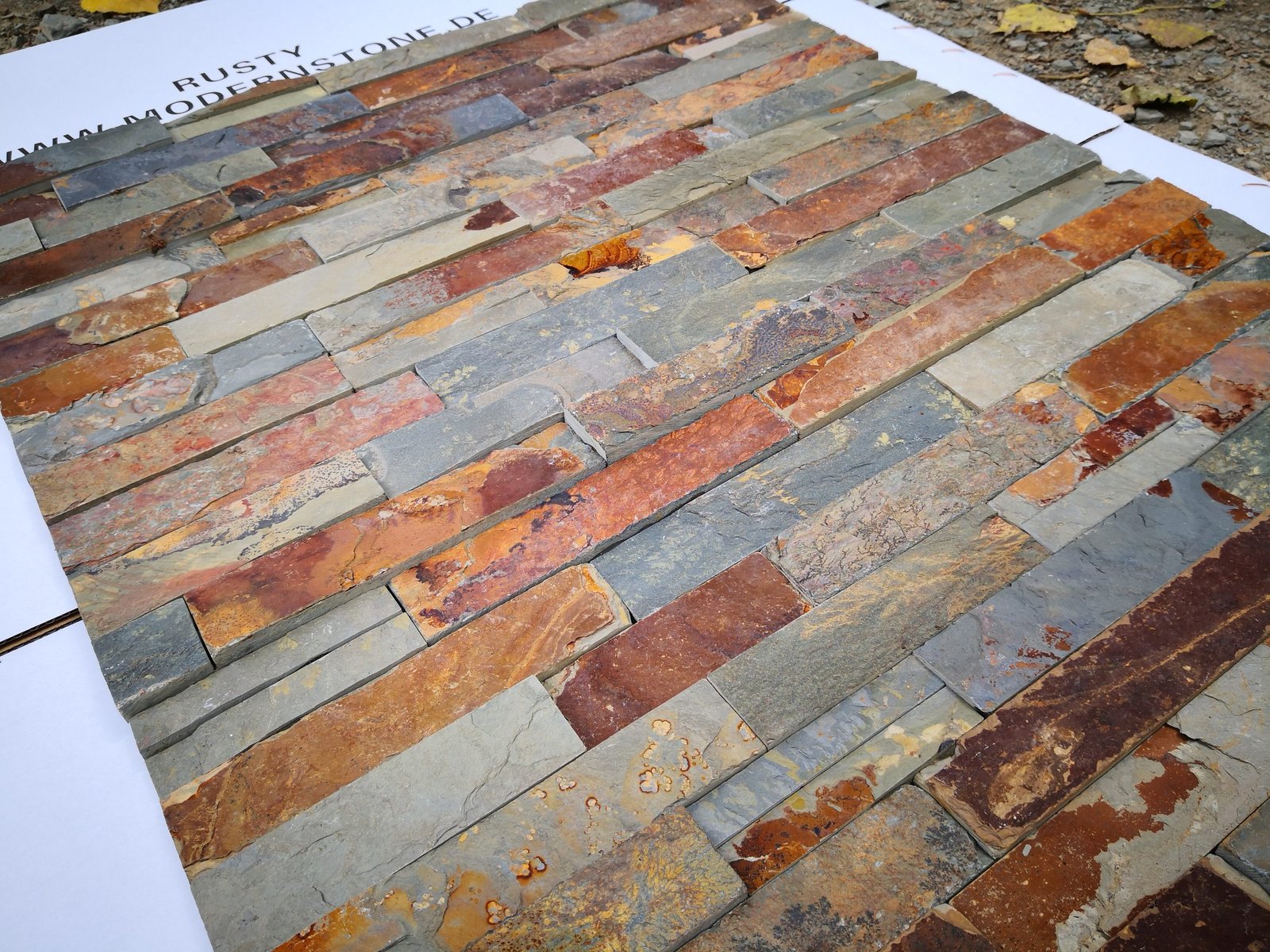
Epoxy-bonded panels are lighter. The adhesive layer is typically 1–2 mm thick compared to the 8–12 mm cement bed, and epoxy has a lower density than cured cement mortar. The weight difference is usually 3–5 kg/m², which translates into meaningful savings on a large project. For a 500 m² commercial facade, choosing epoxy bond over cement backing can reduce the total cladding dead load by 1,500–2,500 kg — a figure that influences structural engineering calculations, steel framing requirements, and foundation sizing.
The lighter weight also affects logistics. A standard 20-foot container loaded with epoxy-bonded panels carries more square meters of coverage than the same container loaded with cement-backed panels. When your FOB price is calculated per container, lighter panels effectively reduce your per-square-meter landed cost.
Installation Ease and Speed
Lighter panels are easier to handle. An installer working with epoxy-bonded panels on a scaffold or lift can maneuver each panel with less effort, which speeds up the installation rate. In our experience — and confirmed by the installers we work with across North America and Europe — epoxy-bonded panels install approximately 15–20% faster than their cement-backed equivalents on the same wall area.
That said, cement-backed panels have an installation advantage in one scenario: when the interlocking Z-panel system is used on a large, flat wall. The male-female edge connections guide alignment and eliminate the need for precision layout on every course. For installers who have worked with Z-panels before, the cement-backed format with interlocking edges can be faster on straightforward, unbroken wall sections.
Cost per Square Meter
Epoxy-bonded panels cost approximately 8–15% more per square meter at the factory gate, driven by the higher material cost of marine-grade epoxy versus Portland cement. However, the total installed cost — which includes shipping, handling, labor, and structural support — often narrows or reverses that gap. Lighter panels mean lower shipping cost per square meter, faster installation means lower labor cost, and reduced structural load can lower framing expenses on new construction.
Which Construction Suits Your Project?
The decision matrix is simpler than the technical details might suggest. After eight years of manufacturing and shipping both panel types across four continents, the patterns are clear.
Choose epoxy bond when: the project is in a freeze-thaw climate with wide temperature swings, the wall assembly needs to be as light as possible (retrofit over existing structures, upper-floor applications, steel-stud construction), the panels will be installed on curved or irregular surfaces where some panel flexibility helps, or moisture exposure is high (pool surrounds, coastal locations, below-grade foundations).
Choose cement backing when: the project involves a large, flat commercial facade with a stable concrete or masonry substrate, the wall assembly includes a proper drainage plane and waterproofing, the panels use an interlocking Z-panel system for continuous coverage, or the specification calls for maximum compressive rigidity.
In practice, many of our distributor partners stock both types. Their product mix includes epoxy-bonded stacked stone for residential and light commercial projects alongside cement-backed Z-panels for large-format commercial work. This dual inventory lets them serve the full range of installer preferences and project specifications from a single source.
How Top Stone Panels Controls Quality for Both Methods
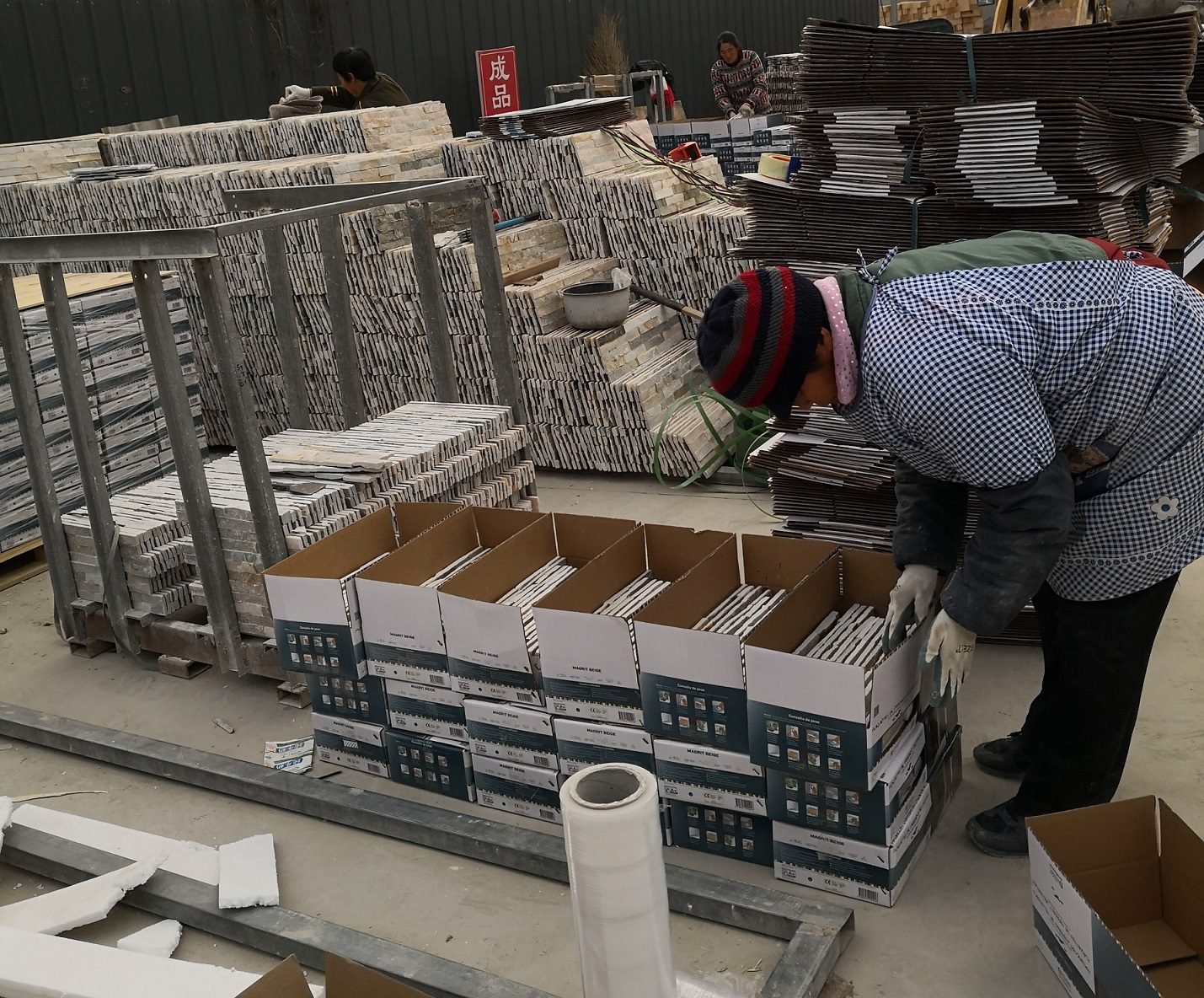
Regardless of which construction method you specify, the quality of the finished panel depends on manufacturing discipline. Our factory runs a three-step quality control process that applies to every panel, whether epoxy-bonded or cement-backed:
Step 1 — Raw material inspection: Every batch of stone is inspected for consistent thickness, color, and structural integrity before it reaches the assembly line. Slate and quartzite are sourced from our own quarries in Hebei, where we control vein selection at the source.
Step 2 — In-process monitoring: During panel assembly, adhesive application rate, stone placement accuracy, and backing alignment are checked at every workstation. For epoxy-bonded panels, we monitor cure temperature and time to ensure complete polymerization. For cement-backed panels, we verify mortar consistency and embedment depth.
Step 3 — Pre-shipment inspection: Finished panels are sampled for bond strength (pull-off test), dimensional accuracy, and visual consistency before they are cleared for packing. Any panel that fails to meet tolerance is rejected before it reaches the container.
Frequently Asked Questions
Is epoxy bond stronger than cement backing for stone panels?
Marine-grade epoxy bond achieves tensile adhesion strength of 3–5 MPa on natural stone, roughly two to three times higher than standard Portland cement mortar. This makes epoxy-bonded panels more resistant to impact, vibration, and freeze-thaw cycling. Cement backing compensates with higher compressive strength, making it suitable for applications where panels face sustained compressive loads.
Can epoxy-bonded stone panels be used outdoors?
Yes. Marine-grade epoxy formulations are engineered to withstand UV exposure, temperature swings from -30°C to +50°C, and high humidity. Epoxy-bonded panels are used on exterior walls, pool surrounds, and commercial facades across North America and Europe without degradation of the adhesive layer.
Are cement-backed stone panels heavier than epoxy-bonded panels?
Yes. Cement backing adds approximately 3–5 kg/m² to the panel weight compared to epoxy bond. The thicker mortar bed (8–12 mm vs 1–2 mm for epoxy) and the higher density of cured cement both contribute. On a 500 m² project, this translates to 1,500–2,500 kg of additional dead load on the structure.
Which stone panel backing is better for freeze-thaw climates?
Epoxy bond generally performs better in freeze-thaw conditions because it remains flexible at low temperatures, absorbing thermal movement without cracking. Cement backing is more rigid and can develop micro-cracks over repeated freeze-thaw cycles unless a polymer-modified mortar is used. Both can perform adequately if manufactured to high standards, but the margin of safety is wider with epoxy.
Do epoxy-bonded stone panels cost more than cement-backed ones?
Epoxy-bonded panels typically cost 8–15% more per square meter at the factory. However, the lighter weight reduces shipping costs, the easier installation lowers labor expenses by up to 20%, and the reduced structural load can save on framing costs. When all installed costs are tallied, the total project cost is often comparable between the two methods.
Final Word for B2B Buyers
The epoxy-bond versus cement-backing decision is ultimately a project-specific engineering call, not a brand preference. Both methods produce durable, high-quality stone panels when manufactured with proper materials and process control. The factory’s job is to give you honest specifications for both options so you can match the construction to the application. If you need test reports, pull-off adhesion data, or sample panels in both formats to evaluate before committing to a container order, request them — a reliable manufacturer will provide these within days, not weeks.
Top Stone Panels manufactures both epoxy-bonded stacked stone panels and cement-backed interlocking Z-panels at our facility in Hebei, China. Request samples or a technical data sheet for your next project through our contact page.