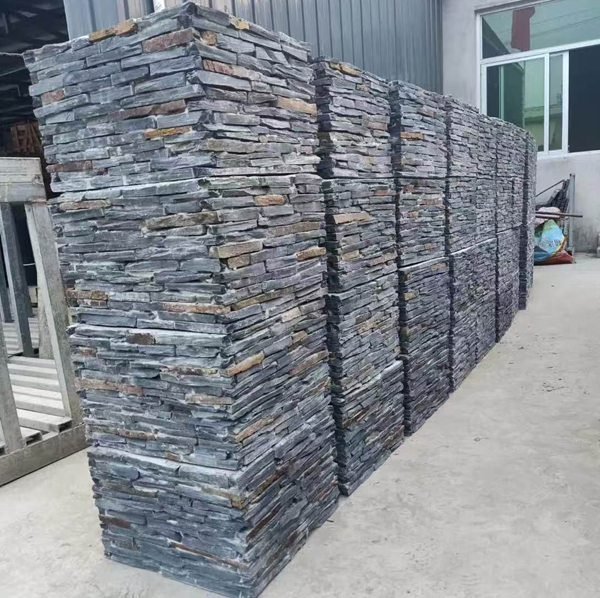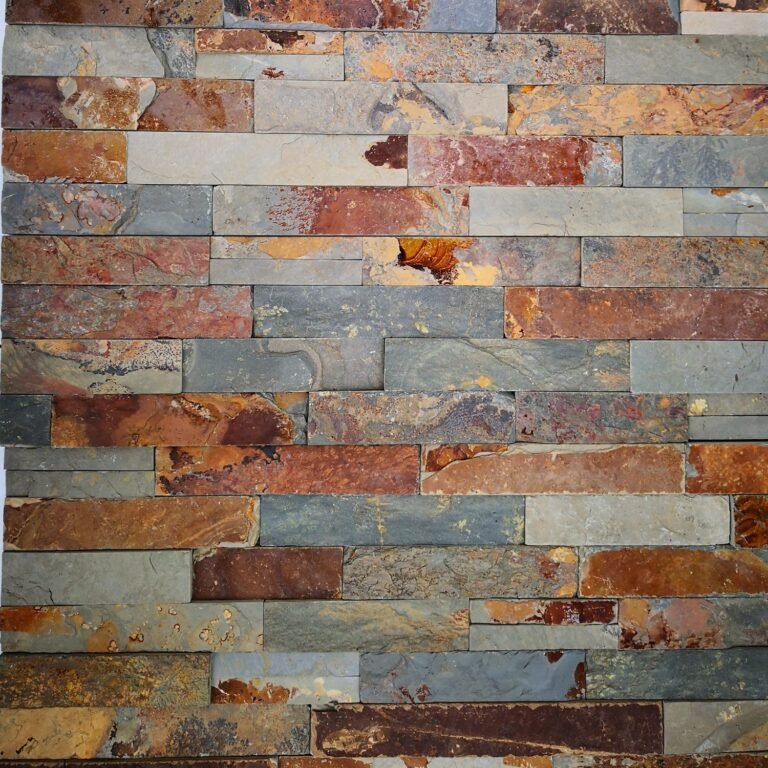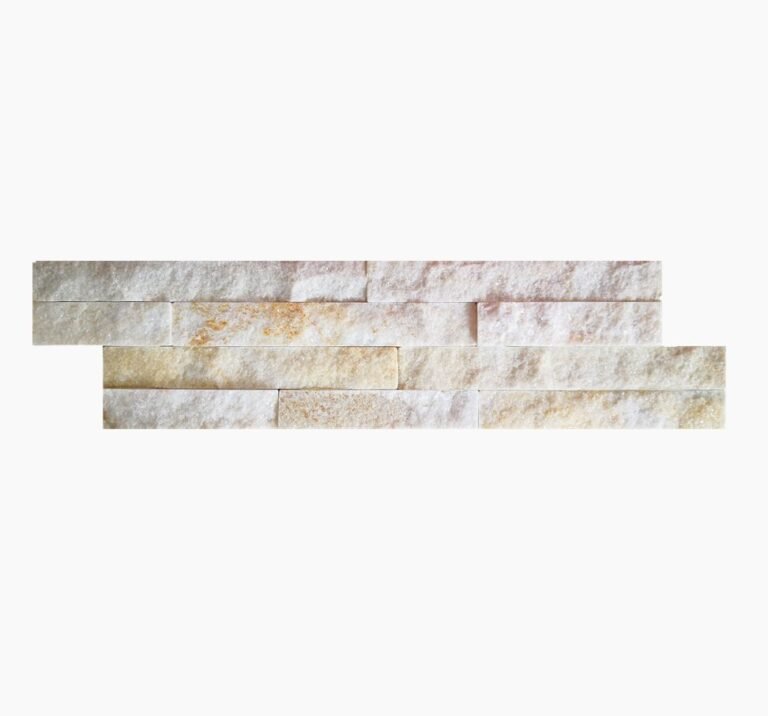
This comparison breaks down the performance, aesthetics, code compliance, and economics of real stone vs manufactured stone panels. The data comes from standardized testing (ASTM and EN standards), field performance records, and 18 years of production experience at Top Stone Panels, where we quarry and fabricate natural slate, quartzite, marble, and sandstone into ready-to-install cladding panels.
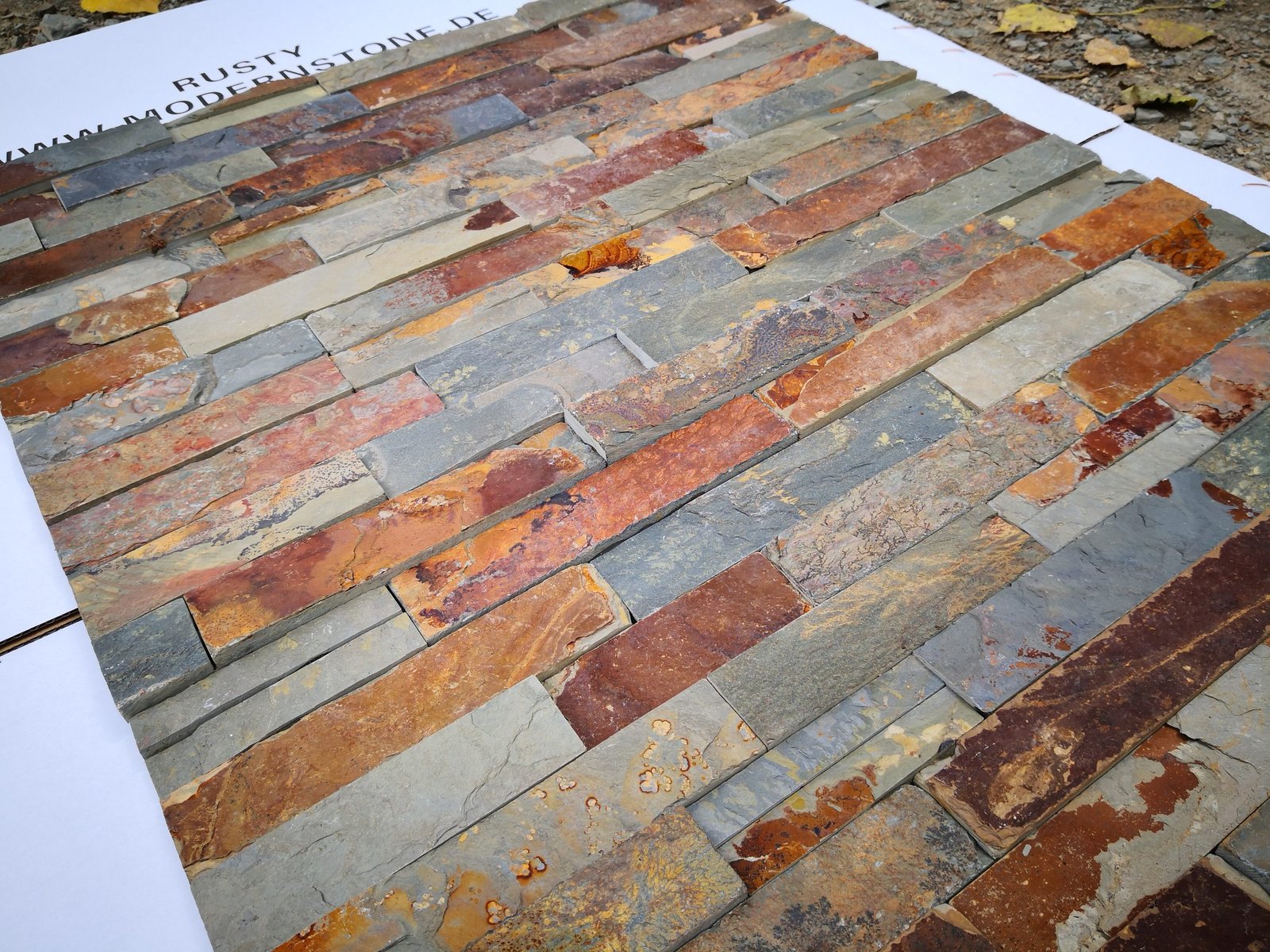
What Is Real (Natural) Stone Cladding?
Real stone cladding consists of panels or veneers cut directly from quarried stone blocks. The material is geological in origin—slate formed under tectonic pressure, quartzite recrystallized from sandstone, marble metamorphosed from limestone. Each panel carries the mineral composition, fossil records, and color patterns created over hundreds of millions of years.
At our facility in Yixian, Hebei Province, we process raw quarried stone into several cladding formats:
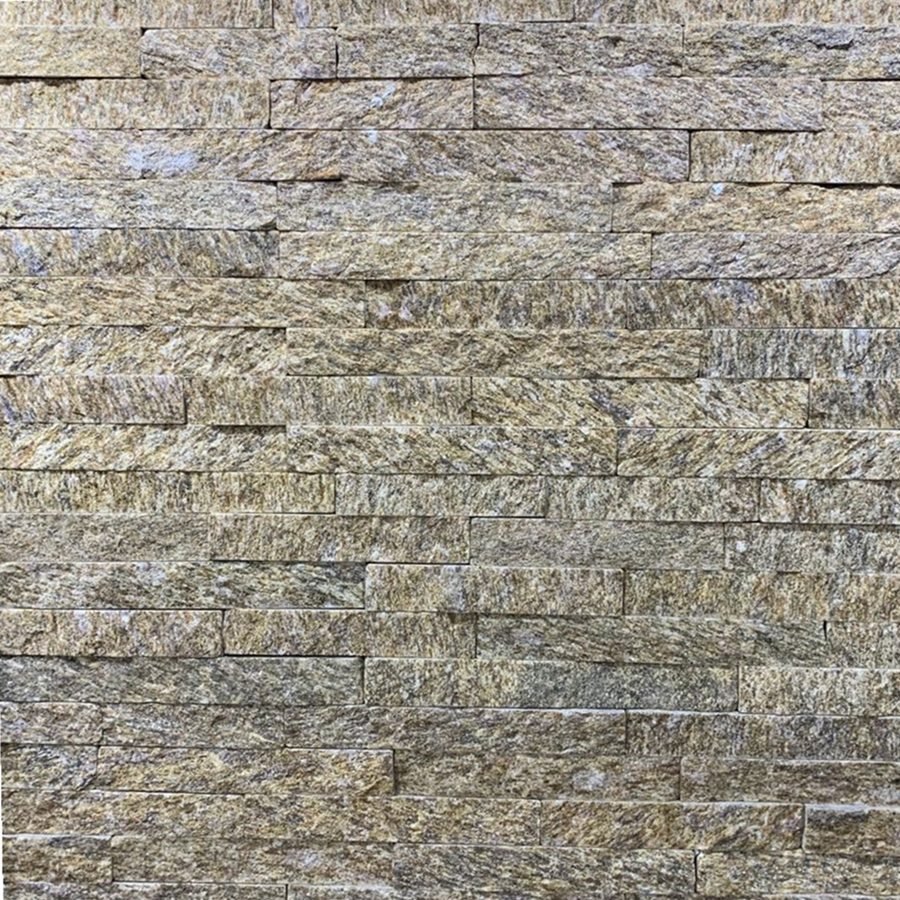
- Stacked stone panels (15×60 cm and 15×55 cm with L-corners) — split-face ledger panels for feature walls and exterior facades
- Thin ledgestone (36×10 cm) — ultra-thin stone strips for interior and exterior applications
- Interlocking Z-panels (20×55 cm and 15.2×61 cm) — male-female connection panels that eliminate visible joints on large commercial facades
- Thin stone veneer — lightweight sliced stone for weight-restricted applications
Processing involves infrared CNC diamond blade cutting for dimensional accuracy, batch-specific vein selection to maintain visual consistency across large orders, and marine-grade epoxy bonding to cement or mesh backing. The result is a genuine stone panel that installs like a tile but performs like a building material that has survived geological epochs.
For a deeper look at how stacked stone panels are made and specified, see our guide on what stacked stone panels are and how they work.
What Is Manufactured Stone?
Manufactured stone veneer (also called cultured stone or artificial stone) is a cast concrete product. Manufacturers pour a Portland cement mixture into molds taken from real stone, add iron oxide pigments for color, and sometimes aggregate for texture. The result is a lightweight panel that approximates the appearance of natural stone at a lower material cost.
The manufacturing process has improved over the past two decades. Modern molds capture finer surface detail, and some producers use integral color (pigment mixed throughout the body rather than surface-applied) to reduce the visibility of chips. However, the fundamental limitations remain:
- Repetitive patterns. Molds produce identical shapes. A wall of 200 manufactured panels will contain repeated forms that the eye registers as artificial, especially at close range.
- Pigment-based color. Iron oxide pigments are stable but not permanent. UV exposure degrades surface color over 10 to 20 years. Integral color helps but does not eliminate this trajectory.
- Cement matrix limitations. Portland cement is porous, susceptible to freeze-thaw damage, and structurally weaker than geological stone formed under extreme pressure and heat.
Manufactured stone serves a purpose in budget-driven residential projects where initial cost dominates the specification decision. For commercial projects evaluated on 30- to 50-year performance horizons, the calculus changes.
Aesthetic Authenticity: Why Natural Variation Matters
Architects and building owners choose stone for one reason above all others: no two pieces look alike. Natural slate from our Yixian quarry contains iron sulfide inclusions that create rust-colored accents unique to each panel. Quartzite carries cross-bedding patterns from ancient river deposits. Sandstone preserves ripple marks from the shallow seas that existed 300 million years ago.
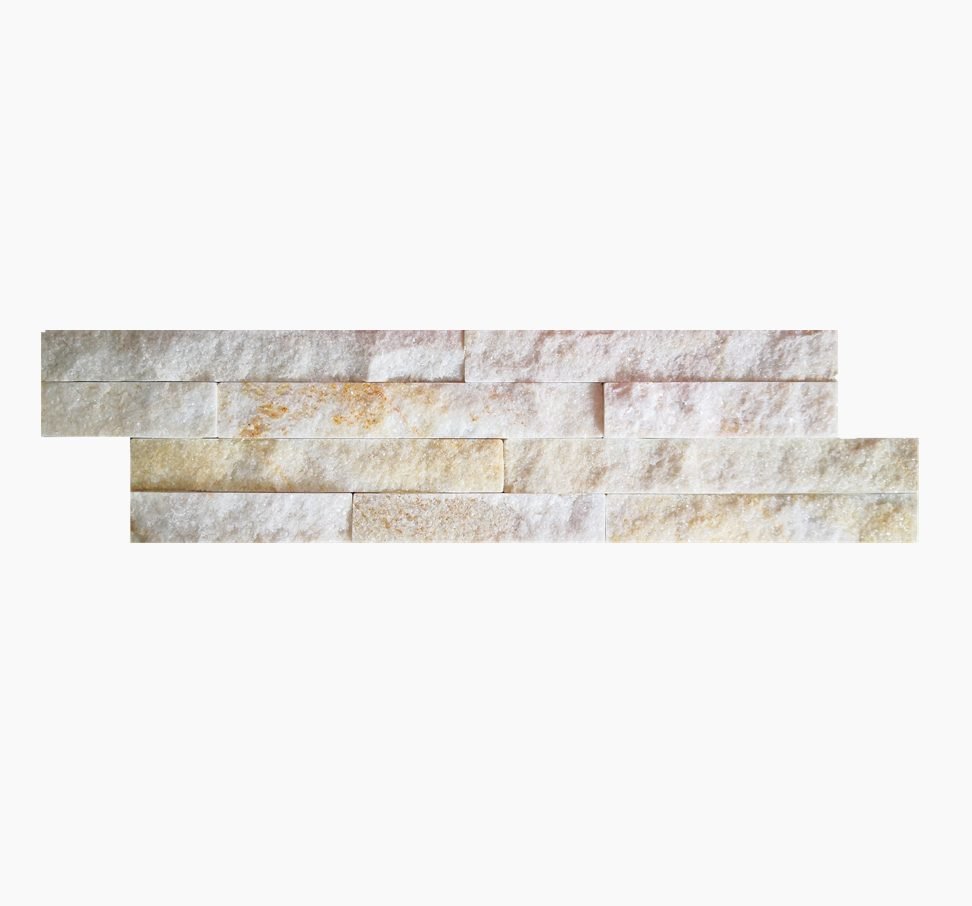
Manufactured stone attempts to replicate this variation through multiple mold sets and hand-applied pigment. The result is a statistical approximation of randomness, not genuine randomness. On a 500-square-meter commercial facade, the repetition becomes visible. Experienced architects, building inspectors, and property buyers recognize it.
This matters for commercial projects because aesthetic authenticity correlates with property valuation. A 2019 study published by the Appraisal Institute found that buildings clad in genuine natural materials command higher per-square-foot valuations than comparable structures finished with simulated alternatives. The perception of quality is not subjective preference—it translates directly into lease rates and resale value.
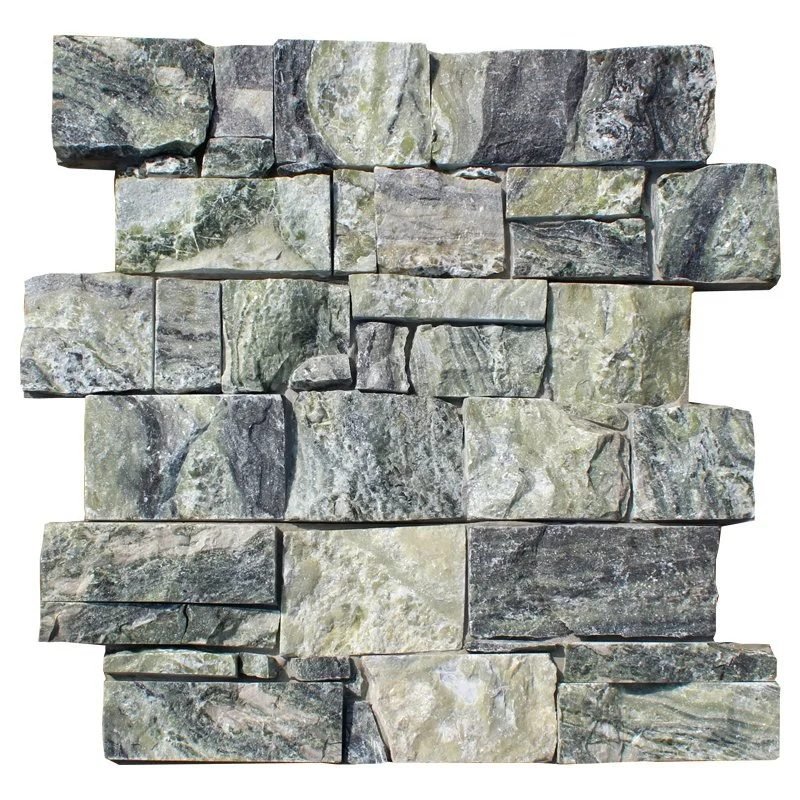
For projects where visual impact drives the specification, our flagstone and crazy paving products offer an even more dramatic expression of natural variation, with each piece carrying a completely unique geological fingerprint.
Durability and Lifespan Comparison
The durability gap between real stone and manufactured stone is where the comparison becomes decisive.
Natural Stone Lifespan
Natural stone cladding panels made from slate, quartzite, and sandstone routinely last 50 to 100 years. European cathedrals and civic buildings clad in stone during the 19th century remain structurally sound and aesthetically intact today, without any maintenance beyond occasional cleaning. In our production experience, the stone itself does not fail—the bonding system or substrate may require attention after several decades, but the stone panels remain serviceable.
Key durability properties of natural stone include:
- Compressive strength: Slate 100–200 MPa, quartzite 200–300 MPa, compared to 20–40 MPa for cast concrete products
- Abrasion resistance: Quartzite ranks 7 on the Mohs hardness scale, making it virtually impervious to surface wear
- Water absorption: Dense slate and quartzite absorb less than 1% water by weight, minimizing the risk of internal moisture damage
Manufactured Stone Lifespan
Manufactured stone veneer typically carries manufacturer warranties ranging from 20 to 50 years, though warranty terms often exclude color fading, efflorescence, and damage from de-icing salts. Real-world field performance, based on building surveys and failure analysis, places the functional lifespan at 20 to 30 years before visible degradation appears. Common failure modes include:
- Surface spalling from freeze-thaw cycling
- Color fading and chalking from UV exposure
- Efflorescence (white mineral deposits) that migrates through the porous cement body
- Cracking from thermal expansion differentials between the cement panel and substrate
Our detailed comparison of exterior stacked stone veneer vs manufactured stone covers field performance data from installations across multiple climate zones.
Fire Rating and Building Code Compliance
Fire performance is a non-negotiable requirement for commercial cladding, particularly for buildings over two stories, mixed-use developments, and structures in wildfire-prone regions.
Natural stone—slate, quartzite, sandstone, and marble—is inherently non-combustible. Testing per ASTM E136 confirms an A-grade fire rating (zero flame spread, zero smoke development). Stone does not ignite, does not contribute fuel to a fire, and does not produce toxic combustion byproducts. This rating holds for the full thickness of the material, not just the surface.
Manufactured stone veneer contains Portland cement (non-combustible) but may include polymer modifiers, lightweight aggregates, and pigment binders that affect fire performance. Most manufactured stone products achieve a Class B or Class C fire rating, which indicates limited flame spread rather than non-combustibility. Some products achieve Class A when installed over specific substrate assemblies, but the rating depends on the full wall system, not the stone product alone.
For specifiers navigating building code requirements, our analysis of natural stone fire ratings and building code compliance provides detailed ASTM test data and code cross-references for slate and quartzite cladding.
The Natural Stone Institute maintains technical bulletins on fire performance of natural stone that can support specification submittals for commercial projects.
Freeze-Thaw and Weather Resistance
In climates with seasonal temperature swings—which covers most of North America and much of Europe—freeze-thaw cycling is the primary mechanism of cladding failure. Water penetrates the material, freezes, expands by approximately 9%, and generates internal pressure that cracks, spalls, or delaminates the surface.
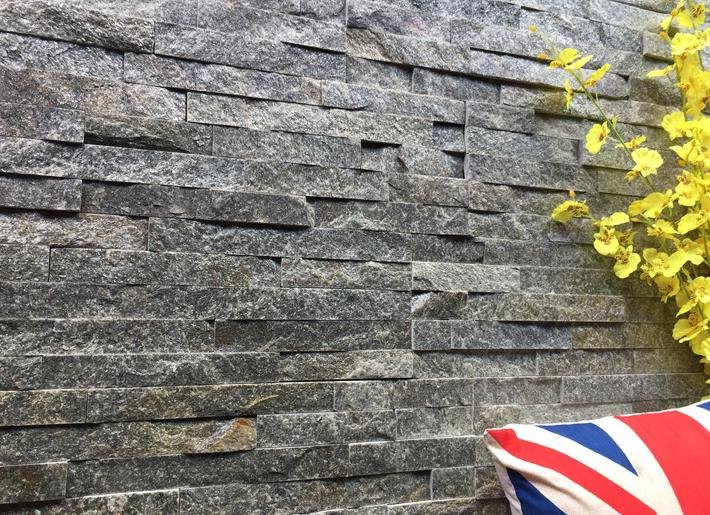
Natural stone panels from our production line withstand continuous exposure from −30°C to +50°C. Dense slate and quartzite absorb less than 1% water by weight, which means there is very little internal moisture available to freeze and expand. Testing per ASTM C666 (Standard Test Method for Resistance of Concrete to Rapid Freezing and Thawing, also applied to stone) confirms that properly selected natural stone maintains structural integrity through hundreds of freeze-thaw cycles without measurable degradation.
Manufactured stone, with its Portland cement matrix, typically absorbs 8% to 15% water by weight. That moisture content provides ample material for freeze-thaw damage. Most manufacturers specify a maximum number of freeze-thaw cycles (often 50 to 100) before performance degrades. In regions with 50 or more freeze-thaw events per year—common across the northern United States, Canada, and northern Europe—manufactured stone can reach its cycle limit within a few years of installation.
For detailed data on how natural stone performs under repeated freeze-thaw stress, our technical guide on freeze-thaw resistance in natural stone cladding provides absorption rates and test results by material type.
UV Stability and Color Retention
Color in natural stone comes from its mineral composition. Iron oxides produce reds, yellows, and browns. Carbonaceous material creates blacks and grays. Chlorite generates greens. These minerals are stable at the Earth’s surface—they have already survived millions of years of solar exposure in the quarry face before we cut them into panels.
Natural stone is UV stable by definition. There is no pigment to degrade, no surface coating to chalk, and no polymer binder to break down under ultraviolet radiation. The color you see on day one is the color that will be present in year 50. Some stones develop a subtle patina over decades, which most specifiers consider a desirable aging characteristic rather than a defect.
Manufactured stone relies on iron oxide pigments, which are among the most UV-stable synthetic colorants available. Even so, prolonged UV exposure causes gradual oxidation and fading at the surface. Products with surface-applied color (rather than integral pigment) show visible fading within 5 to 10 years in high-UV environments. Integral color extends the timeline but does not eliminate the degradation curve. By year 20, most manufactured stone installations show measurable color shift compared to their original specification.
Total Cost of Ownership: Long-Term Value
The upfront cost comparison favors manufactured stone. Material costs for manufactured veneer typically range from USD 6 to 12 per square foot, while natural stone panels range from USD 10 to 25 per square foot depending on material, finish, and panel format. Installation costs are comparable for both products when using standard thin-set methods.
However, commercial projects are evaluated on total cost of ownership (TCO) over the building’s service life, not initial material cost alone. Here the comparison shifts:
| Cost Factor | Natural Stone | Manufactured Stone |
|---|---|---|
| Material cost (per m²) | USD 65–160 | USD 40–85 |
| Installation cost (per m²) | USD 40–75 | USD 35–65 |
| Maintenance (50-year period) | Minimal (periodic cleaning) | Sealing every 3–5 years, possible panel replacement |
| Replacement cycle | None within 50 years | Likely 1 replacement at 20–30 years |
| 50-year TCO (per m²) | USD 105–235 | USD 150–300+ |
The 50-year TCO for manufactured stone includes at least one full replacement cycle, ongoing sealant applications, and the labor cost of removing and disposing of failed panels. Natural stone requires none of these interventions.
Property value impact also favors natural stone. Commercial buildings with genuine stone cladding appraise at a premium compared to identical structures with manufactured veneer, reflecting both perceived quality and the documented durability advantage.
Environmental and Sustainability Considerations
Sustainability assessments for building materials increasingly influence commercial specifications, particularly for projects pursuing LEED, BREEAM, or similar certification.
Natural stone scores well on most sustainability metrics:
- Embodied energy: Quarrying and cutting stone requires less energy than manufacturing Portland cement, which involves heating limestone to 1,450°C. The Natural Stone Institute reports that natural stone cladding has lower embodied carbon per square meter than cast concrete alternatives.
- Durability as sustainability: A cladding material that lasts 100 years and requires no replacement generates less waste than one replaced every 25 years. Lifecycle assessment (LCA) models consistently favor long-service-life materials.
- End-of-life: Stone is inert. Removed panels can be reused as aggregate, landscaping material, or reclaimed for new installations. Manufactured stone containing cement, pigments, and polymer additives presents more complex disposal requirements.
- No VOC emissions: Natural stone does not off-gas volatile organic compounds, contributing to indoor air quality credits in green building rating systems.
At Top Stone Panels, our quarrying operations in Hebei Province follow responsible extraction practices. We ship 220+ containers annually through Tianjin Xingang port, with stone sourced from established quarries that maintain environmental compliance certifications. Each shipment undergoes our three-step quality control process before dispatch.
Comparison Table: Real Stone vs Manufactured Stone Panels
| Criterion | Natural Stone Panels | Manufactured Stone Veneer |
|---|---|---|
| Material origin | Quarried geological stone (slate, quartzite, sandstone, marble) | Cast Portland cement with pigments and aggregates |
| Aesthetic variation | Each piece geologically unique; genuine mineral veining and fossil patterns | Mold-based repetition; surface pigment approximates natural patterns |
| Lifespan | 50–100+ years | 20–30 years (typical field performance) |
| Fire rating | A-grade (non-combustible per ASTM E136) | Class B or C (system-dependent; not inherently non-combustible) |
| Freeze-thaw resistance | Rated for −30°C to +50°C; <1% water absorption | Limited; 8–15% water absorption leads to spalling |
| UV stability | Permanent mineral color; zero UV degradation | Gradual pigment fading over 10–20 years |
| Compressive strength | 100–300 MPa (slate to quartzite) | 20–40 MPa |
| Water absorption | <1% (dense slate, quartzite) | 8–15% |
| Maintenance | Periodic cleaning only | Sealant every 3–5 years; panel replacement as needed |
| Material cost (per m²) | USD 65–160 | USD 40–85 |
| 50-year TCO (per m²) | USD 105–235 | USD 150–300+ |
| Sustainability | Lower embodied energy; inert; reusable; no VOCs | Higher embodied energy (cement kiln); complex disposal |
| Salt spray resistance | Resistant; suitable for coastal installations | Vulnerable; salt accelerates cement degradation |
Frequently Asked Questions
Is real stone better than manufactured stone for exterior cladding?
Real natural stone outperforms manufactured stone in longevity, UV stability, freeze-thaw resistance, and fire rating. Natural stone panels made from slate or quartzite carry an A-grade fire rating, withstand temperatures from −30°C to +50°C, and maintain their color indefinitely without fading. Manufactured stone typically lasts 20 to 30 years before showing signs of deterioration, while natural stone cladding can last 50 years or more with minimal maintenance.
What is the cost difference between real stone and manufactured stone panels?
Manufactured stone panels typically cost 30% to 50% less upfront than natural stone panels. However, when calculated on a total cost of ownership basis over 50 years, natural stone often proves more economical. Manufactured stone may require replacement or significant repair after 20 to 30 years, while natural stone maintains its structural integrity and appearance for decades without intervention. Factoring in replacement costs, maintenance, and property value impact, natural stone delivers superior long-term value for commercial projects.
Can manufactured stone match the look of real stone?
Manufactured stone can approximate the general appearance of natural stone from a distance, but it cannot replicate the geological variation that makes each piece of real stone unique. Natural stone features genuine mineral veining, fossil inclusions, and color gradients formed over millions of years. Manufactured stone relies on molds and surface pigments, which produce repetitive patterns that trained eyes—including architects, inspectors, and discerning building owners—can identify. For premium commercial projects where authenticity matters, natural stone remains the specification standard.
Does natural stone cladding meet commercial building codes?
Yes. Natural stone cladding made from slate, quartzite, sandstone, and marble meets or exceeds most international building code requirements for exterior wall cladding. Natural stone carries an A-grade (non-combustible) fire rating per ASTM E136, passes freeze-thaw testing per ASTM C666, and demonstrates salt spray resistance for coastal applications. Specifiers should verify local code requirements, but natural stone panels from established quarries routinely satisfy commercial and institutional project specifications across North America and Europe.
Specifying Natural Stone for Your Next Commercial Project
The data consistently points in one direction. For commercial projects evaluated on durability, fire safety, code compliance, long-term aesthetics, and total cost of ownership, natural stone cladding delivers measurable advantages over manufactured alternatives. The higher initial material cost is recovered through elimination of replacement cycles, reduced maintenance, and documented property value premiums.
Top Stone Panels supplies natural stone cladding to distributors and project specifiers across North America and Europe. With 18 years of quarrying and export experience, an annual output of 220+ containers, and product formats including stacked stone panels, thin ledgestone, interlocking Z-panels, thin stone veneer, flagstone, and stone columns, we provide the range and consistency that commercial-scale projects require.
Request a Sample or Quotation
Compare the difference firsthand. Request a sample box of our natural stone panels and evaluate the geological variation, split-face texture, and material density against any manufactured product on the market.
Contact Top Stone Panels with your project specifications, square footage requirements, and preferred material type. We respond to commercial inquiries within one business day with pricing, lead times, and technical data sheets.
For distributors evaluating new product lines, our guide to six types of stone veneer panels that distributors should stock provides a market-oriented overview of the formats with the strongest commercial demand.