Two crews, same 40 square meters feature wall, same stone, same day. One finishes by lunch and leaves the wall to cure. The other is still buttering back-faces at four o’clock because the mortar on the first row had not gone off when row three arrived. That gap is the whole argument between interlocking veneer and glued backed panels, and it is worth settling before you decide what to keep in stock.
Both systems are factory-made. Both carry real slate or quartzite on the face. They differ in one mechanical detail that ripples through the entire build: how a course stays where you put it. An interlocking Z-panel answers that question with its edges. A backed panel answers it with adhesive and a bed.
- Interlocking Z-panels locate each course by a male-female edge, so setup time stops being the bottleneck on long flat runs.
- Glued backed panels level with the mortar bed instead of the edge, which is why they hold faster on uneven or out-of-plumb walls.
- Pre-made L-corner sets remove most of the cutting time on 90-degree returns, and the factory treats that as roughly half of the usual corner labor.
- Infrared CNC cutting on both systems controls thickness tolerance and is credited with about 20 percent less on-site trim and breakage.
- Interlocking edges only lock in plane, so radius work belongs to mesh backed panels and loose stone.
- Decide on installed cost per square meter, not crate price. Each line carries its own 1x20GP minimum, 20-25 working days standard, 25-30 days for a custom-carton first order.
Two Systems, One Mechanical Difference
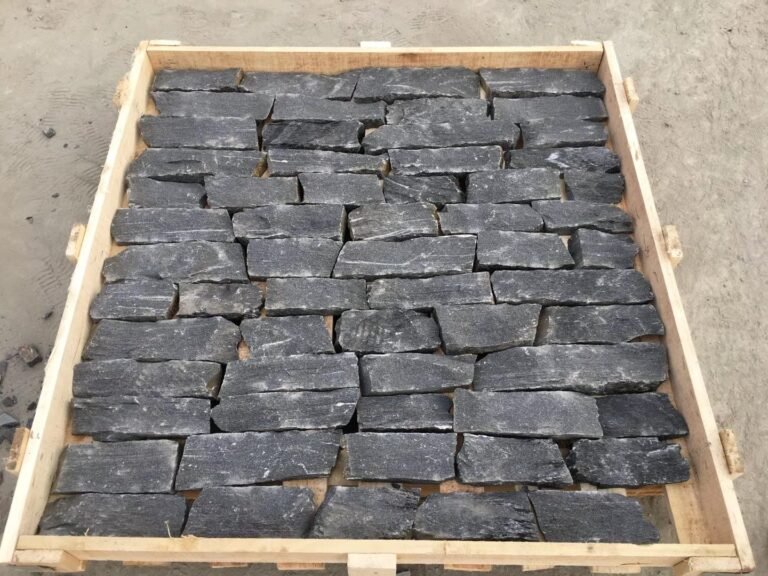
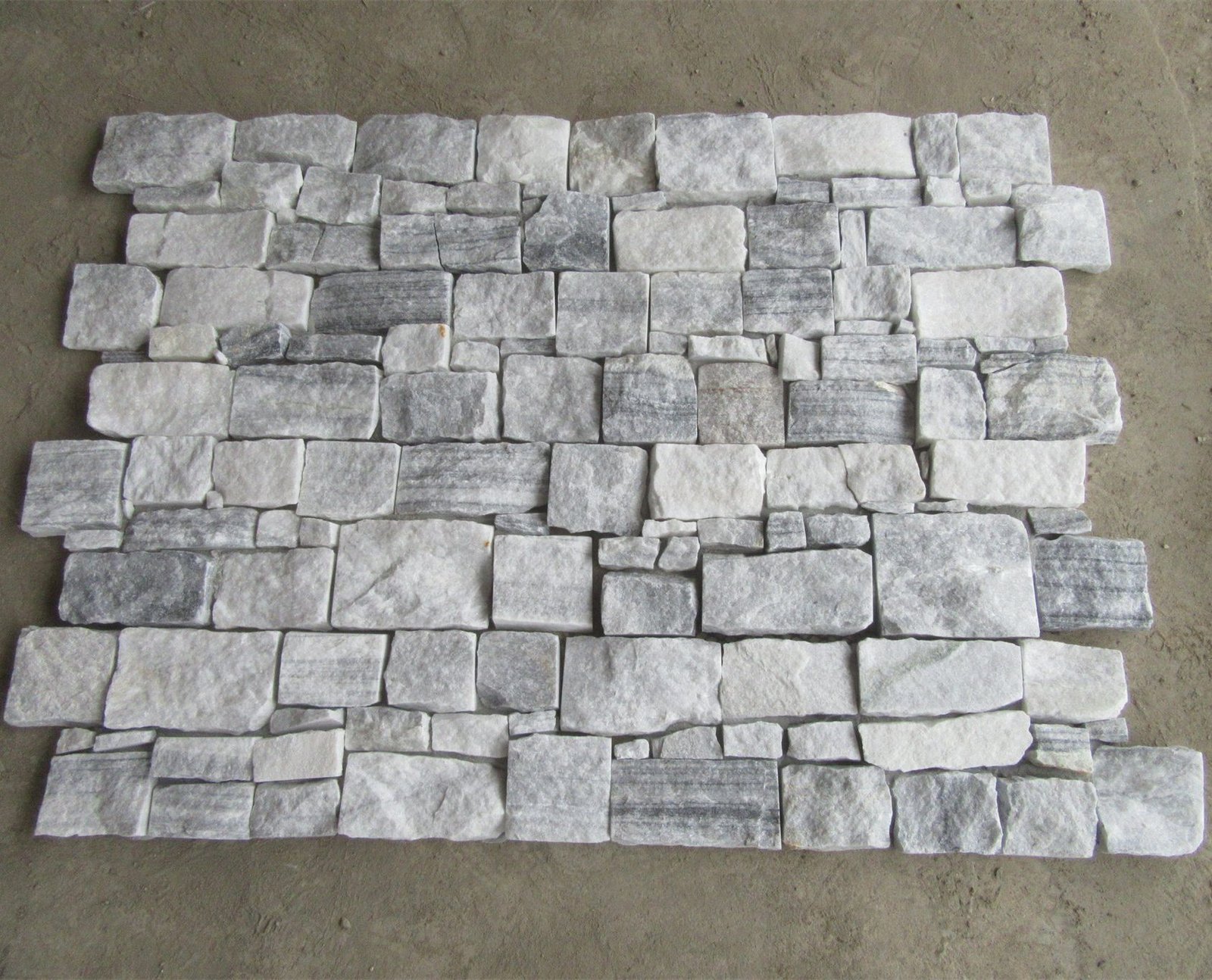
An interlocking Z-panel is a factory-made cladding unit with a stepped edge profile. “Z-panel” is Top Stone Panels’ own name for the format rather than an industry classification, so treat it as a description of the edge, not a standard category. One long edge rises, the opposite edge falls, and the next course seats onto it. The joint does the locating work: line, level, and reveal come from the geometry of the panel rather than from the trowel. Top Stone Panels builds these in two formats, 20x55cm and 15.2x61cm, on a cement or mesh backing, at a rate of 50,000 square meters per month.
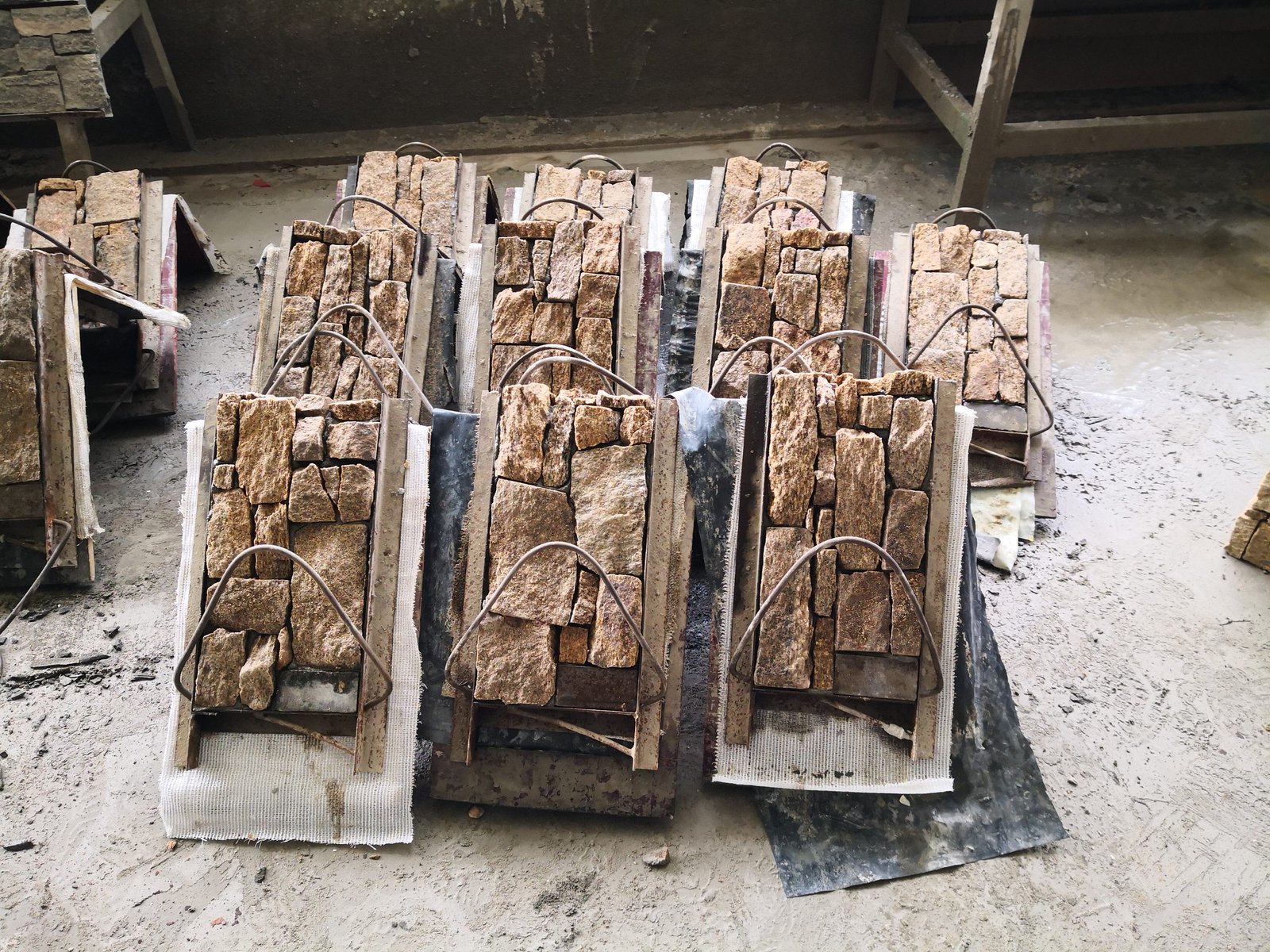
A glued backed panel is a different assembly. Individual split-face pieces are bonded onto a backing plane, either a cement board or a fibreglass mesh skin, with the stone held in a fixed pattern. The panel still needs an adhesive or a mortar bed to attach to the wall, and the bed is what decides where the panel sits. The same bonding logic runs through the stacked stone line in 15x60cm and 15x55cm, where a marine-grade epoxy fixes the face stones to the backing and the line runs at 80,000 square meters per month with prefabricated L-corner sets.
So alignment on the interlocking system is a factory deliverable, and on the backed system it is a site skill. Every speed claim is really a claim about which of those two you are paying for.
Finished appearance follows the same split. An interlocking wall carries a reveal the profile fixed in the factory, so joint width stays equal and the grout line reads as designed. A bed-set wall carries whatever joint the setter pressed into place, which on a rushed day wanders. Where a specifier wants a crisp linear joint, the edge system is an appearance decision that also happens to be faster.
Weight per panel matters as much as the edge. A cement backed unit behaves like a small precast tile and wants a flat, sound substrate; a mesh backed unit is lighter and bends, which buys it tolerance on walls a rigid panel cannot touch. The three backing types and what each one does to the finished panel decide more of your site behavior than the face pattern does, so treat backing as a specification choice, not a packing detail.
Where the Hours Go, Stage by Stage
Crews argue about speed in the abstract. Break the build into the stages that actually consume a shift and the argument settles. Four mechanisms eat the hours on an adhered stone wall: open time on the setting material, the shim and level decisions on every course, cutting at the corners, and rectification of joints that wandered. The table below maps those four against both systems on the same wall type — flat, plastered, sound, and in plane. Before you use any productivity number, check the setting material’s published minimum application temperature with its manufacturer; cold conditions stop a mortared wall long before they stop a dry-locked one.
| Build stage | Interlocking Z-panel | Glued backed panel |
|---|---|---|
| Wall prep | Needs a flat, in-plane wall | The bed takes the difference |
| Setting | Edge seats the course, little trowel work | Butter, press, wiggle, check |
| Waiting | Little wait between courses | Open time governs pace |
| Alignment | Lippage controlled by design | Checked course by course |
| Corners | L-corners drop onto the return | Site mitres, more cutting |
| Joints | Factory-fixed line, grout follows | Joint width varies with the bed |
| Weather limits | Little waiting on cure | Mortar has a temperature window |
| Cut waste | Trim clean at ends | Cuts can break the bond line |
Read the table as a labor map rather than a scorecard. Interlocking takes seven of those eight rows on a good wall: no wait between courses, no per-course leveling decision, corner work converted from cutting to placing. The row it loses is wall prep, and that is where the real arguments live, because the edge demands a plane the bed forgives.
What Makes Interlocking Panels Fast
The edge removes a decision. Every course on a mortared wall asks the same question: how hard do I press, and where does this stop? A male-female joint answers it mechanically. The installer sets the panel, the profile locates it, and the next course inherits that position. On a long straight run, that inheritance is where the time comes from, and the reason is structural rather than cosmetic.
Nothing waits on an open time. A crew on a backed system often stands at the wall while the bed goes off, because a second course pressed onto green mortar slides. Dry-stacked logic cuts that wait, and the same reason dry stack mortar-free installation suits contemporary linear facades applies here: when the joint is not carrying the alignment, the assembly keeps moving.
Corners pre-fabricated. A 90-degree return built on site means cutting, dry-fitting, and re-checking every unit at the change of plane. A one-piece L-corner arrives as a single unit and lands in one motion. The factory credits it with roughly 50 percent less corner installation labor, which is why corner sets are the first thing to spec on a project with many returns, pilasters, or window reveals. A distributor who stocks the corner profile with the panel profile sells a faster wall, not just a nicer detail.
Where a Glued Backed Panel Beats the Clock
A mortar bed is not just glue. It is a leveling device, and on a bad wall it is the cheapest leveling device on site. Old plaster, a block wall that drifted out of plumb, a retrofit over patched render: a backed panel pressed into a bed takes up what the wall failed to deliver. An interlocking edge cannot bridge the same defect. Force the courses into line and the profile stops seating, the reveal goes uneven, and the wall is now a troubleshooting job.
Two conditions favor the backed system on real jobs:
- Substrate truth is unknown until the skin comes off. On renovation work a bed keeps the crew moving while the wall is corrected locally; the edge system rewards sites where setting-out was worth the survey.
- Small or broken-up areas. Three square meters of chimney breast, a plinth, a pier between windows. No long run exists for the edge to compound, so bed tolerance wins on a single setup.
Repair is a quieter advantage. A backed panel lifts off a bed and a replacement bonds back in; an interlocking course that comes out disturbs the two courses seated onto it. On retail and hospitality work where a wall gets cut into later for services, that difference lands in the maintenance budget rather than the install schedule.
Then there is the curve. A rigid edge profile cannot lock out of plane, which is why radius work falls to mesh backed panels and loose stone. The rules for cutting and fitting corner pieces get harder, not easier, the tighter the radius, and the honest answer on a curved wall is to leave the interlocking system out of the specification.
Stocking the right system
Interlocking Z-panels and backed stacked stone ship from the same Yi County production base in Hebei, on slate and quartzite faces with pre-made corner sets. Orders start at one 20GP container, samples arrive in 1-3 days, and standard production runs 20-25 working days.
See the Z-panel cladding range | 20x55cm and 15.2x61cm | Cement or mesh backing | 50,000 square meters monthly
Installed Cost vs Crate Cost
Interlocking material usually lands higher per square meter than a backed panel cut from the same stone. The extra comes from the profiled edge, the tighter thickness tolerance that profile needs to seat, and the corner sets that make the speed real. Buying on the crate line is the standard mistake in this category, because labor is the larger half of an installed wall and it moves the other way.
Because nobody can price your labor for you, build the model yourself and fill it with your own rates. Take the crate price per square meter, add consumables (adhesive or mortar, lath where used, sealant at movement joints), add crew hours per square meter measured on your mock-up multiplied by your loaded day rate, add a waste allowance measured against developed wall length rather than box coverage, and add the cost of rectification visits your crews have made on the last ten walls. Run that sum twice, once per system, and the winner is the one whose total is lower in your market — not the one with the better datasheet.
Two other cost lines belong in the same conversation, and they are the ones buyers usually skip:
| Cost line | Interlocking Z-panel | Glued backed panel |
|---|---|---|
| Waste on cuts | Lower: fixed-profile trims | Higher: cuts break the bond |
| Corner labor | L-corner, one motion | Site mitre or fitted pieces |
| Rectification visits | Rarer, harder to undo | More common on uneven joints, easier to patch |
| Substrate correction | Born by the wall prep budget | Absorbed by the bed |
| Training depth needed | Setting-out matters most | Trowel skill drives it |
Holding both systems means two minimum orders — one 20GP container per line — and two sets of slow-moving SKUs. Put three questions to the factory first: whether panel lines can mix into one container and at what ratio, what the per-line minimum is on a first order, and how the 25-30 days a custom-carton first order takes differs from the 20-25 working days of a repeat run. The answers change the working-capital picture more than the unit price does.
CNC cutting compresses the waste line on both systems. Panels are cut with infrared CNC and held to batch thickness tolerance inside the factory’s three-step check, which is credited with about 20 percent less on-site trim and breakage. Tolerance is not a vanity spec: on an interlocking edge it decides whether the profile seats at all, and on a backed panel it decides how thick a bed hides the difference.
Which System Fits Which Wall
Most specification arguments end when the wall type gets named. Here is the honest allocation, including the cases where neither system wins outright.
| Wall condition | Specify | Reason in one line |
|---|---|---|
| Long flat new-build facade | Interlocking Z-panel | Geometry holds the line |
| Commercial run with repeated window returns | Z-panel plus L-corners | Corners hide the labor |
| Renovation over patched render | Backed panel in a bed | The bed absorbs wall defects |
| Curved or radius wall | Mesh backed or loose stone | A rigid edge will not lock |
| Chimney breast, plinth, piers | Glued backed panel | No long run to compound |
| Walls opened later for services | Glued backed panel | Single-unit removal |
| Cold-climate exterior, freeze-thaw exposure | Either, drained and flashed | Faces carry -30C to +50C |
| Tall wall or a height the designer must engineer | Structural detail first | Adhered systems have a height ceiling |
| Interior feature wall or heat-exposed surround | Either, subject to substrate | Setting material decides, not the face |
One row deserves a second look. Cold-climate exterior work does not care which edge you bought; it cares whether water gets behind the assembly. The failure mode on freeze-thaw sites is a wet backing plane, not a slow crew, so waterproofing behind stone veneer on exterior walls belongs in the same specification page as the panel choice. The material tolerance is a property of the stone itself rather than of the edge: 100 percent natural slate and quartzite faces, dense enough to take -30°C to +50°C swings, A-class non-combustible and UV stable. Keep the sealant specification separate from that claim and cite ASTM C920, the standard specification for elastomeric joint sealants, for the movement and transition joints in the finished wall.
How to Test the Speed Claim Before You Stock
Do not accept a productivity number from a datasheet. Build a mock-up, then work through the five checks that decide whether a system performs on your sites. An afternoon on a bench costs nothing next to a container of product that will not seat.
- Order physical samples, not photos. Samples ship in 1-3 days from approval. Stack three courses on a bench with a straight edge and see whether the profile seats without shimming. If a sample needs a shim, a wall will need a survey.
- Ask for the thickness tolerance record. Panels that vary within a batch force a thicker bed and kill the edge’s advantage. The factory’s own control is a three-step internal QC — material selection at the vein, in-process re-inspection, and a full pre-shipment check on thickness tolerance — so ask for the record behind your batch rather than a generic promise.
- Check corner supply against your job mix. Count the meters of return runs on your last three projects. If corners are 15 percent of the wall area and the stock list has no L-corner SKU, the speed advantage never reaches site.
- Time a mock-up both ways. Same wall, same crew, half interlocking and half backed. This gives you an installed number for your own labor rate rather than somebody else’s marketing figure, and it is the fastest way to settle a stocking argument with a contractor.
- Confirm packing and the freight assumption. Zero-breakage packing runs on 3-5 layer corrugation, fumigation-exempt treated pallets, four to six steel straps, and airbags inside the container. A speed advantage disappears when a crate arrives with broken faces, which is why the packing spec belongs on the purchase order and not in a brochure.
Before a first order, ask what the supplier will show you after the container closes. Pre-shipment inspection video and loading photographs are standard terms here, with the 70 percent balance released against confirmation of the loading layout, which makes the speed claim a documented one rather than a verbal one.
Frequently Asked Questions
Can you mix interlocking and backed panels on one wall?
Yes, and field work does it often. Run the interlocking system on the long flat planes where its edge earns time, then switch to backed panels on piers, plinths, and scattered small areas. Detail the change of plane where the two meet.
Do interlocking panels need less mortar?
They need adhesive or thin-set to bond to the substrate, but they do not need a thick bed to hold alignment. That is the saving: a thin, combed bed instead of a build-up coat that has to level the course as well as stick it.
Which system is better for freeze-thaw climates?
Neither edge is the deciding factor. The stone face and the drainage detail are. Slate and quartzite panels on both systems tolerate -30°C to +50°C, so specify a flashed, drained wall and a sealant joint meeting ASTM C920 at movement points.
Is an interlocking Z-panel heavier than a backed panel?
Cement backing adds weight compared with a mesh skin, so a cement-backed interlocking unit is the heaviest of the three common constructions. That is a handling and substrate-fixing question rather than a durability question.
What is the minimum order for either system?
One 20GP container applies across the panel lines, standard production runs 20-25 working days after approval, and physical samples ship in 1-3 days so a mock-up can happen before the container is committed.
Conclusion
The two systems are not competitors so much as they answer different questions. Interlocking Z-panels answer “how do we keep this line true without re-checking every course,” and they win on long, flat, properly prepared walls with many returns. Glued backed panels answer “how do I build this on a wall that is not ready for me,” and they win wherever the substrate, the geometry, or a future opening makes tolerance more valuable than throughput.
Key takeaways:
- Buy the interlocking edge when the wall is in plane and the schedule is tight; the speed comes from factory geometry, not from a faster crew.
- Buy the backed panel with a bed when walls are imperfect, areas are small and scattered, or the wall will be cut into later.
- Stock corner sets with the panel profile. Pre-made L-corners are where roughly half the corner labor disappears.
- Price installed cost per square meter with your own day rates, and prove it with a half-and-half mock-up rather than a datasheet figure.
Top Stone Panels runs both constructions from the same Yi County base on slate and quartzite faces, with 1-3 day sample dispatch and 20-25 working days standard production, so a distributor can hold the fast system and the forgiving one against the same job mix. Start with a sample and a tolerance record and put both systems on the same wall.