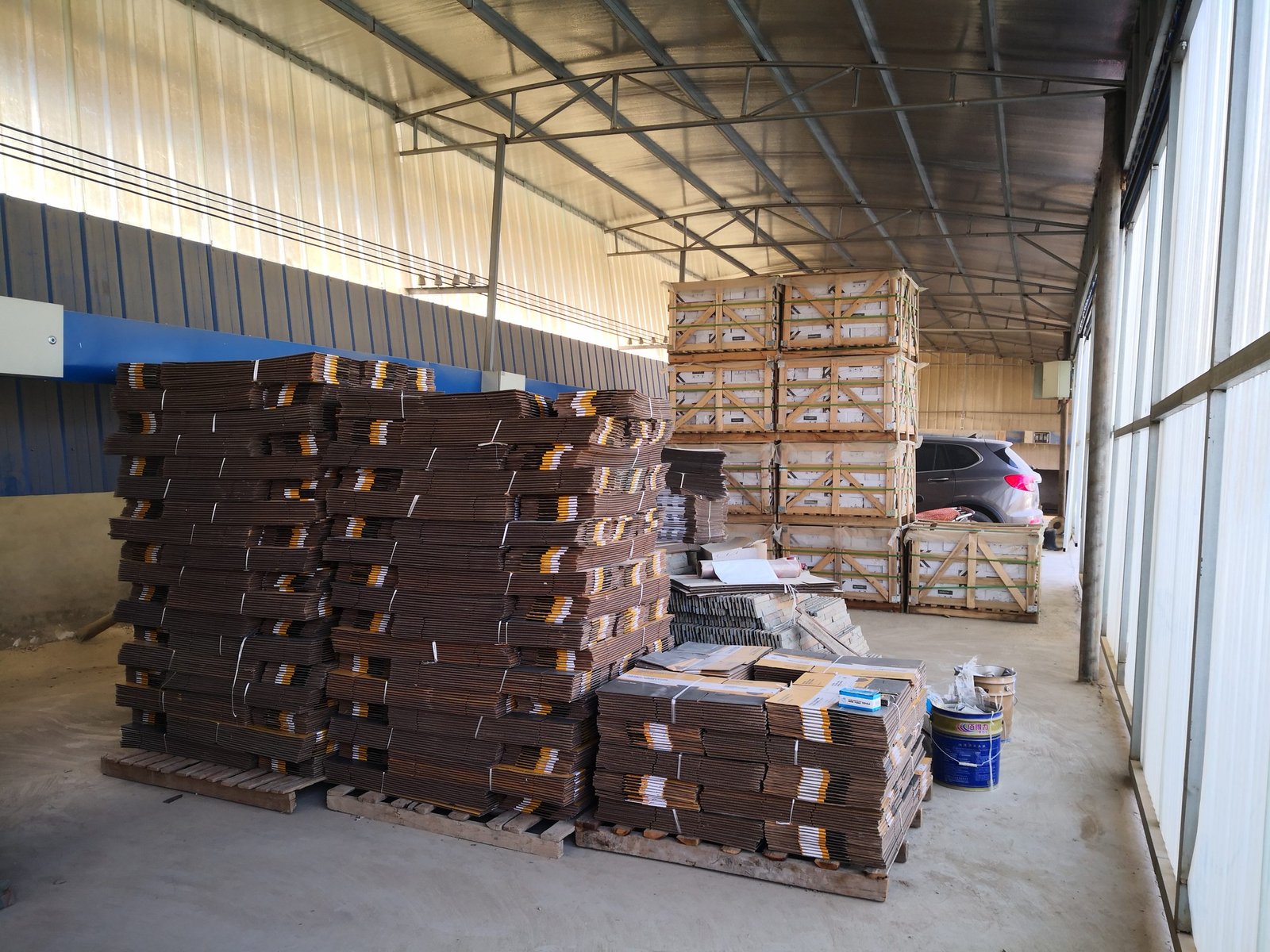
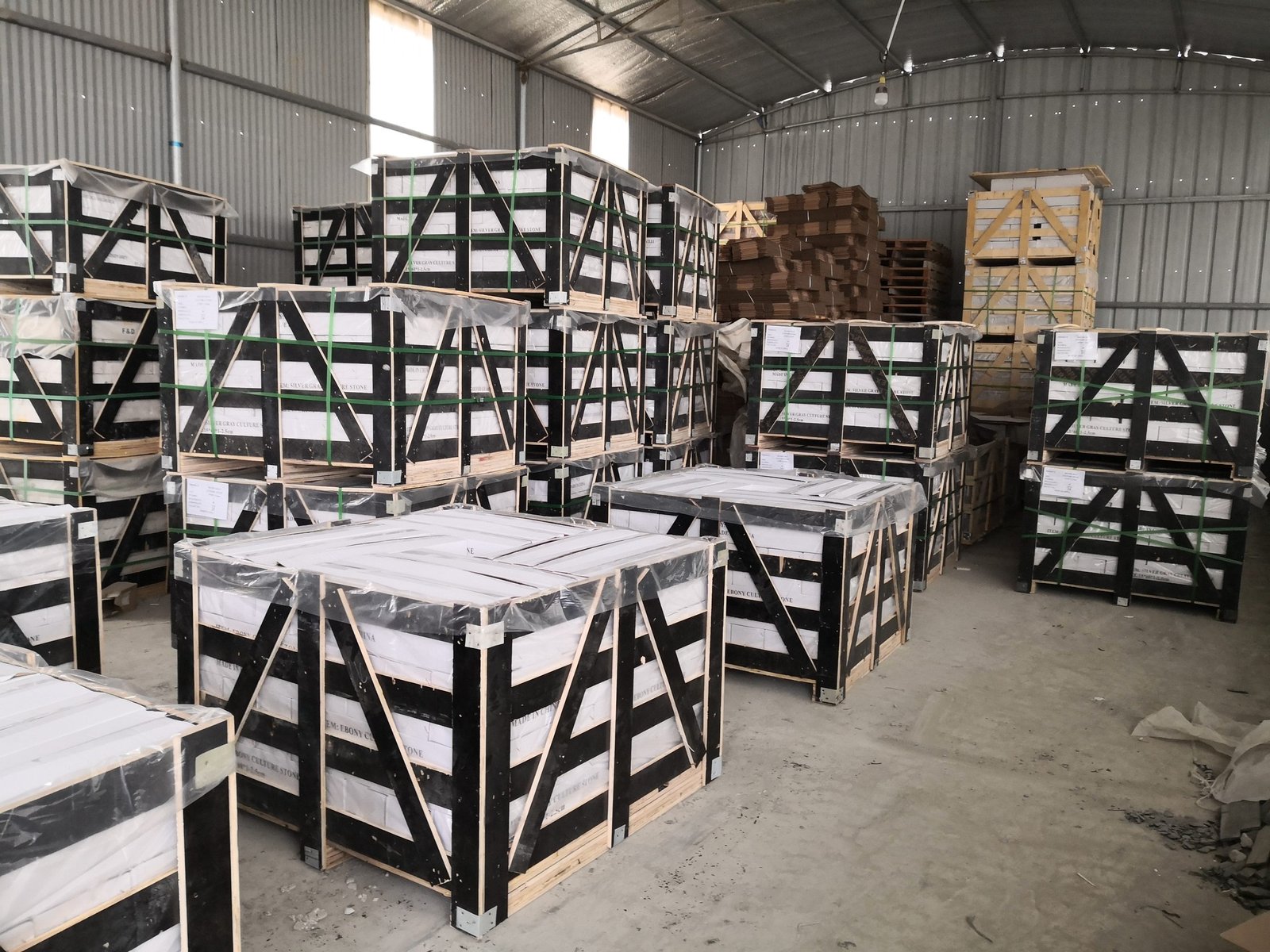
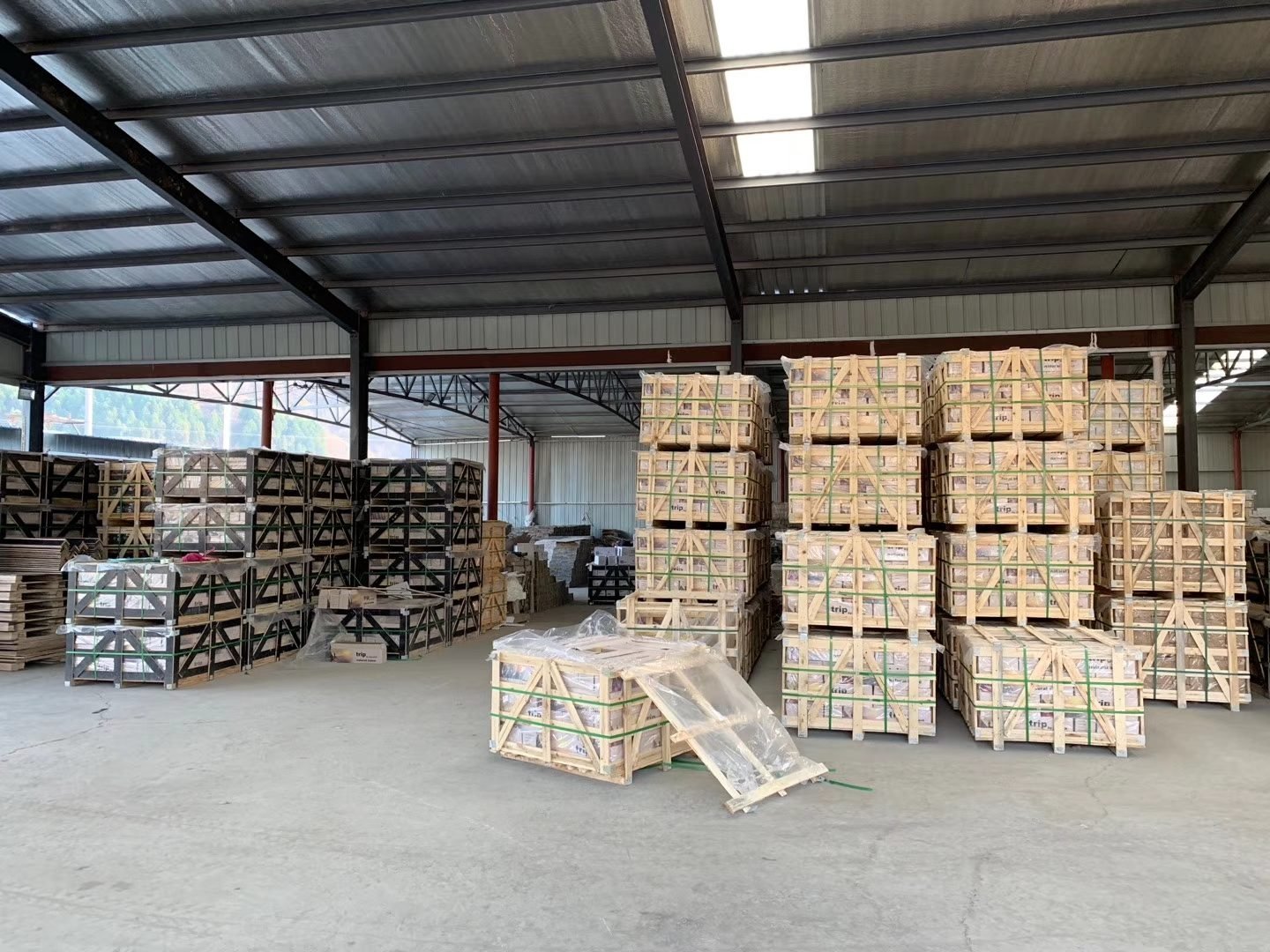
Most stone veneer damage on a jobsite does not happen in the factory, on the truck, or during install. It happens in the gap between delivery and installation, when pallets sit on damp ground, sheets lean against a wall in the sun, and a forklift blade pokes through a corner that was destined for a visible wall. The panels arrive packed for an ocean crossing — zero-breakage cartons, wooden pallets, steel strapping, internal air bags — and then lose the argument against weather, gravity, and bad stacking.
This guide covers the full on-site storage problem: what to check at receiving, how to stack each panel type correctly, how to protect the stack from weather and temperature, and which mistakes cause the cracks that surface months later. If you are a contractor, distributor, or site manager, the receiving checklist in section two is printable as-is.
- Store panels flat on a level, raised surface — never on bare ground, never leaning unsupported against a wall.
- Keep cement-backed and Z-panel units protected from moisture pick-up at the back and edges; mesh-backed sheets stay flat on a rigid support.
- Cover the stack from rain, snow, and direct sun, but leave airflow — a tarp that cooks the stack traps heat and condensation.
- Stack only as high as the packaging and density allow, and keep stacks away from forklift paths and wall foot traffic.
- Inspect every crate at receiving, photograph the damage, and claim before the driver leaves — silent carrier claims fail.
- Why On-Site Storage Goes Wrong
- Receiving Checks: What to Inspect at the Truck
- Stacking Rules: Flat, Raised, and Supported
- Weather: Rain, Snow, Sun, and Freeze-Thaw
- Backing Type Matters: Mesh, Cement, and Loose Strips
- Handling and Moving Panels on Site
- Short-Term vs Long-Term Storage
- Common Storage Mistakes to Avoid
- FAQ
- Conclusion
Why On-Site Storage Goes Wrong
The pattern repeats on jobsites everywhere. A container arrives, the crew unloads pallets next to the building pad, and the panels sit there for a week while the substrate is framed and weatherproofed. In that week, one afternoon of rain leaks under a torn tarp; the lower cartons wick moisture from damp ground; a stack of loose strips leans against a wall, bows, and develops a hairline crack no one sees until it is mortared into place.
The physics is simple. Natural stone is dense, and thin veneer formats — ledgestone strips, split-face ashlar, mesh-backed sheets — are thin in at least one dimension. Thin stone is a bending problem waiting for an excuse: a hard point under the pallet, an unsupported span, a thermal shock, or a heavy sheet dropped flat. Water multiplies every one of those problems by softening packaging, feeding freeze-thaw, and staining faces you cannot scrub later.
The good news is that correct storage is cheap. It takes a level surface, blocks, a cover, and a plan made before the truck arrives. The rest of this guide is that plan.
Receiving Checks: What to Inspect at the Truck
Storage starts at the tailgate. Every check here happens before the driver leaves, because the moment the truck is gone, the damage claim is yours.
- Photograph everything. Crate numbers, pallet condition, strapping tightness, any torn or water-stained carton. Date-stamped photos on delivery day are the evidence that resolves a claim in your favor.
- Check the count. Match the packing list: number of crates or pallets, cartons per unit, and any separately shipped accessories like L-corners or adhesive.
- Open-check a sample crate. Face of the panel, then the edges and corners — corners are where transit damage hides. Look for clean cuts, no cracked corners, and consistent color from the batch.
- Note moisture. A water-stained carton does not automatically mean damaged stone, but it means the stack will need extra care and the film should be flagged.
- Sign clean or annotate. If anything is wrong, write it on the delivery note before signing. Do not sign a clean receipt for a damaged shipment.
If you are buying container quantities, the supplier’s documentation help — packing lists, pre-shipment inspection videos, and ISPM 15 fumigation certificates — is part of what makes this check fast. Top Stone Panels ships each order with the inspection trail from its 3-step QC process, so the receiving check is a verification of known-good packaging, not a mystery box.
Stacking Rules: Flat, Raised, and Supported
Three rules cover 90% of correct stacking:
- Flat, never leaning. A leaning stack concentrates the weight of the whole bundle onto edges and corners. Flat stacks distribute it across faces, where thin stone is strongest.
- Raised off the ground. Wooden pallets alone are not enough; add solid support blocks or a rack so the underside of the stack stays clear of surface water and mud. 10-15 cm of clearance is the working number.
- Supported, not bridged. The support surface must be continuous enough that no panel spans freely. Mesh-backed sheets especially need a rigid, full-support platform — a sagging sheet is a pre-cracked sheet.
Stack height depends on the product. Heavy cement-backed or interlocking Z-panels (20x55cm / 15.2x61cm units) stay low — two to three units on a pallet is the practical working height for manual handling, and higher only with mechanical lifting. Thin ledgestone and split-face panels are lighter, but the limit is still what the cartons and pallets were engineered for, not what a crew can stack. When in doubt, keep the stack shorter — a few extra minutes of handling beat a pallet of crushed corners.
Keep stacks out of forklift paths, away from scaffold lifts, and off the path to the mixer. Stoneside, the scaffolding and staging guide shows how to plan the work zone so material staging does not collide with the installation crew.
Weather: Rain, Snow, Sun, and Freeze-Thaw
Weather is the storage enemy with the longest memory. The stone itself is built for the climate — dense slate and quartzite veneer is documented for -30°C to +50°C, freeze-thaw resistance, and salt-spray resistance — but packaging, adhesive backings, and mesh are not stone.
Rain and standing water
Keep the stack under cover even in a drizzle. Water finds carton seams, lifts cardboard, and wicks into the gap between stacked faces, where it sits out of sight. If panels get wet, dry the faces before stacking them face-to-face, and never stack wet panels in the cartons they arrived in for another week.
Snow and freeze-thaw
In freezing weather, water trapped between stacked panels or in packaging is the same freeze-thaw mechanism that stresses installed stone — but now with no drainage and no joints to absorb it. Keep frozen moisture off, or bring the stack into a dry space for the night.
Sun and heat
No-one worries about the sun until it ruins something. Direct sun on a covered stack turns the cover into a greenhouse: heat builds, condensation forms at night, and dark-toned panels in stacked bundles can develop thermal differentials across the stack. Use a light-colored, breathable cover and shade the stack where possible.
The cover that works
A tarp held up off the panels by a simple frame — scaffolding planks or pallets — beats a tarp draped directly on the stack. The air gap stops condensation and lets trapped moisture escape. Weigh the cover down at the corners, but do not shrink-wrap or seal it airtight; the stack needs to breathe.
| Weather event | What it does to the stack | Correct response |
|---|---|---|
| Rain | Softens cartons, wicks between stacked faces | Air-gapped cover; dry faces before re-stacking |
| Snow and freeze-thaw | Trapped water expands, spalls cement and mesh edges | Indoor or fully protected storage overnight |
| Direct sun | Greenhouse effect under dark covers, thermal differentials | Light-colored cover, shade the stack, ventilate |
| Standing water / mud | Rises through pallets into the underside | 10-15 cm clearance, gravel or rack base, drain the area |
Backing Type Matters: Mesh, Cement, and Loose Strips
Not all panel types store the same way, and the difference is the backing.
| Panel type | Storage hazard | Correct handling |
|---|---|---|
| Mesh-backed sheets (flagstone, crazy paving) | Sag and flex on unsupported spans | Flat on rigid, full-support pallet; lift with two hands or a carrier |
| Cement-backed panels (Z-panels) | Moisture pick-up at the back and edges; heavy | Low stacks, dry perimeter, mechanical lifting |
| Thin ledgestone strips | Corner chipping in loose bundles | Keep batch-sorted; stack on edges or flat with edge protectors |
| Loose thin veneer strips | Bow and mix across batches | Stacked flat in sorted lots, protected at the ends |
Cement-backed and interlocking Z-panels deserve the most respect. The cement matrix is strong in-plane but brittle at the edges, and exposed cement absorbs water, which then freezes and spalls. Store them low, keep the back face dry, and never let them sit on a damp slab overnight. The Z-panel installation guide covers the panel behavior you need to plan around before the material shows up.
Handling and Moving Panels on Site
Moving panels from storage to the wall is where most on-site cracking happens, because it is done fast and by hand.
- Carry panels on edge, two people for anything wide. A 15x60cm stacked panel carried flat over a distance flexes and can crack; carried on edge it stays stiff.
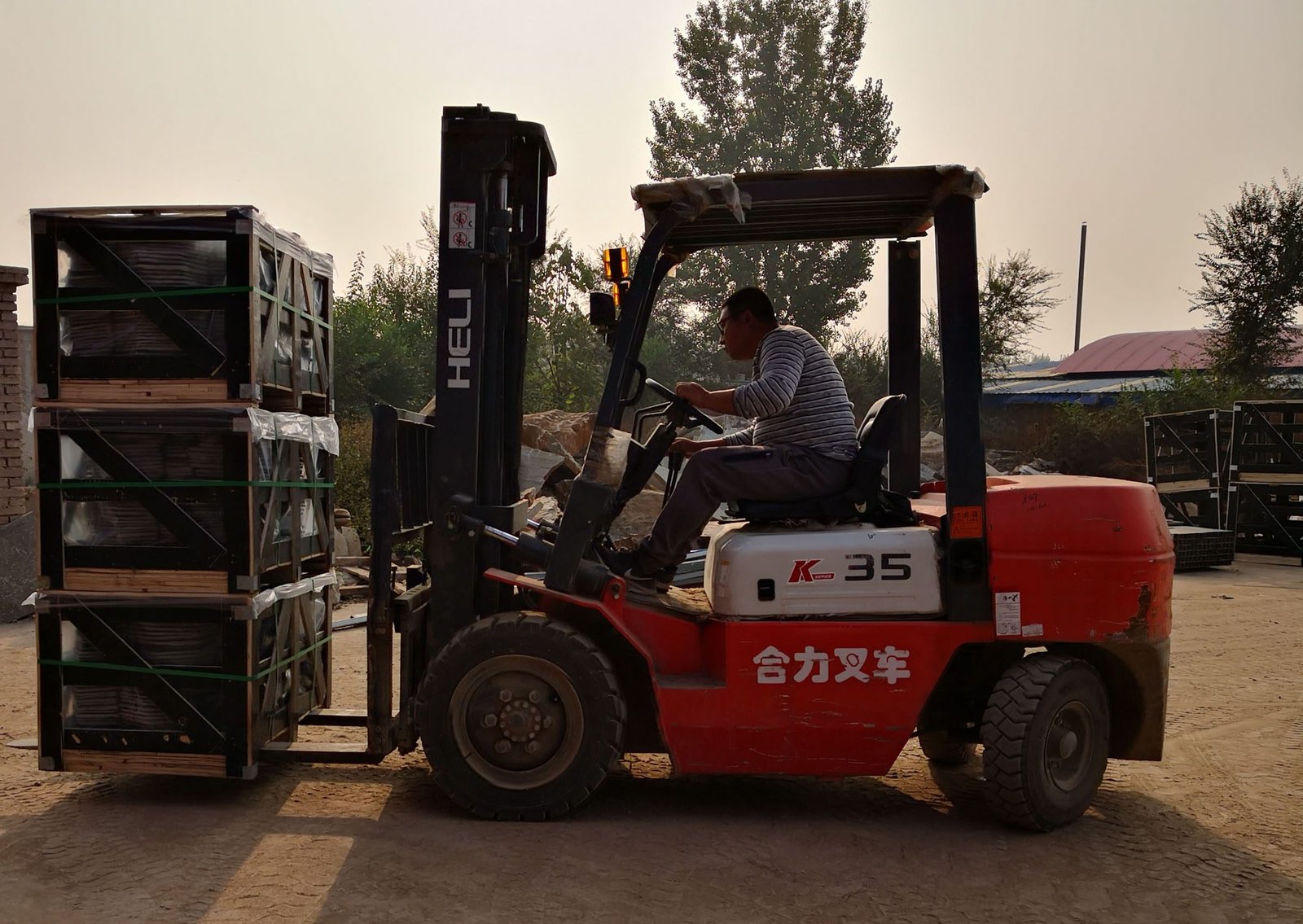
- Use the right lifting aid. Panel carriers, vacuum lifters for large sheets, and proper forklift forks with the load on a platform. Forklift blade edges are the classic source of corner damage.
- Move one lot at a time. Keep batch-sorted material together from the storage area to the installation point. Mixed batches create mixed-color walls and hours of fixing.
- Set down, never drop. Thin stone has no give; a dropped sheet arrives at the wall with a hairline fault that will open up in year two.
The cutting and fitting stage creates its own waste and debris problem; the panel cutting guide shows how to manage wet cutting so slurry and chips stay away from stored material.
Short-Term vs Long-Term Storage
Time changes the rules.
Short-term (days): the flat-raised-covered rules above are enough. A stack that moves to the wall within days mainly needs protection from rain and foot traffic.
Medium (weeks): add the air-gapped cover, watch the ground for ponding water, and rotate the stack so nothing sits in contact with the same damp surface the whole time. Inspect weekly for moisture, mold on cartons, or settling supports.
Long (months): bring the material indoors if it exists — a dry warehouse or an enclosed garage beats any outdoor tarp arrangement. If it has to stay outside, raise it higher, use a framed cover, keep it out of winter weather entirely, and check it after every storm. Cement-backed panels should not be left outdoors in winter, period.
If the project hit a weather delay and the substrate is not ready, better to re-arrange the schedule than to leave stone waiting: a dry, sorted storage area is a fixed cost that protects a container-scale investment.
Common Storage Mistakes to Avoid
Five mistakes account for most damaged stock:
- Storing on bare ground. Even slightly damp ground softens pallets and wicks moisture into the stack. Raise it; there is no excuse not to.
- Leaning panels against a wall. This is the single most common way thin stone develops bowing cracks. Flat or nothing.
- Tarps laid directly on the stack. They trap heat and condensation. Air-gap the cover.
- Overstacking by hand. The physical limit of a crew is not the packaging limit. Keep mechanical-lift heights for the heaviest backings.
- Mixing batches or sorting on the fly. Loose strips and mesh sheets get rearranged at install time; a pile of mixed stock is how a wall ends up mismatched and a reorder becomes urgent.
The wider failure modes of a stone veneer project — beyond storage — are catalogued in the installation mistakes guide, worth a read before the first panel is mortared.
FAQ
Can stone veneer panels be stored outside?
Yes, for short periods, if they are raised off the ground, stacked flat, and kept under a breathable cover with an air gap. For long-term or winter storage, keep panels indoors; cement-backed panels in particular should not spend weeks exposed to moisture and freeze-thaw.
How high can you stack stone veneer panels?
High enough that the packaging is engineered for it and the stack stays stable. In practice that means low heights for cement-backed and interlocking panels — two to three units on a pallet for manual handling — with mechanical lifting for anything heavier.
Does rain damage natural stone veneer before installation?
The stone itself can handle rain, but the packaging, mesh, and cement backings cannot. Water softens cartons, wicks into stacked faces, and freeze-thaw can spall cement edges. Cover the stack with an air-gapped tarp and dry any wet faces before re-stacking.
Can you store stone veneer panels in a garage or warehouse?
Yes — indoors is the best storage for any stone veneer. Keep the stack flat, raised off the floor, dry, and away from traffic. Indoors removes rain, sun, and freeze-thaw from the equation entirely.
How do you move large stone veneer panels on site?
Carry panels on edge with two people for anything wide, use panel carriers or vacuum lifters for large sheets, and never let forklift blades touch panel faces or corners unprotected. Set panels down gently — dropping thin stone creates cracks that appear later.
Conclusion
On-site storage is a short list of non-negotiable rules: flat, raised, supported, covered, dry, and away from forklift paths. Follow those and the panels that left the factory packed for an ocean voyage arrive at the wall in the same condition — clean faces, intact corners, correct batches. Skip them and the same panels become a claim, a reorder, and a mismatched wall.
Key takeaways:
- Inspect, photograph, and claim at receiving — once the driver leaves, the claim is yours to prove.
- Stack flat and raised on continuous support; leaning and bridging are crack factories.
- Air-gapped, breathable covers beat tarps draped on the stack; bring cement-backed panels indoors for winter.
- Match stacking and handling to the backing — mesh sheets, cement panels, and loose strips each have their own hazards.
- Keep batches sorted from delivery through installation; never sort on the fly.
Plan the storage zone before the truck arrives, and if you are ordering the panels, ask about the packaging protocol, the inspection documentation, and the sample box. Contact Top Stone Panels for container-quantity panels shipped under the zero-breakage packaging protocol, with 1-3 day samples to test before you commit.