The first fireplace order usually starts the same way. A distributor forwards a photo of a stone surround, the client asks what arrives in the kit, and the estimator realizes nobody priced the corners. Fireplace walls are small next to full facades, but the detail work is dense. Panels, corners, adhesive, firebox clearance, drywall thickness near the opening: each one is a line item that decides whether the job closes or stalls.
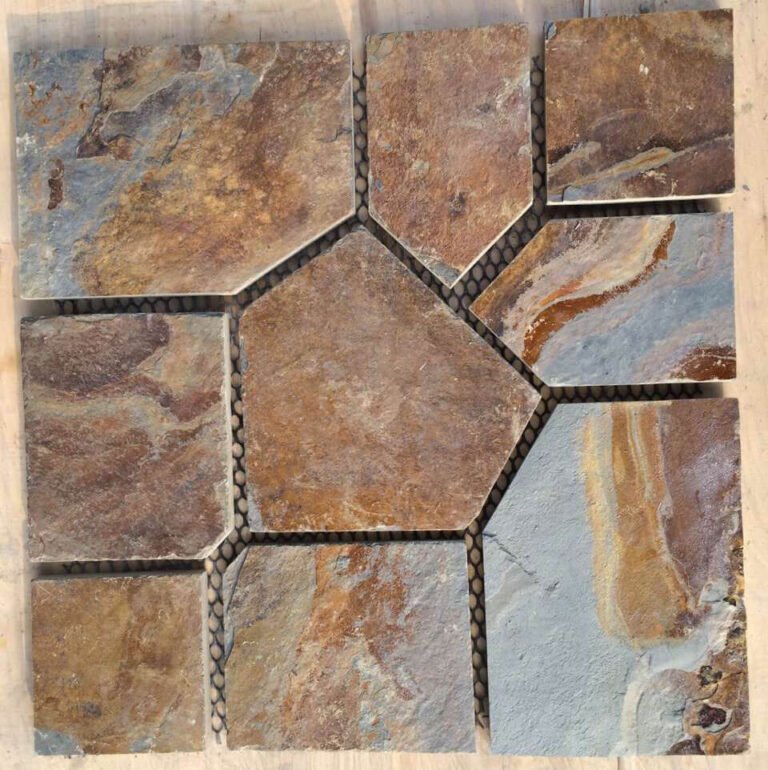
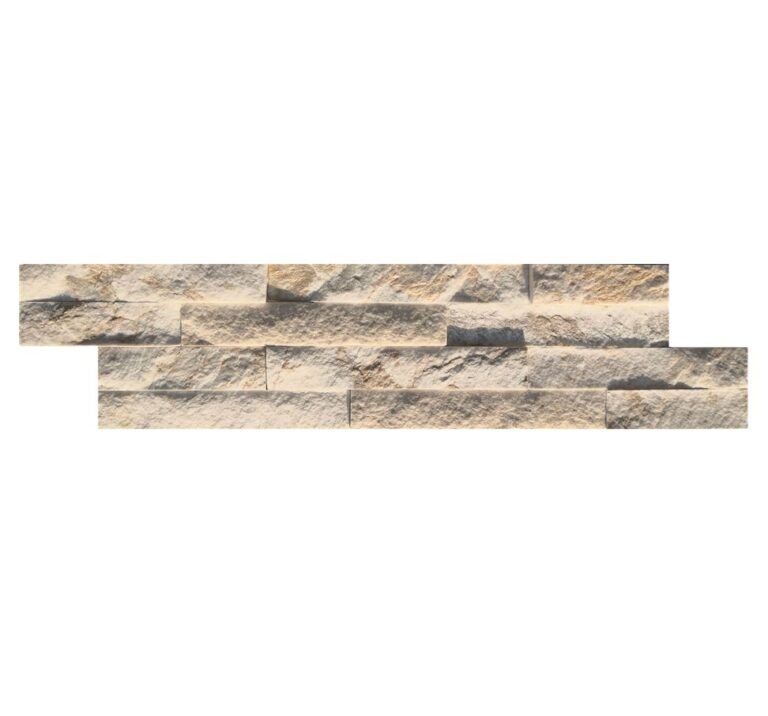
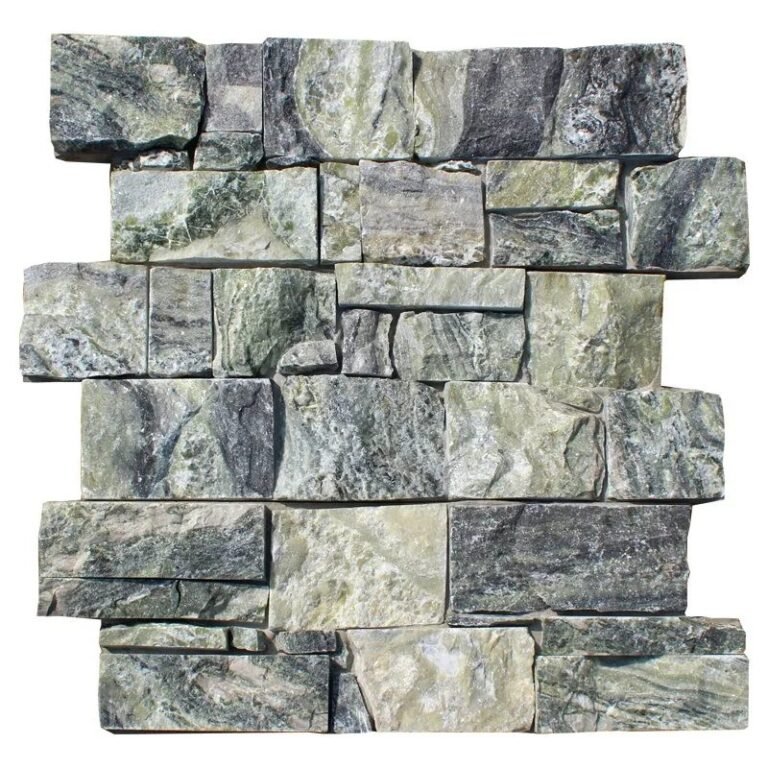
Stone veneer fireplace kits from Top Stone Panels ship the natural stone factory-cut into panel sizes: 15x60cm stacked stone, 36x10cm ultra-thin ledgestone, or interlocking z-panels. A standard 15x60cm panel covers 0.09 m2, so a 3.6 m2 fireplace face takes about 44 panels including cuts and returns. Installed weight runs 35 to 55 kg per square meter, and natural stone’s non-combustible face is why the assembly earns Class A interior finish expectations in the ICC model codes.
- A kit ships the stone: panels, matching L-corner sets, and the documents. The firebox, backing, adhesive, and sealant stay in the buyer’s scope.
- Standard 15x60cm panels cover 0.09 m2 each, so count 11.1 panels per square meter before cuts and returns.
- Installed veneer weighs 35 to 55 kg per square meter, roughly 7 to 11 lb per square foot, and the framing has to carry it.
- Natural stone is non-combustible, which supports Class A interior finish in most building departments.
- Factory L-corner sets wrap returns without field miter cuts and cut corner labor about in half.
- Samples ship in 1 to 3 days, production runs 20 to 25 working days, and the MOQ is one 20GP container.
- 1. What a Fireplace Kit Contains
- 2. What the Owner Supplies
- 3. Ledger vs Stacked vs Z Panel Fireplaces
- 4. How Much Veneer a Fireplace Wall Needs
- 5. Corners, Returns, and Trim
- 6. Fire Performance and Heat Clearance
- 7. Substrate and Adhesive Near the Firebox
- 8. Installation Sequence in One Day
- 9. Ordering Quantities and Container Math
- 10. Questions to Ask Before You Order
- FAQ
- Conclusion
1. What a Fireplace Kit Contains
A factory stone veneer kit is the stone side of the assembly, nothing more. You get the panels in the format you ordered, L-corner sets to match, plus the paperwork that makes an order importable. That file holds the commercial invoice, packing list, certificate of origin, ISPM 15 fumigation certificate on request, and the pre-shipment inspection photos from the factory QC pass.
That last stack matters more than it looks. A fireplace wall is inspected under living-room light, not a jobsite sky. The 3-step QC trail at Top Stone Panels covers raw material selection, in-process re-inspection, and a final check before the boxes close, and it tells a distributor exactly which batch each box belongs to. Batch color control is the quiet difference between a wall that reads as one stone and a wall with a visible patch line.
One warning before ordering: the word kit means different things from different suppliers. A big-box prefab surround typically includes foam or modular components and paste, which is a different product class. A natural stone veneer kit is panels and corners. When a quote uses the word kit, ask the supplier to list what ships, box by box, before comparing prices.
2. What the Owner Supplies
The honest answer to what is supplied is the stone and the corners. Everything the panel bonds to, cuts against, or seals with comes from the installer’s supply chain. Getting this scope settled before the quote prevents the field stop that shows up at the firebox.
| Item | Included in kit | Owner supplies |
|---|---|---|
| Stone panels and L-corners | Yes | – |
| Trim and cut pieces | Square-cut trim on request | Field cuts at the firebox opening |
| Mortar and adhesive | No | Modified thin-set rated for the panel weight |
| Backer board or lath | No | Non-combustible substrate per the fireplace manual |
| Firebox and insert | No | The appliance itself |
| Sealant and grout | No | Stone-compatible, heat-tolerant products |
| Tools | No | Notched trowel, wet saw, level, mixing paddle |
Distributors who resell fireplace kits commonly add the mortar and backer as their own line items. That turns a single SKU into a basket, which is fine as long as the basket is priced on the quote. The client sees one thing, then finds the real scope in the fine print, and the deal gets renegotiated on the jobsite.
3. Ledger vs Stacked vs Z Panel Fireplaces
Format decides the look of the surround, and for fireplaces the choice is mostly about masonry style, not performance. All three carry the same non-combustible face. The differences show in joint rhythm, panel size, and how fast a crew covers the wall.
| Format | Panel size | Look | Fireplace fit |
|---|---|---|---|
| Stacked stone | 15x60cm / 15x55cm | Level courses, strong texture | Classic surrounds, full feature walls |
| Thin ledgestone | 36x10cm ultra-thin | Fine linear ledger | Modern linear surrounds, retrofit over drywall |
| Interlocking z-panel | 20x55cm / 15.2x61cm | Large repeat pattern | Full-height feature walls, fast coverage |
Stacked stone is the default around fireplaces because the horizontal ledger courses read naturally next to a mantel. Thin ledgestone earns its place on retrofit jobs where the wall depth is tight and the design wants a finer grain. The z-panel is the coverage champion for ceiling-height runs, where the interlocking edge keeps joints aligned without constant check.
The stacked stone panel family anchors most fireplace programs, the thin ledgestone and interlocking z-panel lines round it out, and every line ships with matching corner sets. A distributor who stocks those three formats can quote nearly any residential surround without a custom run.

4. How Much Veneer a Fireplace Wall Needs
Measure the face and the returns first, then add waste. A fireplace surround is a rectangle around the firebox, plus any return that wraps the side of the chimney breast. The formula is the same one the factory uses: area equals width times height, panels equal area divided by single-panel coverage, and waste runs 5 to 10 percent depending on openings.
| Example wall | Area | 15x60cm panels with 10% waste | Installed weight |
|---|---|---|---|
| 2.4m wide x 1.2m high | 2.9 m2 | ~36 panels | 101 to 159 kg |
| 2.4m wide x 1.5m high | 3.6 m2 | ~44 panels | 126 to 198 kg |
| 3.0m wide x 1.8m high | 5.4 m2 | ~66 panels | 189 to 297 kg |
Each 15x60cm panel covers 0.09 m2, so a square meter takes 11.1 panels before waste. The weight column is the number the contractor converts into the framing question. A 3.6 m2 surround hangs roughly 126 to 198 kg of stone; the lath, backer, and framing must carry that load, and the answer cannot be assumed from a stud layout made for drywall alone.
Order the entire visible face from one production batch. Fireplace walls are viewed in warm interior light, and a second batch from the same stone bed can shift a shade. The specification should say one batch for the project, samples approved against that batch, and one box held back for repairs.
5. Corners, Returns, and Trim
Corners decide whether a fireplace reads as specified or improvised. The flat wall sets the pattern; the detail lives at the returns, the firebox opening, the mantel line, and the hearth nose. Factory L-corner sets handle the outside corners, and square-cut trim finishes the exposed edges.
Use the L-corner instead of a field miter on outside corners. Miters on thin natural stone open with thermal movement and collect dust in the seam. The factory corner wraps the return and staggers the joint, which is faster and looks cleaner from the armchair across the room. The ledgestone fireplace design guide shows how these returns frame the firebox on a modern surround.
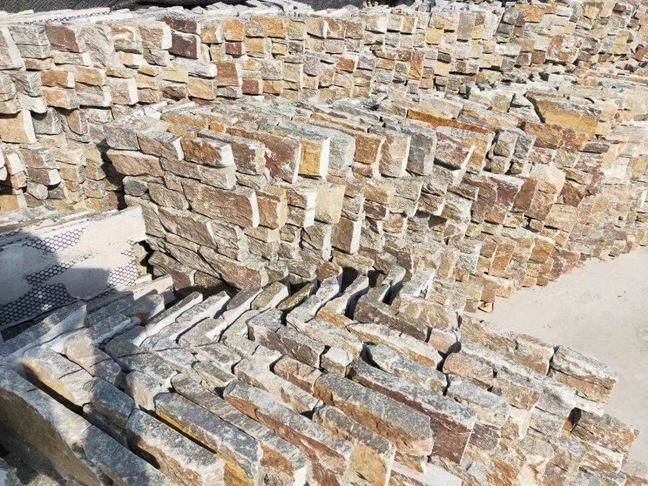
At the firebox opening, cut panels fit before setting, and the cut edge lands behind the trim line instead of hanging in the air. At the mantel shelf and hearth nose, square-cut trim pieces finish the exposed plane. Leaving a raw sawn edge at a doorway or shelf reads as unfinished, and on a fireplace the eye goes straight to it.
6. Fire Performance and Heat Clearance
Natural stone is non-combustible, and that property does the heavy lifting near a firebox. In the International Code Council model codes, interior finish materials are classified by flame spread and smoke development, and dense slate and quartzite routinely land in the lowest class, Class A, in most building departments. The stone face does not add flame spread the way a textile or a wood veneer can.
The clearance envelope, though, belongs to the appliance manual, not the veneer brochure. The fireplace insert or firebox manufacturer sets the required clearance from combustibles, and the surround assembly has to fit that envelope. Two jobs with identical veneer can have different rules because the appliances differ. Pull the manual before the quote, not after the framing is closed.
The Natural Stone Institute maintains the property data specifiers use on submittals, and its dimension stone vocabulary, such as ASTM C119, keeps supplier language consistent. When a supplier answers a fire question with a slogan instead of a test report, ask for the assembly test.
7. Substrate and Adhesive Near the Firebox
Near the firebox, the substrate and adhesive are part of the safety assembly. The typical non-combustible build uses a cement backer or equivalent substrate called out by the appliance manual, not foam. Foam board is insulation and a packaging material, not a heat-rated surface for a fireplace surround, and no veneer layer changes what sits behind it.
For the mortar, the working family is the ANSI A118-series thin-set and mortar standards shared by tile and stone, with a modified thin-set rated for the panel weight. The factory’s marine-grade epoxy is built into the panel backing; the installer’s mortar carries the finished weight to the substrate. Read the adhesive label for the assembly, not just the tile, because a fireplace wall asks more of the bond than a backsplash.
Two field checks catch most failures. First, mortar coverage: at the end of each day pull one fresh panel and confirm the notches combed out to continuous coverage. Second, lippage: run a straightedge across joints and flag any panel standing more than 2mm proud. Both go on the daily report, and the hearth is the wrong place to skip either check.
Panels and L-corners from one batch, samples in 1 to 3 days, production in 20 to 25 working days. Top Stone Panels supplies the stone side in MOQ quantities with the documents a project file needs.
8. Installation Sequence in One Day
A one-wall fireplace veneer job fits one day for a two-person crew, with a half-day pass for grouting and cleanup. The sequence below is the discipline that keeps a small wall from turning into a multi-day story.
- Prep the substrate. Install the non-combustible backer per the firewall manual, tape the joints, and let the assembly dry. Warning: setting panels over damp compound is the first source of hollow-sounding bonds.
- Dry-lay the panels. Sort the batch face-up, mix the shade variation across the wall, and mark the cut line for the firebox opening. Warning: this layout, not the first panel, sets the joint rhythm.
- Mix and mortar. Mix only what one pass will use, and keep the modified thin-set within its working time. Warning: a stiffened batch is a failed bond, and it is cheaper to remix than to pull panels later.
- Set full panels bottom-up. Start at the hearth line, level with full panels, and comb each panel so coverage stays continuous. Warning: a panel that thins out at the edges will telegraph on a warm wall.
- Run the corners with the field. Set L-corner pieces as the courses climb, not after the flats are done, so the return wraps the joint rhythm of the face.
- Cut and set the firebox opening. Wet-cut the marked panels, set them around the opening, and finish the edge behind the trim line. Warning: dry-cutting stone near a finish floor is a suction, dust, and liability problem; protect the floor first.
- Joint work. Either rake joints to a consistent depth or pack them per the schedule, before the mortar skins. Warning: joints finished after the mortar sets leave a gray haze at the edges.
- Clean and inspect. Wipe mortar film with a damp sponge before it cures, then run the coverage and lippage checks from the day’s last wall.
The ledger panel fireplace installation guide walks the same sequence on a masonry surround, and the hearth and surround design guide covers the proportions to order in the first place. Between the two, a distributor has the sales sheet and the install script for the same sale.
9. Ordering Quantities and Container Math
Ordering boils down to the same math as installing: convert the wall to panels, then to boxes, then to containers. A multi-suite project of 12 fireplaces at 3.6 m2 per face comes to roughly 43 m2 of stone, around 480 panels before waste. That is a mixed-order problem, not a panel problem, because the factory scale starts at container level.
Top Stone Panels works from a minimum order of one 20GP container, which carries roughly 500 to 530 m2 of stacked stone at 35 to 55 kg per square meter. A distributor who pairs a fireplace program with feature walls, column wraps, or thin veneer strips fills that container with sellable product instead of a single project’s balance.
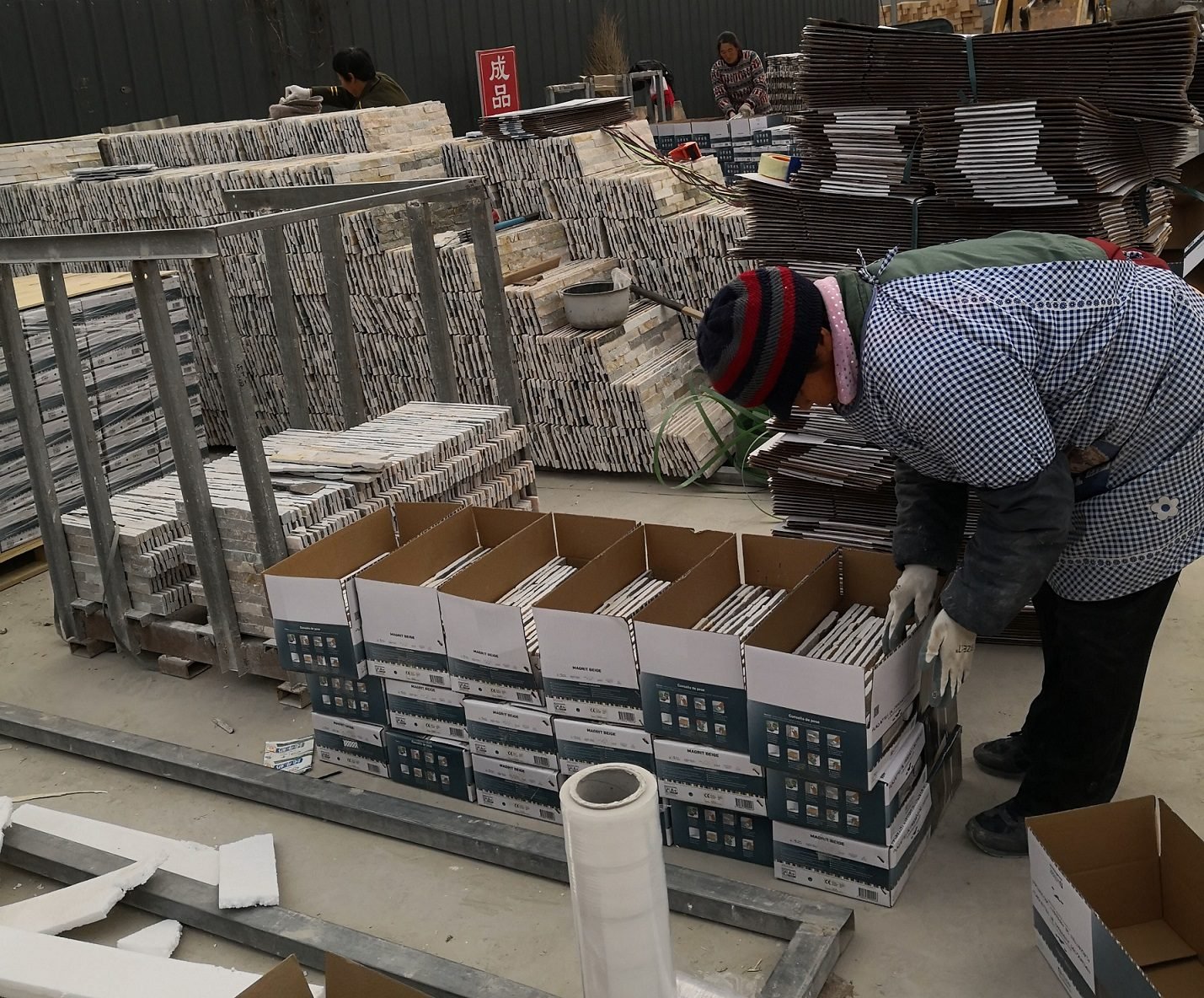
Physical samples ship in 1 to 3 days, standard production runs 20 to 25 working days after approval, and orders ship FOB Xingang from Tianjin with EXW, CIF, and DDP options. Terms run 30 percent T/T deposit and 70 percent before balance, with the loading video and batch layout photos sent before the balance clears.
10. Questions to Ask Before You Order
Six questions separate a confident order from a re-negotiation on the jobsite. Run them on the first call with any supplier.
- What ships, box by box? Require a packing list that counts panels, L-corners, and trim per box, not a pallet total.
- Do the corners match the format? L-corner sets are format-specific. An L-corner from a different panel size will not wrap the course.
- One batch for the whole order? Color sorting happens per batch, and a fireplace wall cannot tolerate a shade seam in the middle of the face.
- What documents come with the shipment? COO, ISPM 15 fumigation certificate, and the pre-shipment photos belong in the file before the container leaves the yard.
- What is the real lead time? Samples in 1 to 3 days and 20 to 25 working days of production are the factory’s standard lane; confirm the per-order plan in writing.
- How is the sample approved against the batch? The physical sample should be a piece of the same vein and batch that will ship, or the sign-off means nothing.
For first-time buyers, the complete stone panel buying guide covers the sourcing side of these questions in depth, from sample sign-off to container planning.
FAQ
Do stone veneer fireplace kits include adhesive?
No. Factory kits ship the natural stone panels, L-corner sets, and documentation; the mortar, backer board, and sealant stay in the owner’s scope.
Can you install stone veneer directly on a fireplace?
On sound masonry, yes, with approved mortar. On framed fireplaces, panels go over the non-combustible substrate called for by the appliance manual.
Is natural stone veneer safe around a fireplace?
The stone face is non-combustible and supports Class A interior finish in most building departments, while the appliance manual sets the clearance envelope.
How many stone veneer panels do I need for a fireplace?
Measure the face plus returns, divide by 0.09 square meters for 15x60cm panels, and add about 10 percent for cuts at the firebox opening.
What is the MOQ for fireplace stone kits?
Top Stone Panels works from one 20GP container, with samples in 1 to 3 days and production in 20 to 25 working days.
Conclusion
A fireplace kit order becomes a clean sale when the scope is fixed: panels and L-corner sets from one batch, the owner’s scope listed on the quote, and the coverage math done before the sample ships. Small walls hide the same detail complexity as big facades, and they show it under the brightest light in the house.
Key Takeaways
- A stone veneer fireplace kit ships the stone and corners; mortar, backer, and sealant are owner-supplied line items.
- Count 11.1 panels per square meter for 15x60cm formats and add 5 to 10 percent for firebox cuts and returns.
- Natural stone supports Class A interior finish, and the appliance manual owns the clearance envelope.
- Samples ship in 1 to 3 days, production takes 20 to 25 working days, and the MOQ is one 20GP container.
Ready to order a kit program? Top Stone Panels supplies stacked stone, ultra-thin ledgestone, and z-panel fireplace formats with batch-matched corners, physical samples in 1 to 3 days, and container-level documentation. Send the wall schedule and preferred format for a coverage, weight, and batch plan.