This scenario plays out dozens of times a year at European, North American, and Australian ports. The stone is never the problem. The packaging is. And the regulation that governs the packaging is ISPM 15 — a rule that every natural stone exporter must understand before the first crate leaves the factory floor.
This guide covers what ISPM 15 is, which treatment methods apply to stone export packaging, what the IPPC mark means, how fumigation certificates work, and what happens when compliance fails. It is written for B2B buyers who import stone panels from China and need to verify that their supplier handles wood packaging correctly — and for procurement teams who have been burned by a container hold and want to make sure it never happens again.
Key Takeaways
- ISPM 15 applies to all solid wood packaging (pallets, crates, dunnage) thicker than 6 mm used in international trade — stone panels ship on wood, so every container must comply.
- Two treatment methods: heat treatment (HT, 56 degrees C for 30 minutes) and methyl bromide fumigation (MB, 24-hour gas exposure). Heat treatment is the default for most destination markets.
- The IPPC stamp on the wood must show country code, facility number, and treatment code — and it must be legible on at least two opposite sides of the crate or pallet.
- Plywood, OSB, and engineered wood are exempt from ISPM 15, which is why many stone exporters default to plywood pallets.
- Non-compliance triggers re-export, destruction, or on-site treatment at the destination port — plus demurrage charges of 100 to 300 USD per day.
- Top Stone Panels uses heat-treated solid wood crates or ISPM 15 exempt plywood pallets, with certificates included in every shipping document set.
- What ISPM 15 Is and Why It Exists
- Which Stone Export Packaging Is Regulated
- Heat Treatment vs Methyl Bromide Fumigation
- Reading the IPPC Mark on a Stone Crate
- The Fumigation Certificate: What It Contains
- Destination Country Rules: EU, US, Australia
- Common Failures and How to Prevent Them
- How Top Stone Panels Handles ISPM 15
- FAQ
What ISPM 15 Is and Why It Exists
ISPM 15 stands for International Standards for Phytosanitary Measures No. 15. It was developed by the International Plant Protection Convention (IPPC), a treaty body under the Food and Agriculture Organization of the United Nations. The standard was first adopted in 2002 and has since been ratified by over 180 countries — essentially every major trading nation in the world.
The purpose is narrow and specific: to prevent the international spread of wood-borne pests — bark beetles, wood wasps, nematodes, and fungal pathogens — through solid wood packaging materials used in trade. A wooden pallet that carried timber from an infested forest can harbor insect larvae in its core, and when that pallet crosses an ocean and arrives in a new ecosystem, those larvae can emerge and devastate local forestry. The Asian longhorned beetle, which arrived in North America and Europe inside Chinese export packaging in the 1990s, is the case study that drove ISPM 15 into law.
For stone exporters, the relevance is indirect but unavoidable. Natural stone — slate, quartzite, sandstone — is not a regulated commodity under ISPM 15. A panel of stacked stone veneer does not carry wood-borne pests. But the wooden crate that holds the panels, the solid wood pallet underneath them, and the timber blocking and bracing that prevents the crate from shifting inside the container are all regulated. The stone is innocent; the packaging is guilty by association. And because customs inspectors cannot easily separate the cargo from the crate at the port of entry, non-compliant packaging can hold the entire shipment.
Which Stone Export Packaging Is Regulated
ISPM 15 applies to solid wood packaging materials (SWPM) that are thicker than 6 mm. For a stone panel export shipment, the following items are regulated:
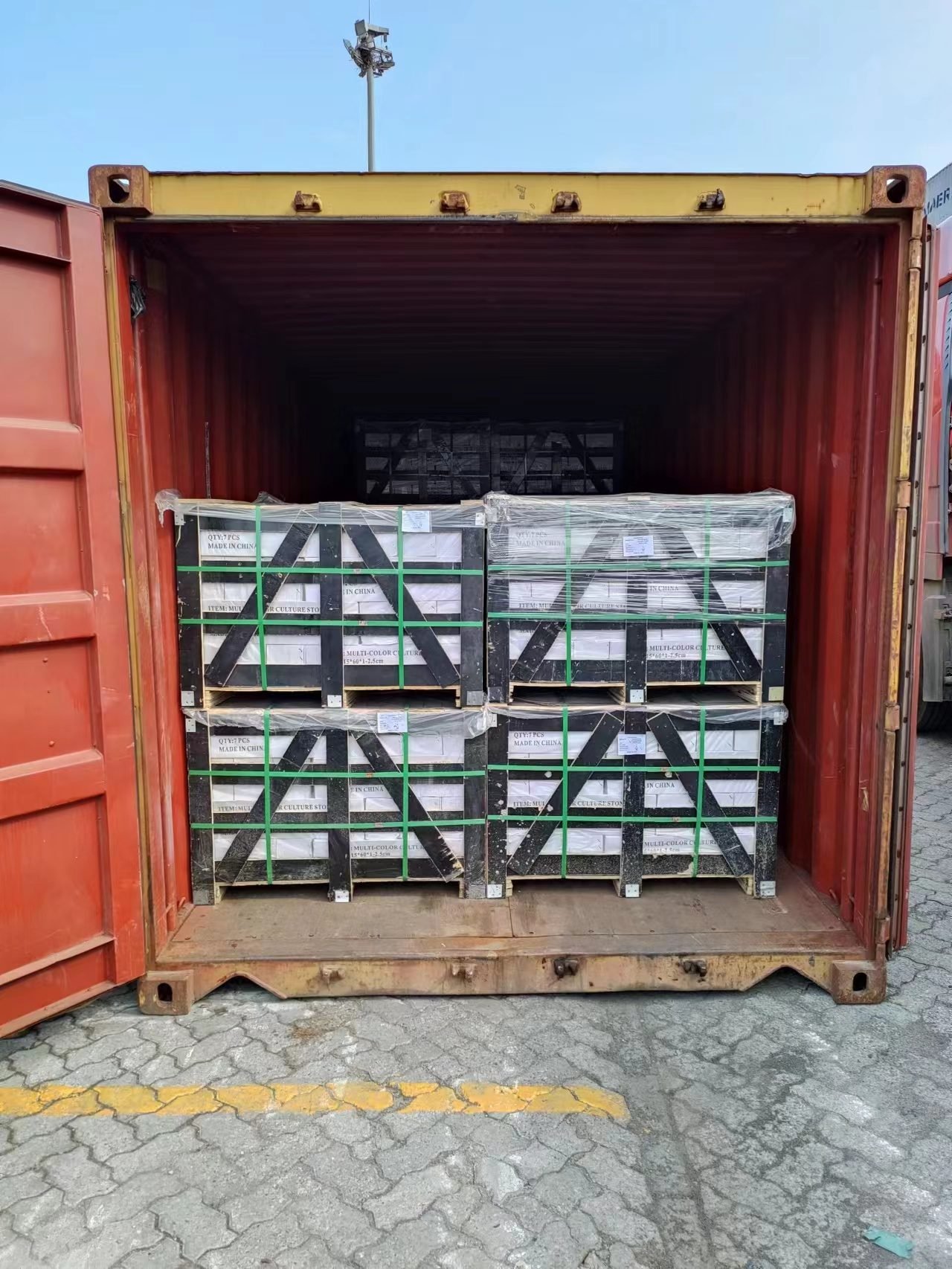
Solid wood pallets. The standard two-way or four-way entry pallet made from sawn lumber. These are the most common pallet type used in Chinese stone export, and they are the item most frequently inspected at destination ports. Every piece of solid wood in the pallet — deck boards, stringers, blocks — must be treated and marked.
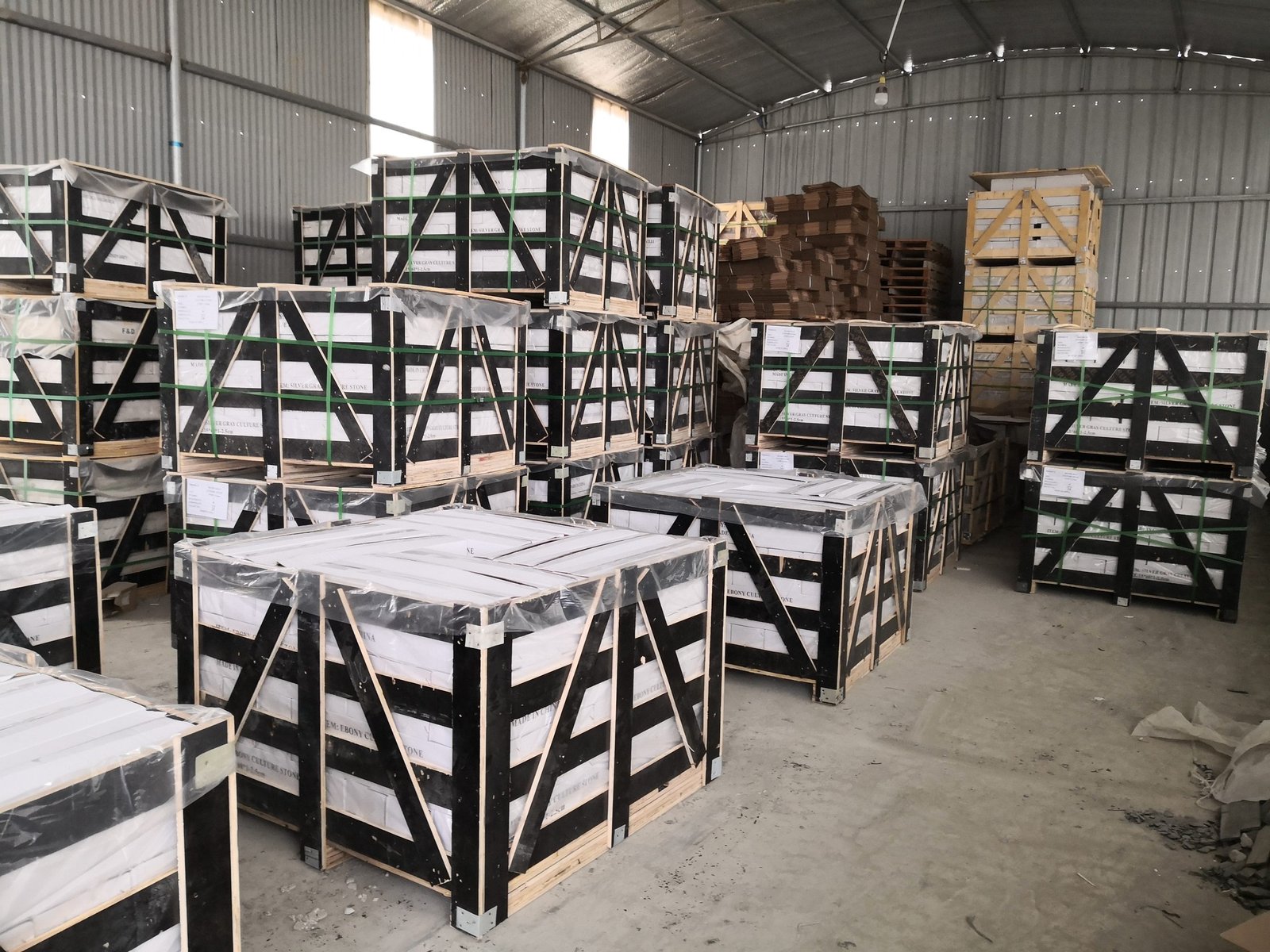
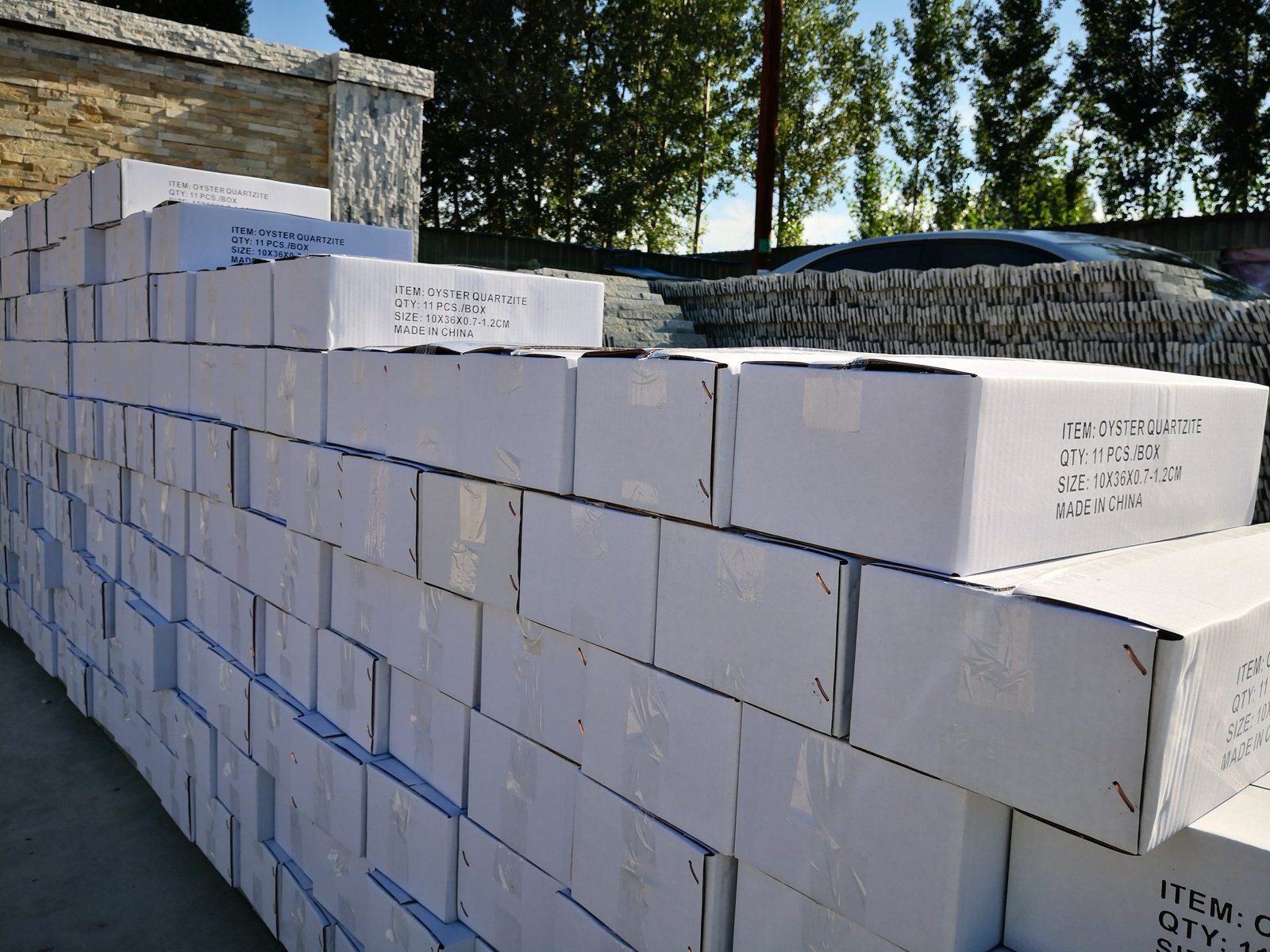
Wooden crates and boxes. Heavy-duty crates built from sawn lumber to protect stone panels during ocean freight. Top Stone Panels uses reinforced wooden crates for cement-backed stone cladding shipments, and every timber member must carry the IPPC mark. A stone panel crate typically contains 10 to 20 linear meters of solid wood, which means multiple surfaces that an inspector will check.
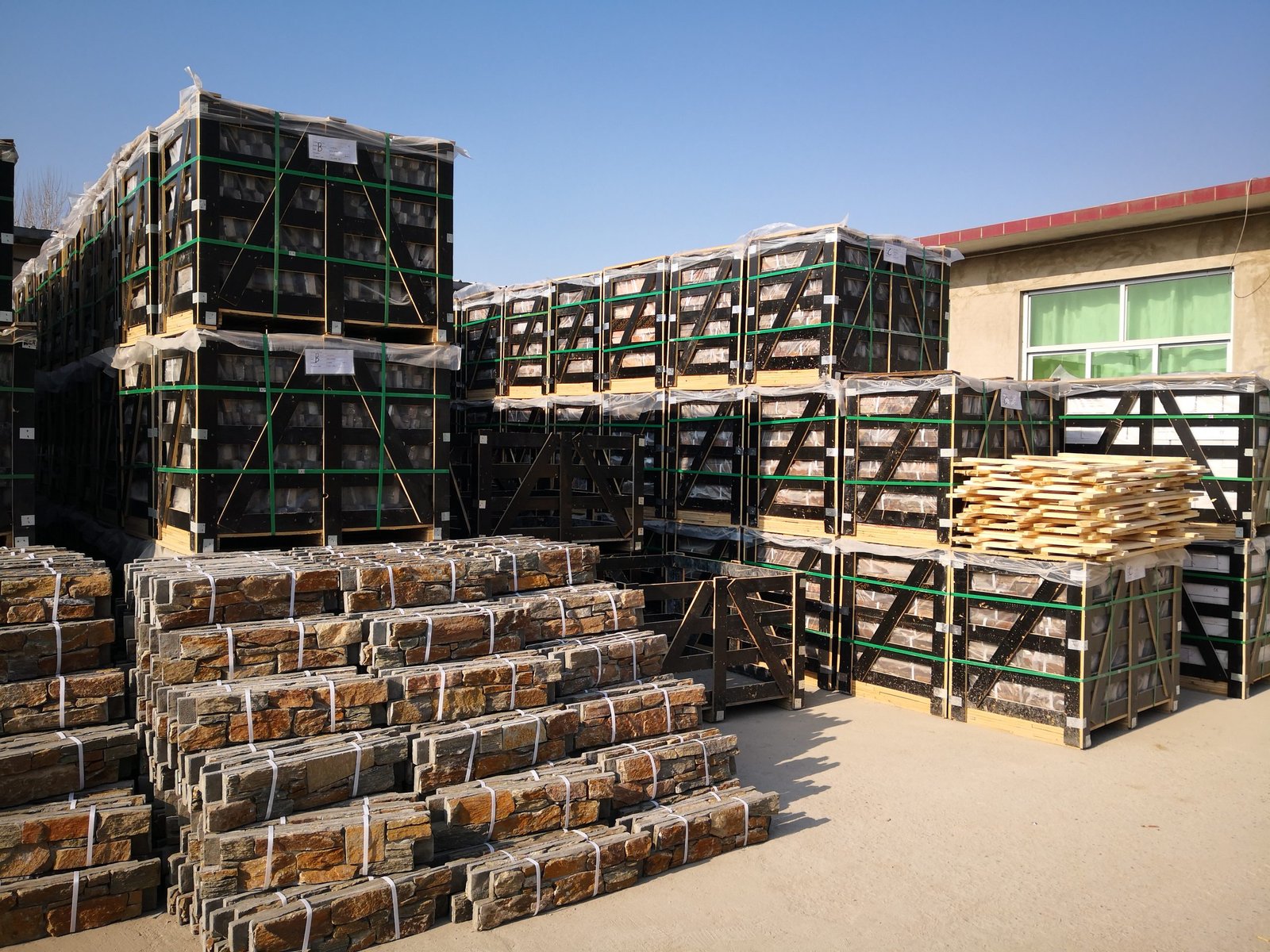
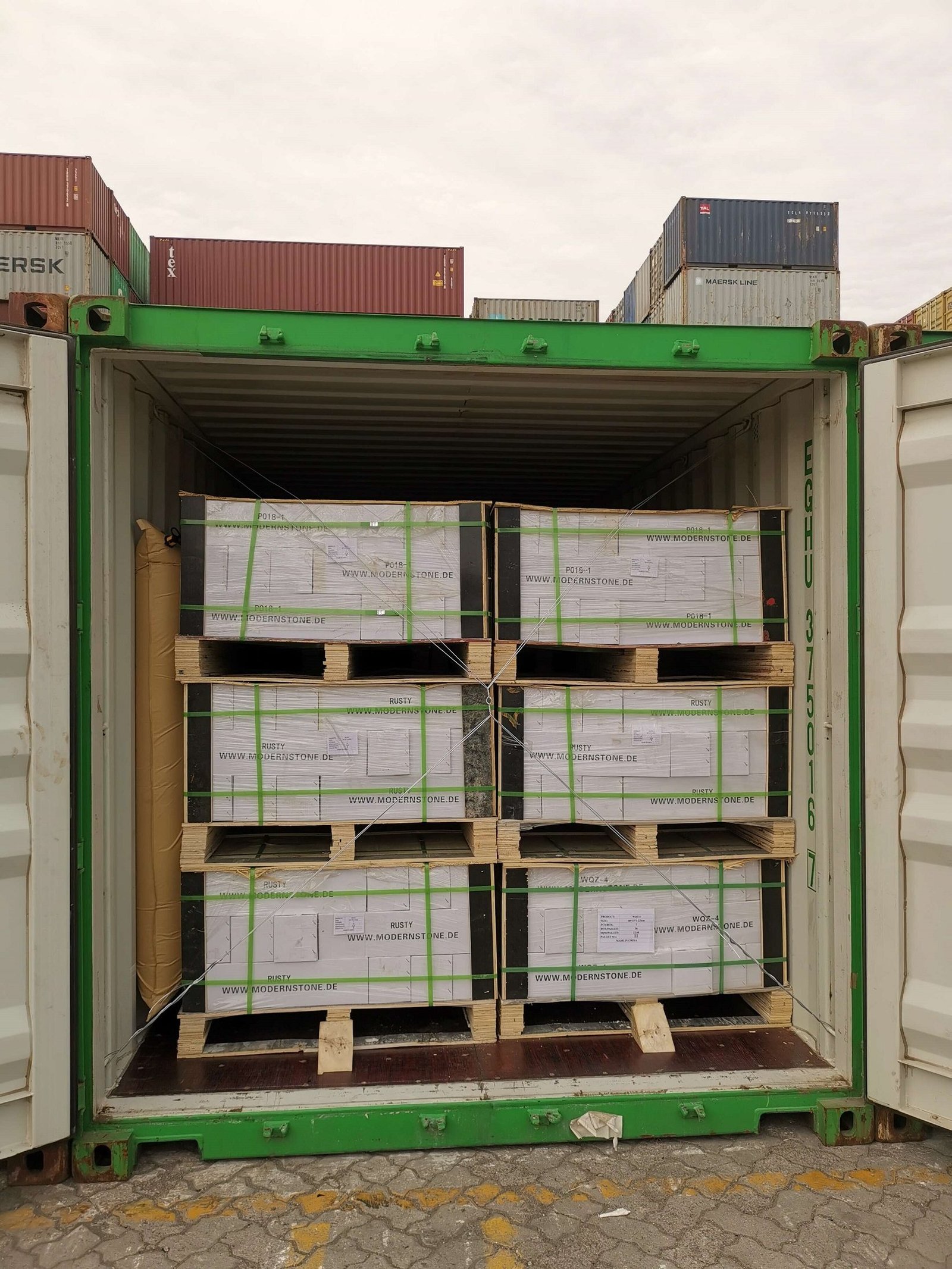
Dunnage, blocking, and bracing. The timber wedges, spacer blocks, and cross-braces used to secure pallets and crates inside a shipping container. These are often overlooked because they are installed last, inside the container, and they are sometimes made from offcuts of untreated lumber. If any piece of solid wood dunnage exceeds 6 mm in thickness and does not carry the IPPC mark, the shipment is non-compliant — even if the pallets and crates themselves are properly treated.
Items that are exempt. Plywood, oriented strand board (OSB), medium-density fiberboard (MDF), and other engineered wood products manufactured using heat, pressure, or adhesive are not regulated under ISPM 15. The manufacturing process — typically involving temperatures above 100 degrees C and resin bonding — already destroys any wood-borne organisms. This exemption is the reason many stone exporters, including Top Stone Panels, offer plywood pallets as a default option for markets where solid wood packaging triggers extra scrutiny.
The 6 mm thickness threshold means that thin veneer strips, plywood skins, and cardboard corner protectors are all outside the regulation. The rule targets wood thick enough to harbor a larva, which is the biological risk the treaty was designed to address. For a full breakdown of how stone panels are packaged for export, see our guide on container loading best practices for stone panels.
Heat Treatment vs Methyl Bromide Fumigation
ISPM 15 recognizes two approved treatment methods. Each has a distinct process, cost profile, and market acceptance.
Heat treatment (HT) requires that the core temperature of the wood reach at least 56 degrees Celsius and be maintained at that temperature for a minimum of 30 continuous minutes. The wood is loaded into a kiln or heat chamber, the temperature is ramped up, and sensors embedded in the thickest timber members confirm that the core has reached the threshold. The entire cycle typically takes four to eight hours depending on the wood species, moisture content, and cross-section thickness.
Heat treatment kills all life stages of wood-borne insects — eggs, larvae, pupae, and adults — through sustained thermal stress. It does not leave any chemical residue on or in the wood. The treated wood is safe to handle immediately, and there are no restrictions on its disposal at the destination country. For the stone exporter, heat treatment is the cleanest option: no chemical odor, no ventilation requirement, no residue that could stain the stone surface or the importer’s warehouse floor.
Methyl bromide fumigation (MB) uses a chemical gas — bromomethane — applied at a specified concentration (typically 48 g per cubic meter) for a minimum exposure period of 24 hours at a temperature above 10 degrees C. The gas penetrates the wood and kills insects at all life stages. After exposure, the wood must be aerated to allow residual gas to dissipate before it is loaded into a container.
Methyl bromide is effective and was the original treatment method when ISPM 15 was first implemented. However, it is also an ozone-depleting substance regulated under the Montreal Protocol, and an increasing number of destination countries now restrict or prohibit methyl bromide-treated packaging. The European Union banned its use for packaging treatment in 2010, with limited quarantine exemptions. Australia and New Zealand accept it but impose additional residue limits. The United States still allows it under specific quarantine protocols, but most American importers prefer heat treatment to avoid any chemical handling on their dock.
| Factor | Heat Treatment (HT) | Methyl Bromide (MB) |
|---|---|---|
| Process | 56 degrees C core for 30 minutes | 48 g/m3 gas for 24 hours at above 10 degrees C |
| Cycle time | 4 to 8 hours | 24 hours plus aeration |
| Chemical residue | None | Residual gas; requires ventilation |
| EU acceptance | Accepted (default method) | Restricted (banned for packaging since 2010) |
| US acceptance | Accepted | Accepted under quarantine protocols |
| Australia acceptance | Accepted | Accepted with residue limits |
| Relative cost | Lower per cycle | Higher (gas cost plus aeration time) |
| Preferred for stone export | Yes (default) | Only when HT facility unavailable |
For the stone exporter sourcing from China, the practical decision is straightforward: heat treatment is cheaper, faster, universally accepted, and carries no chemical risk. Any supplier that defaults to methyl bromide without a specific buyer request is either working with an outdated process or operating near a port where heat treatment kilns are not available. The full logistics of stone panel export from China, including packaging and port selection, is covered in our B2B buyer’s checklist for sourcing stone cladding from China.
Reading the IPPC Mark on a Stone Crate
The IPPC mark is the visual proof that a wood packaging item has been treated to ISPM 15 standards. It is a standardized stamp that must appear on at least two opposite sides of the treated article — on a pallet, typically on the outside face of a stringer or block; on a crate, on two opposite exterior panels.
The mark contains five elements:
The IPPC symbol. A stylized wheat stalk enclosed in a circle or oval. This is the universal identifier that the treatment was conducted under the authority of the IPPC treaty.
The ISO country code. Two letters identifying the country where the treatment was performed. For stone exports from China, this is CN.
The treatment facility number. A unique numeric code assigned to the certified treatment facility by the national plant protection organization (in China, the General Administration of Customs). This number is traceable: a customs inspector at the destination port can look it up in the IPPC database and verify which facility treated the wood.
The treatment code. Either HT (heat treatment) or MB (methyl bromide). Some facilities also stamp DB (debarked) to indicate that the wood was debarked before treatment, which is a requirement under ISPM 15 but is sometimes included explicitly for clarity.
The certifying agency mark. Some countries include an additional agency identifier or logo alongside the IPPC symbol. In China, this is typically the mark of the inspection body that audited the treatment facility.
A buyer inspecting a stone shipment on arrival should look for the stamp on the crate’s exterior panels and the pallet stringers. The stamp should be legible — not faded, not painted over, not partially obscured by a label or strap. A stamp that cannot be read is functionally the same as no stamp, and the inspector will treat it as non-compliance. For buyers who want to pre-verify before the container ships, ask the supplier for a photograph of the IPPC stamp on the assembled crates before loading. A reputable factory provides this photograph as a matter of routine — our pre-shipment inspection protocol includes IPPC mark photos alongside thickness reports and packing lists. The full pre-shipment checklist is covered in our guide on verifying a stone cladding supplier through factory audit.
The Fumigation Certificate: What It Contains
The IPPC stamp on the wood is the first layer of proof. The fumigation certificate (or heat treatment certificate) is the second — a paper or electronic document that accompanies the shipping documents and provides the detailed record of the treatment.
A valid certificate contains:
- Treatment facility name and address — matching the facility number stamped on the wood.
- Date of treatment — which must precede the date of container loading. A certificate dated after the bill of lading date is a red flag that the treatment was backdated.
- Treatment method — HT or MB, with the specific parameters: core temperature and duration for heat treatment, or gas concentration and exposure time for fumigation.
- Description of the treated articles — typically “wooden pallets,” “wooden crates,” or “solid wood packaging materials.” The description should match what is actually in the container.
- Container number and seal number — linking the certificate to the specific shipment. This is the critical cross-reference that customs inspectors use to verify that the certificate applies to the container they are examining.
- Signature and stamp of the treatment provider — and, in some jurisdictions, countersignature by the national plant protection authority.
The certificate travels with the commercial invoice, packing list, bill of lading, and certificate of origin. It should be listed on the document checklist provided to the freight forwarder and should be available to the customs broker at the destination port before the vessel arrives. In practice, a good supplier sends a scanned copy of the certificate to the buyer within 48 hours of container loading, so the buyer’s broker can pre-file the import entry with the phytosanitary document already attached.
One common confusion: the fumigation certificate is not the same as the phytosanitary certificate. A phytosanitary certificate is a government-issued document that certifies the cargo is free from regulated pests — it applies to agricultural products, not to packaging. Stone panels do not require a phytosanitary certificate. The fumigation certificate applies to the wood packaging and is issued by the treatment facility, not the government. If a buyer’s customs broker asks for a “phytosanitary certificate” for a container of stone panels, they are typically referring to the fumigation certificate by the wrong name. Clarifying this before the shipment sails prevents a last-minute scramble.
Destination Country Rules: EU, US, Australia
ISPM 15 is a global standard, but enforcement varies by country. The three largest markets for Chinese stone panels — the European Union, the United States, and Australia — all implement ISPM 15 but with different inspection intensities and penalty structures.
European Union. The EU implemented ISPM 15 through Commission Directive 2004/102/EC and subsequent amendments. All solid wood packaging entering the EU must comply. Methyl bromide-treated wood has been effectively banned since 2010, meaning only heat-treated packaging is accepted for routine imports. EU customs inspections of wood packaging are systematic at major ports (Rotterdam, Hamburg, Antwerp) and non-compliance triggers mandatory re-export or destruction of the wood packaging — with the stone cargo released only after the non-compliant wood has been separated and disposed of under supervision. Demurrage charges at EU terminals average 150 to 250 EUR per day.
United States. US Customs and Border Protection (CBP) enforces ISPM 15 under 7 CFR 319.40. Non-compliant wood packaging receives a Notice of Arrival that holds the container until the wood is separated and destroyed by a licensed pest control operator. The stone cargo is released once the wood is removed. CBP does not require re-export of the cargo itself, which is a more practical approach than the EU’s — but the hold can still add five to ten business days and 1,500 to 3,000 USD in storage and handling fees. Methyl bromide is still accepted for imports into the US, but American importers increasingly specify heat treatment in their purchase contracts.
Australia. The Department of Agriculture, Fisheries and Forestry (DAFF) enforces ISPM 15 under the Biosecurity Act 2015. Australia has some of the strictest biosecurity inspection rates in the world, and containers from China are flagged for wood packaging inspection at a high rate. Non-compliant packaging can result in the container being ordered for treatment at an approved facility (at the importer’s cost, typically 500 to 1,200 AUD), or the entire container being re-exported. Australia also has specific requirements for bark-free wood — any visible bark on solid wood packaging, even if the wood is otherwise treated, can trigger rejection.
The pattern across all three markets is consistent: compliance is cheap, non-compliance is expensive, and the cost of non-compliance always falls on the importer. For a buyer, the rational response is to make ISPM 15 compliance a contractual requirement in the purchase order and to verify the IPPC stamp photograph before the container sails. The cost dynamics of stone panel importing, including how packaging compliance fits into the total landed cost, are covered in our guide on natural stone cladding cost breakdown.
Common Failures and How to Prevent Them
In eighteen years of exporting stone panels from China, the failures that cause ISPM 15 non-compliance fall into a small number of predictable categories.
Faded or missing IPPC stamps. The stamp is applied at the treatment facility, but if the wood sits in outdoor storage for weeks before being assembled into a crate, weathering can fade the ink. The solution is to stamp the wood after it is cut and assembled into the final crate — not before. Top Stone Panels stamps crates on the assembly line immediately before loading, so the mark is fresh and legible when the container is sealed.
Untreated dunnage. The pallets and crates are properly treated, but the wedge blocks and spacer sticks used to secure the load inside the container are made from untreated offcuts. This is the most common failure in stone exports because the dunnage is added at the last minute, often from a scrap pile near the loading bay. The fix is procedural: all dunnage wood must come from the same treated stock as the crates, or the factory must switch to ISPM 15 exempt plywood or plastic dunnage blocks.
Wrong treatment method for the destination. A supplier fumigates with methyl bromide for a shipment bound for the EU, where MB-treated wood is effectively banned. The container arrives, the inspector reads “MB” on the stamp, and the wood is non-compliant regardless of whether the treatment itself was effective. This failure is preventable with a simple check: confirm the destination country’s treatment requirements before the container is loaded, and specify the required treatment code in the purchase contract.
Expired or mismatched certificates. The fumigation certificate date does not match the bill of lading date, or the container number on the certificate does not match the actual container. This is usually a paperwork error — the treatment provider issued the certificate for one container and the freight forwarder assigned the cargo to a different container number at the last minute. The fix is a verification step: the supplier must confirm that the container number on the fumigation certificate matches the container number on the booking confirmation before the documents are sent to the buyer.
Bark on treated wood. ISPM 15 requires that wood be debarked before treatment, with limited exceptions for small bark remnants (less than 3 cm in width, or less than 50 square centimeters in total area). Visible bark on a crate is a rejection trigger in Australia and the EU, even if the underlying wood is properly treated. A quality treatment facility removes all bark during the milling stage, and the receiving inspector at the factory should reject any timber that arrives with bark attached.
How Top Stone Panels Handles ISPM 15
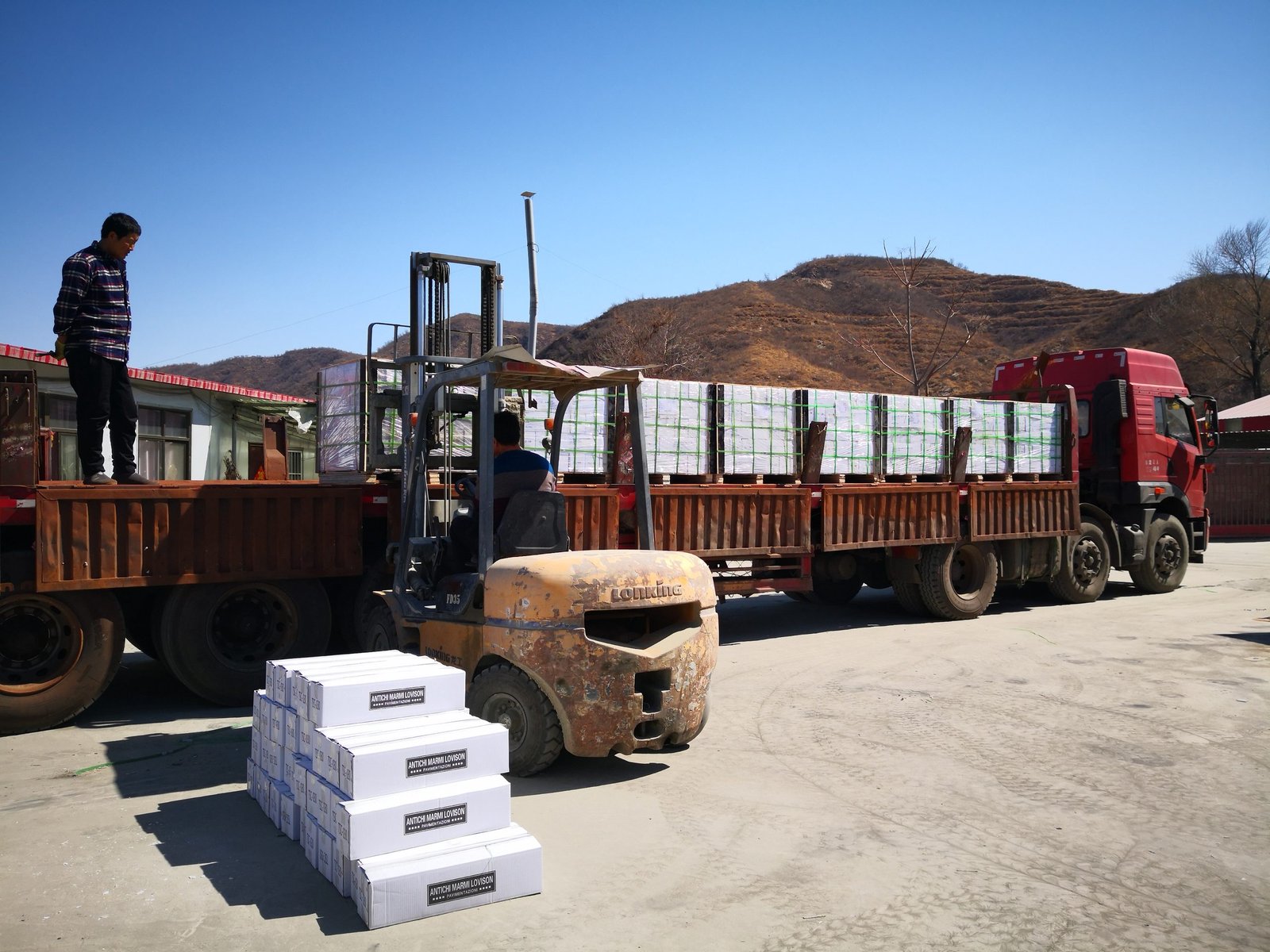
At Top Stone Panels, ISPM 15 compliance is built into the production and shipping workflow rather than treated as an afterthought. The factory exports over 220 containers per year from Xingang (Tianjin) port, and the compliance record across 18 years of operation includes zero destination-port rejections for wood packaging non-compliance.
The workflow operates as follows:
Pallet selection. For the majority of export shipments, Top Stone Panels uses plywood pallets — which are ISPM 15 exempt — as the primary load-bearing platform. This eliminates the treatment requirement for the pallet itself. Where solid wood pallets are specified by the buyer (typically for heavy-load applications exceeding 26 tons), the factory sources pallets from a certified heat treatment facility in the Tianjin port area, and each pallet arrives at the factory with the IPPC mark already stamped.
Crate construction. Solid wood crates used for cement-backed stone panels are constructed from heat-treated lumber sourced from the same certified supplier. The IPPC stamp is applied to each crate panel during assembly. The factory maintains a stock of pre-treated timber so that crate construction does not depend on last-minute treatment scheduling.
Dunnage protocol. All dunnage — blocking, wedges, bracing — is cut from the same treated timber stock as the crates, or the factory uses engineered wood (plywood blocks) and plastic dunnage for ISPM 15 exemption. No offcuts from untreated sources are permitted on the loading bay.
Certificate issuance. The heat treatment certificate is issued by the certified facility and collected by the factory logistics team on the same day as container loading. A scanned copy is sent to the buyer within 48 hours. The original certificate is included in the shipping document set provided to the freight forwarder. The certificate references the specific container number, seal number, and treatment date — all cross-referenced against the bill of lading before the documents are released.
Pre-shipment documentation. Every container of stone panels ships with a complete document set: commercial invoice, packing list, bill of lading, certificate of origin (Form A or general COO depending on destination), heat treatment or fumigation certificate, and a pre-shipment inspection report that includes photographs of the IPPC marks on the assembled crates. The full document checklist is part of the purchase specification template we provide to B2B buyers — covered in our guide on writing a stone cladding purchase specification.
Frequently Asked Questions
What is ISPM 15 and why does it matter for stone exports?
ISPM 15 is a global regulation that requires all solid wood packaging materials — pallets, crates, dunnage — thicker than 6 mm to be heat-treated or fumigated and stamped with an IPPC mark before crossing international borders. Stone panels ship on wooden pallets and in wooden crates, so every container of stone cladding exported from China must comply or risk rejection, re-export, or costly delays at the destination port.
Does ISPM 15 apply to the stone itself or just the packaging?
ISPM 15 applies only to solid wood packaging materials — not to the stone panels, thin veneer, or flagstone themselves. Natural stone is not a regulated commodity under the treaty. However, because the stone is physically inside the regulated packaging, a non-compliant pallet or crate can hold the entire shipment at the destination port until the wood is separated and disposed of.
What is the difference between heat treatment and methyl bromide fumigation?
Heat treatment (HT) brings the wood core to 56 degrees Celsius for 30 minutes and leaves no chemical residue. Methyl bromide (MB) fumigation uses a chemical gas for 24 hours and requires aeration before the wood is safe to handle. The EU has banned MB-treated packaging since 2010; most other markets prefer HT. For stone exports, heat treatment is the default and recommended method.
Do plywood pallets need ISPM 15 treatment?
No. Plywood, OSB, MDF, and other engineered wood products are exempt from ISPM 15 because the manufacturing process (heat, pressure, and adhesive bonding) already destroys any wood-borne pests. Many stone exporters default to plywood pallets to eliminate the treatment requirement entirely.
What happens if a stone shipment arrives without ISPM 15 compliance?
The destination port authority can order re-export, destruction, or on-site treatment of the wood packaging — all at the importer’s cost. Demurrage charges typically run 100 to 300 USD per day during the hold, and the delay can add 1,000 to 3,000 USD to a container’s landed cost before the stone panels are released.
How does Top Stone Panels ensure ISPM 15 compliance?
The factory uses ISPM 15 exempt plywood pallets as the default, heat-treated solid wood crates stamped with the IPPC mark where solid wood is required, and a strict dunnage protocol that prevents untreated wood from entering the container. A heat treatment certificate referencing the specific container number is issued on the day of loading and sent to the buyer within 48 hours. In 18 years of operation, the factory has had zero destination-port rejections for wood packaging non-compliance.
For further reading on stone export logistics, see our guides on understanding Incoterms for stone exports, lead time and production scheduling, and MOQ and container mix planning. Contact the Top Stone Panels export team for a quotation with full ISPM 15 documentation included.
Paperwork and wood packaging are one half of a smooth arrival; the other half is the customs clearance guide for stone imports.