For building material distributors, general contractors, and landscape architects evaluating cladding options in 2026, thin veneer is no longer an “alternative.” It is increasingly the default specification for feature walls, commercial facades, fireplace surrounds, and exterior accent work. The shift is driven by three forces: stricter energy codes that penalize excessive dead load, rising labor costs that make lightweight panels more attractive, and manufacturing advances—CNC diamond-blade cutting, infrared sorting, marine-grade epoxy bonding—that have closed the quality gap between thin and full-thickness products.
This guide breaks down what thin veneer actually is, how it compares to full-thickness stone on every metric that matters, where it performs best, and what B2B buyers need to know before sourcing a container.

What Is Natural Thin Stone Veneer?
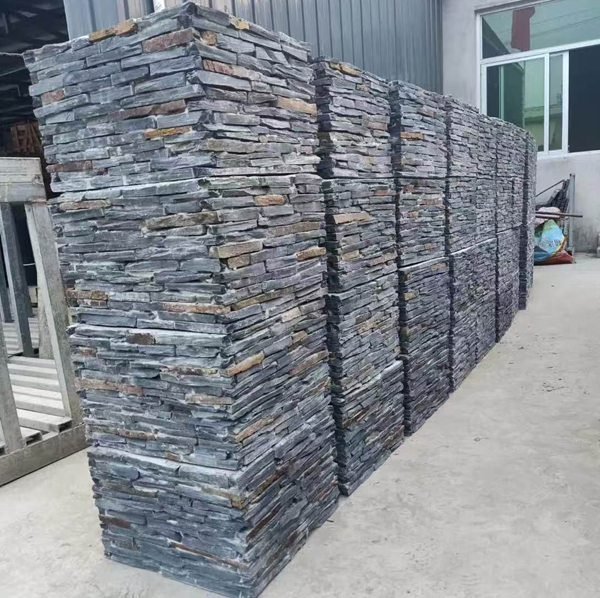
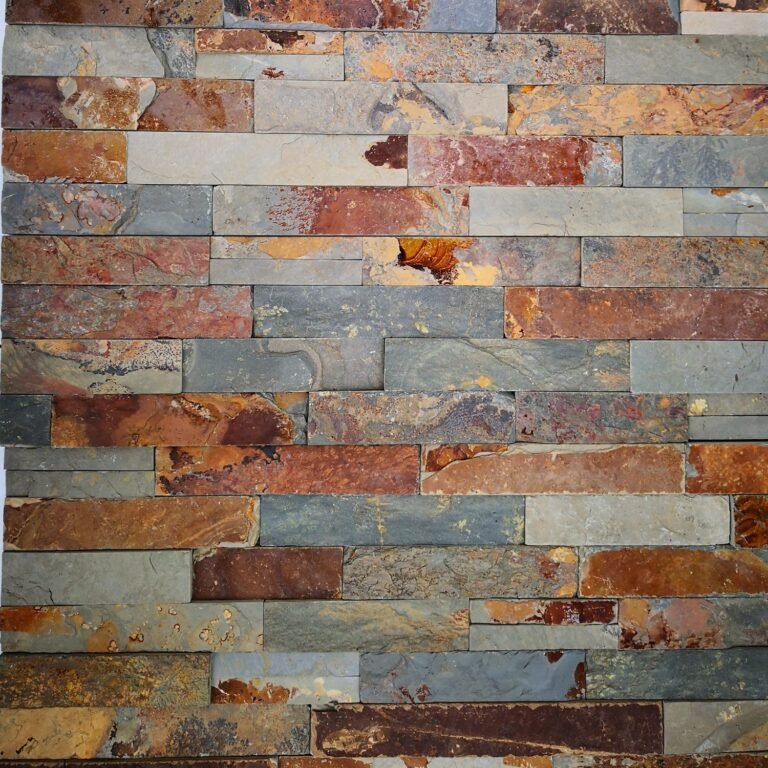
Thin stone veneer is real stone—quarried, not manufactured—sliced to a reduced thickness of 10 mm to 20 mm. Unlike cultured stone, reconstituted stone, or concrete-based replicas, thin veneer retains the mineral composition, color variation, and split-face texture of the original geological formation. The “thin” refers to the profile, not the material.
At Top Stone Panels’ thin stone veneer line, the raw material comes from the company’s own quarry in Yixian, Hebei province, one of China’s most established slate and quartzite regions. Blocks are selected for color consistency, then sliced using infrared-guided CNC diamond blades that maintain uniform thickness across every panel. A same-vein color selection process ensures that panels from a single production batch share the same geological stratum, eliminating the tonal jumps that plague multi-source stone orders.
Thin veneer comes in several standard formats:
- Random strip stone — irregular widths that create an organic, dry-stack appearance. This is the most popular format for large commercial facades where a natural, non-modular look is desired.
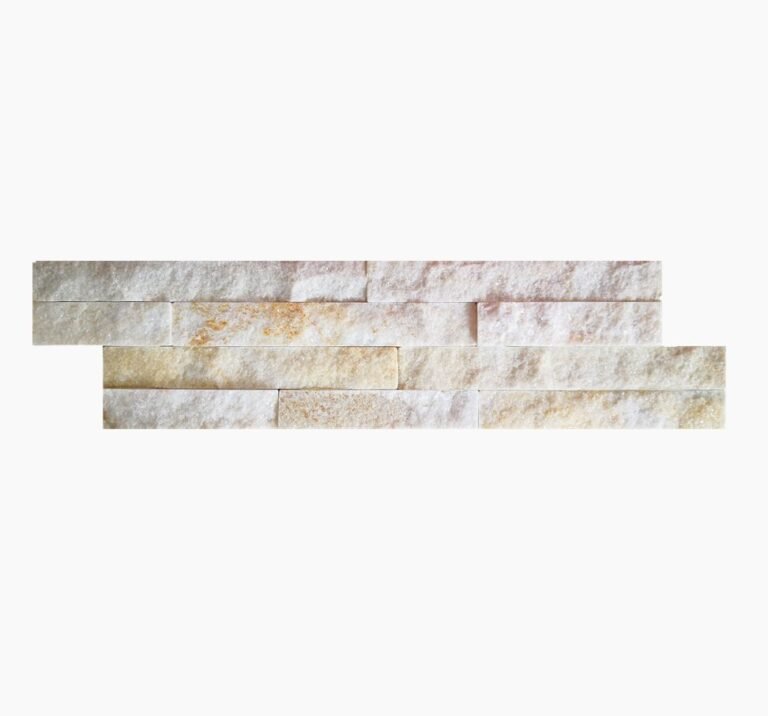
- Thin ledgestone panels — standardized at 36×10 cm, these ultra-compact units install quickly on curved surfaces, columns, and tight architectural details. See the full thin ledgestone product range.
- Stacked stone panels — typically 15×60 cm or 15×55 cm, available with matching L-corner pieces for clean external returns. Browse the stacked stone collection.
Backing options include marine-grade epoxy bond, cement backing, and fiberglass mesh. The choice of backing affects both the adhesive method on-site and the panel’s flexural strength during transport. For a more detailed breakdown of how thin veneer is produced, the article Thin Stone Veneer Explained covers the full manufacturing chain.
Thin Veneer vs. Full-Thickness Stone: A Side-by-Side Comparison
The decision between thin veneer and full-thickness stone comes down to five variables: weight, structural load, installation speed, material cost, and design flexibility. The table below compares the two across the specifications that B2B buyers evaluate most frequently.
| Specification | Natural Thin Stone Veneer | Full-Thickness Stone |
|---|---|---|
| Thickness | 10–20 mm | 75–150 mm |
| Weight (per m²) | 25–45 kg | 120–200 kg |
| Structural support needed | Standard wall framing; no additional footings | Reinforced footings, lintels, shelf angles |
| Installation method | Adhered (epoxy, thinset, or mechanical clip) | Mortar bed + mechanical ties |
| Installation speed | 8–15 m² per mason per day | 2–5 m² per mason per day |
| Labor cost (relative) | 40–60% lower | Baseline |
| Shipping cost (per m²) | 60–75% lower (more m² per container) | Baseline |
| Fire rating | A1 non-combustible | A1 non-combustible |
| Freeze-thaw resistance | -30°C to +50°C (tested) | -30°C to +50°C (tested) |
| Design flexibility | Curves, columns, soffits, interiors | Flat walls, limited to vertical surfaces |
| Material authenticity | 100% natural stone | 100% natural stone |
Two rows in that table deserve emphasis. First, installation speed. A skilled mason can install 8 to 15 square meters of thin veneer per day, compared to 2 to 5 square meters for full-thickness work. On a 500 m² commercial facade, that translates to a 3-to-4-week schedule reduction—and in North American markets where mason day-rates run $400–$600, that time savings alone can exceed $30,000 on a single project.
Second, shipping density. A 20-foot container holds roughly 25 tonnes. At 30 kg/m², thin veneer yields approximately 800 m² per container. Full-thickness stone at 150 kg/m² yields roughly 160 m². That is a five-fold difference in coverage per shipment, which has a direct, compounding effect on landed cost for distributors importing from China. For a deeper analysis, see our earlier comparison of thin veneer stone vs full-thickness stone.

How Thin Stone Veneer Is Made: From Quarry to Panel
Manufacturing thin stone veneer well is harder than it looks. The challenge is not simply cutting stone thin—it is cutting stone thin while maintaining structural integrity, consistent thickness, and geological color matching across an entire production run. Top Stone Panels’ process addresses each of these constraints through a three-stage workflow.
Stage 1: Raw Material Selection
Blocks arrive from the Yixian quarry and are graded by color family, mineral composition, and structural soundness. Blocks with visible fracture lines, clay seams, or excessive iron oxidation are diverted to flagstone or aggregate production. Only the top-grade material—dense, well-cleaved slate and quartzite with consistent mineral banding—enters the thin veneer line. This first gate eliminates the single biggest cause of field complaints: panels that delaminate or discolor after installation.
Stage 2: Infrared CNC Diamond Blade Cutting
Selected blocks are mounted on an infrared-guided CNC saw. The infrared sensor reads the block’s surface profile in real time and adjusts blade depth to maintain a target thickness tolerance of ±1 mm. Diamond blades produce a clean kerf with minimal micro-fracturing, which is critical at 10–15 mm thicknesses where a single hairline crack can render a panel unusable. After cutting, each panel is hand-inspected for edge chips and surface defects.
Stage 3: Backing Application and Batch Sorting
Depending on the product specification, panels receive one of three backing treatments: marine-grade epoxy bond for maximum adhesion strength, cementitious backing for compatibility with standard thinset mortars, or fiberglass mesh for lightweight applications. Panels are then sorted by vein and color into production batches. This same-vein selection process means that every panel in a given shipment originates from the same geological layer, ensuring visual continuity across a project’s entire facade.
The facility’s stone veneer thickness guide explains how different thickness targets serve different applications—from 10 mm interior accent panels to 20 mm exterior cladding rated for harsh freeze-thaw cycles.

Applications That Drive Demand: Where Thin Veneer Wins
Thin veneer is not a replacement for full-thickness stone in every application. Retaining walls, paving, and heavy-duty commercial flooring still require the mass and compressive strength of full-depth stone. But for the majority of vertical cladding applications—interior and exterior—thin veneer now holds a clear advantage. Here are the four use cases driving the strongest demand growth in 2026.
Commercial Feature Walls and Lobby Cladding
Hotels, corporate headquarters, and retail flagship stores increasingly specify natural stone feature walls as a brand-defining element. Thin veneer allows designers to clad walls up to 12 meters high without intermediate shelf angles or structural ledges. The reduced weight means standard steel-stud framing is sufficient, eliminating the cost of reinforced concrete backup walls. Linear and random strip formats are the most specified patterns for these applications.
Exterior Facade Accents
Full building envelopes in thin stone veneer are possible, but the more common specification is accent cladding—building bases, entry surrounds, elevator lobbies, and podium-level facades. These applications benefit from thin veneer’s compatibility with rainscreen systems and exterior insulation finishes. The material’s exterior wall specification profile covers wind-load ratings, moisture management, and substrate preparation requirements in detail.
Fireplace Surrounds and Chimney Cladding
Fireplace applications are a natural fit. The A1 fire rating means thin veneer meets the most stringent non-combustibility standards, and the reduced weight simplifies installation on prefabricated fireplace units and chase walls. For chimney exteriors, thin veneer eliminates the need for a brick ledge at the foundation level—a significant structural saving in residential construction.
Landscape Architecture and Hardscape Accents
Landscape architects use thin veneer to clad planter walls, pool house exteriors, outdoor kitchen surrounds, and garden privacy screens. The material’s freeze-thaw resistance (rated for -30°C to +50°C) makes it suitable for northern climates where temperature cycling destroys lesser materials. Salt spray resistance adds another layer of durability for coastal projects.

Durability Specs That Matter: Freeze-Thaw, Fire, and UV Resistance
Distributors evaluating a new stone veneer supplier need to look past aesthetics and verify the engineering specifications that determine long-term field performance. Three properties matter most.
Freeze-Thaw Durability
Natural stone cladding in northern climates is subjected to hundreds of freeze-thaw cycles per year. Water penetrates the stone’s pore structure; when it freezes, it expands by roughly 9%. If the stone’s internal tensile strength is insufficient, micro-cracks propagate, leading to spalling, delamination, and eventual failure. Top Stone Panels’ thin stone veneer is tested across a -30°C to +50°C range and demonstrates no measurable degradation after standard cyclic testing. The key factor here is raw material quality: dense, low-porosity slate and quartzite from the Yixian formation have absorption rates well below the thresholds where freeze-thaw damage becomes a concern.
Fire Rating
All thin veneer products from Top Stone Panels carry an A1 fire classification—the highest rating in the European EN 13501-1 system and equivalent to non-combustible status under North American building codes. This rating applies to the stone itself, the backing material, and the complete assembled panel. For B2B buyers supplying projects in jurisdictions with strict fire codes—California’s WUI zones, European high-rise regulations, Middle Eastern commercial standards—the A1 rating removes a significant compliance hurdle.
UV Stability and Salt Spray Resistance
Natural stone is inherently UV stable. Unlike manufactured veneers that rely on surface pigments and sealants, the color in thin stone veneer runs through the full thickness of the material. There is nothing to fade, chalk, or peel. Salt spray resistance is equally important for coastal projects in Florida, the Mediterranean, the Gulf states, and Australian seaboard markets. Quartzite and slate, in particular, show negligible reaction to salt exposure over decades of service.
For a comprehensive overview of how these durability metrics are tested and certified, the freeze-thaw resistance guide provides lab-testing methodology and field-performance data across multiple stone types.
Installation Economics: Why Contractors Are Switching to Thin Veneer
For general contractors, the labor equation often decides the cladding specification. Thin veneer offers structural advantages on paper, but the real-world economics of the installation phase are what drive adoption on active job sites.
No structural modification required. Full-thickness stone cladding at 120–200 kg/m² typically requires a reinforced concrete or steel backup wall, shelf angles at every floor level, and engineered footings at the foundation. Thin veneer at 25–45 kg/m² adheres directly to standard substrates—concrete masonry units, cement board, or properly prepared drywall—using thinset mortar or construction adhesive. On a typical 400 m² commercial project, eliminating structural reinforcement saves $15,000–$40,000 in steel and concrete work before a single stone panel is installed.
Faster crew deployment. Thin veneer installation does not require a specialized stone mason. A competent tile setter or general carpenter with basic adhesive-application skills can achieve professional results, especially with pre-assembled panel formats like stacked stone and thin ledgestone. In markets where skilled masons are scarce—and in 2026, the masonry labor shortage remains acute across North America and Western Europe—this accessibility is a significant scheduling advantage.
Reduced waste and breakage. Thinner panels are lighter and easier to handle on-site. Cutting waste is lower because panels can be scored and snapped or cut with a standard wet saw rather than a bridge saw. Top Stone Panels’ packaging protocol—3-to-5 layer corrugated cartons on fumigation-free pallets with 4–6 steel bands and airbag filling—arrives on-site with breakage rates consistently below 2%, compared to the 5–8% industry average for poorly packaged stone shipments.

Sourcing Natural Thin Stone Veneer at Scale: What Distributors Need to Know
For B2B buyers—distributors stocking stone yards, procurement managers for cladding contractors, or specifiers writing project documentation—sourcing thin veneer from China involves a specific set of considerations that differ from buying full-thickness stone or manufactured alternatives.
Capacity and Lead Time
Top Stone Panels produces 40,000 m² of thin stone veneer per month and 60,000 m² of thin ledgestone panels. Standard lead time is 20 to 25 working days after deposit confirmation. First orders require 25 to 30 working days due to the initial color-matching and vein-selection process. For distributors planning seasonal inventory—spring stocking for the North American building season, for example—ordering 60–90 days in advance is the standard recommendation.
Minimum Order and Container Optimization
The minimum order quantity is one 20GP container. At approximately 800 m² per container (depending on panel format and thickness), a single container provides enough material for 3 to 5 mid-size commercial projects or 10 to 15 residential feature-wall installations. The MOQ is designed to be accessible for regional distributors who may not have the volume to justify full-container loads of heavier stone products.
Quality Control: The Three-Step Process
Every production run passes through a three-step quality control protocol:
- Raw material selection — blocks are graded for color consistency, density, and freedom from structural defects before cutting.
- In-process recheck — during production, random panels are pulled from the line and measured for thickness tolerance (±1 mm), edge quality, and surface integrity.
- Pre-shipment final inspection — before container loading, a statistically sampled inspection verifies color matching, backing adhesion, panel dimensions, and packaging integrity.
This QC protocol is documented with photographic records available to buyers on request. For distributors evaluating stone veneer suppliers across multiple product categories, the article on six types of stone veneer panels distributors should stock provides a useful framework for comparing thin veneer, stacked stone, ledgestone, and other formats within a single sourcing strategy.
Payment and Logistics
Standard payment terms are 30% T/T deposit at order confirmation, with the remaining 70% due before shipment. Containers are loaded at the Xingang/Tianjin port facility. The flagstone and columns product lines ship from the same port, allowing buyers to consolidate multiple product categories into a single container when volume permits.

How to Evaluate a Thin Stone Veneer Supplier: Five Questions to Ask
Not all thin veneer is created equal. The market includes products that look similar in a sample board but diverge sharply in field performance. Before placing a container order, B2B buyers should verify the following with any prospective supplier.
- Do they own or control the quarry? Quarry ownership ensures raw material consistency and protects against the supply disruptions that plague traders sourcing from multiple third-party quarries. Top Stone Panels has operated its own Yixian quarry for over 18 years.
- What is their batch-matching process? Color variation between batches is the number-one complaint in natural stone cladding. A reliable supplier should be able to explain how they match panels to the same geological vein within a single production run.
- What backing system do they use? The backing material determines both adhesion performance and panel durability during transit. Marine-grade epoxy, cementitious, and mesh backing each serve different installation scenarios—your supplier should be able to recommend the correct option for your market.
- What are their freeze-thaw test results? Request documented test data, not marketing claims. The relevant standard is a cyclic freeze-thaw test across the full operating temperature range (-30°C to +50°C for most northern markets).
- What does their packaging protocol include? Stone breakage during ocean freight is a margin killer. Look for multi-layer corrugated cartons, steel-banded pallets, and container airbag filling as baseline standards.
Frequently Asked Questions
What is the typical thickness of natural thin stone veneer?
Thin stone veneer typically ranges from 10 mm to 20 mm in thickness, depending on the stone type and panel format. Top Stone Panels produces thin veneer in random strip formats, standardized sizes like 36×10 cm for ledgestone, and 15×60 cm for stacked stone. This is substantially thinner than full-thickness stone, which runs 75 mm to 150 mm. See the stone veneer thickness guide for a complete breakdown by product type.
Can thin stone veneer be used on exterior walls in cold climates?
Yes. High-quality thin veneer is tested for freeze-thaw durability and withstands temperatures from -30°C to +50°C. When installed with marine-grade epoxy adhesive and proper cement or mesh backing, thin veneer maintains structural integrity through hundreds of freeze-thaw cycles. This makes it suitable for projects across Canada, Scandinavia, the northern United States, and other cold-climate markets.
What is the minimum order quantity for thin stone veneer from China?
The standard MOQ is one 20GP container, which holds approximately 800 m² of thin stone veneer depending on the panel format. Samples are available within 1–3 days for evaluation before committing to a production order.
How long does production take for a container of thin stone veneer?
Standard production lead time is 20–25 working days after deposit confirmation. First orders may require 25–30 working days due to initial color matching and batch setup. Monthly production capacity is 40,000 m² for thin stone veneer and 60,000 m² for thin ledgestone panels.
Is thin stone veneer suitable for fireplaces and high-heat areas?
Yes. Top Stone Panels’ thin stone veneer carries an A1 fire rating—the highest non-combustibility classification. This makes it fully suitable for fireplace surrounds, chimney cladding, pizza oven exteriors, and other high-temperature applications in residential and commercial settings.
The Bottom Line for 2026
Natural thin stone veneer has moved past the “emerging product” phase. With 18+ years of quarry-to-panel experience, infrared CNC cutting precision, and documented durability testing across freeze-thaw, fire, and UV exposure, thin veneer from established manufacturers like Top Stone Panels now matches full-thickness stone on performance while outperforming it on cost, weight, and installation speed.
For distributors building their 2026 stone cladding inventory, the product line worth evaluating first includes thin stone veneer, thin ledgestone, and stacked stone panels—the three formats with the broadest cross-market demand and the strongest margins for stocking dealers.
Ready to evaluate thin stone veneer for your next project or inventory order? Request samples (shipped within 1–3 days) or discuss container pricing by visiting topstonepanels.com. MOQ: 1×20GP. Port: Xingang/Tianjin. Lead time: 20–25 working days.