A stone veneer panel is not a slab of rock. It is an assembly, and nearly every question a distributor or contractor has about one, from dead load on the substrate to whether vertical joints stay hidden across a commercial facade, is answered by what sits behind the visible stone.
This page takes that assembly apart: stone face, bond layer, backing carrier, interlock geometry on Z-panels, and the pre-made corner units that close the edges. For each it covers what the layer does structurally, which product lines use it, and what it changes about install method, weight, thermal behaviour and freight.
- Every factory panel is a three-part assembly at minimum: stone face, bond layer, backing carrier. Interlocking formats add a fourth element, the male-female edge profile.
- Backing is the deciding layer. Cement is rigid and flat; mesh-back is flexible and loads more coverage per container; an epoxy-bonded assembly unitises the pieces with no separate board.
- Faces are 100 percent natural slate and quartzite, split or sawn, with batch-specific quarry vein selection held to at least 95 percent colour harmony.
- Marine-grade epoxy bonds are rated for 26.5-ton heavy-load sea freight and cycling from -30C to +50C, an 80C span, with zero pop-off.
- Pre-made L-corners remove field 45 degree miter cutting, worth about 20 percent less material waste and more than 50 percent less on-site labour.
- Construction sets freight: a 36x10cm mini ledgestone unit covers 0.036 square metres against 0.09 for a 15x60cm ledger panel.
- What a Stone Veneer Panel Is
- The Layer Stack From Face Outward
- Layer One: The Natural Stone Face
- Layer Two: The Bond Layer
- Layer Three: The Backing Carrier
- Layer Four: Interlock Geometry on Z Panels
- Edges, Corners, and Pre-Made Corner Units
- Which Product Line Uses Which Construction
- How Construction Drives Weight and Freight
- Specifying a Panel Construction Correctly
- Frequently Asked Questions
- Conclusion
What a Stone Veneer Panel Is
A stone veneer panel is a non-structural skin. It carries no load from the building above it and depends entirely on the substrate and the fixing behind it. That is what separates it from full-thickness masonry, where the stone is the wall, and it is why the layers behind the face matter more than the face itself.
The word “panel” hides three different constructions. A glued ledger unit, a cement-backed interlocking module and a mesh-backed mosaic all arrive in cartons on a pallet and all look alike in a photograph, but they behave differently on a wall, in a truck and through a freeze-thaw winter. Comparing quotes without comparing constructions means comparing three products at three price points.
Terminology also matters in a submittal. In North American standards language an adhered manufactured stone masonry veneer unit is a cast product governed by ASTM C1670/C1670M, while a natural stone veneer is quarried rock, split or sawn, fixed to a carrier. The two are not interchangeable. Top Stone Panels ships the second kind only: 100 percent natural slate and quartzite, exported under HS code 6803.00.90 for slate and 6802.93.11 for quartzite.
The Layer Stack From Face Outward
Read the panel from the outside in and the stack is short. The visible stone is the face. Behind it sits a bond layer, either a marine-grade epoxy or a cementitious bed. Behind that sits the carrier: a cement board, a fibreglass mesh skin, or nothing at all in an epoxy-bonded assembly where the pieces lock each other. On interlocking formats the perimeter is cut into a male-female profile so neighbours mate instead of butting, and at every change of direction a pre-made corner unit replaces a field cut.
| Layer | What it is | What it decides |
|---|---|---|
| 1. Stone face | Slate or quartzite, split or sawn | Appearance, density, absorption, thickness tolerance |
| 2. Bond layer | Marine-grade epoxy or cementitious bed | Pop-off resistance, thermal cycling, freight survival |
| 3. Backing carrier | Cement board, mesh skin, or bonded assembly | Rigidity, weight, curve capability, site adhesive |
| 4. Edge geometry | Z, S or puzzle male-female profile | Joint visibility, alignment speed, lateral stability |
| 5. Corner unit | Pre-made L-shaped return piece | Waste, on-site labour, corner appearance |
Bond and backing travel together in most specification conversations, because the carrier dictates which bond is used and which site adhesive will hold the panel to the wall. Treating them as one decision rather than two is what produces a panel that cannot be installed on the substrate the project actually has.
Layer One: The Natural Stone Face
Two rock types carry this range. Slate splits along a defined bedding plane, which produces a riven, naturally textured face. Quartzite is denser and harder, holds a sharper arris when sawn, and carries the mineral movement that high-end residential and hospitality projects specify. How the face is made changes everything downstream: a split face varies in thickness piece to piece and no two in a carton repeat, while a sawn face is cut with diamond tooling on a calibrated line, so the surface is consistent and the edges repeatable. Precision CNC-diamond cutting is also what makes an interlock possible at all, because a puzzle edge is a tolerance-dependent geometry.
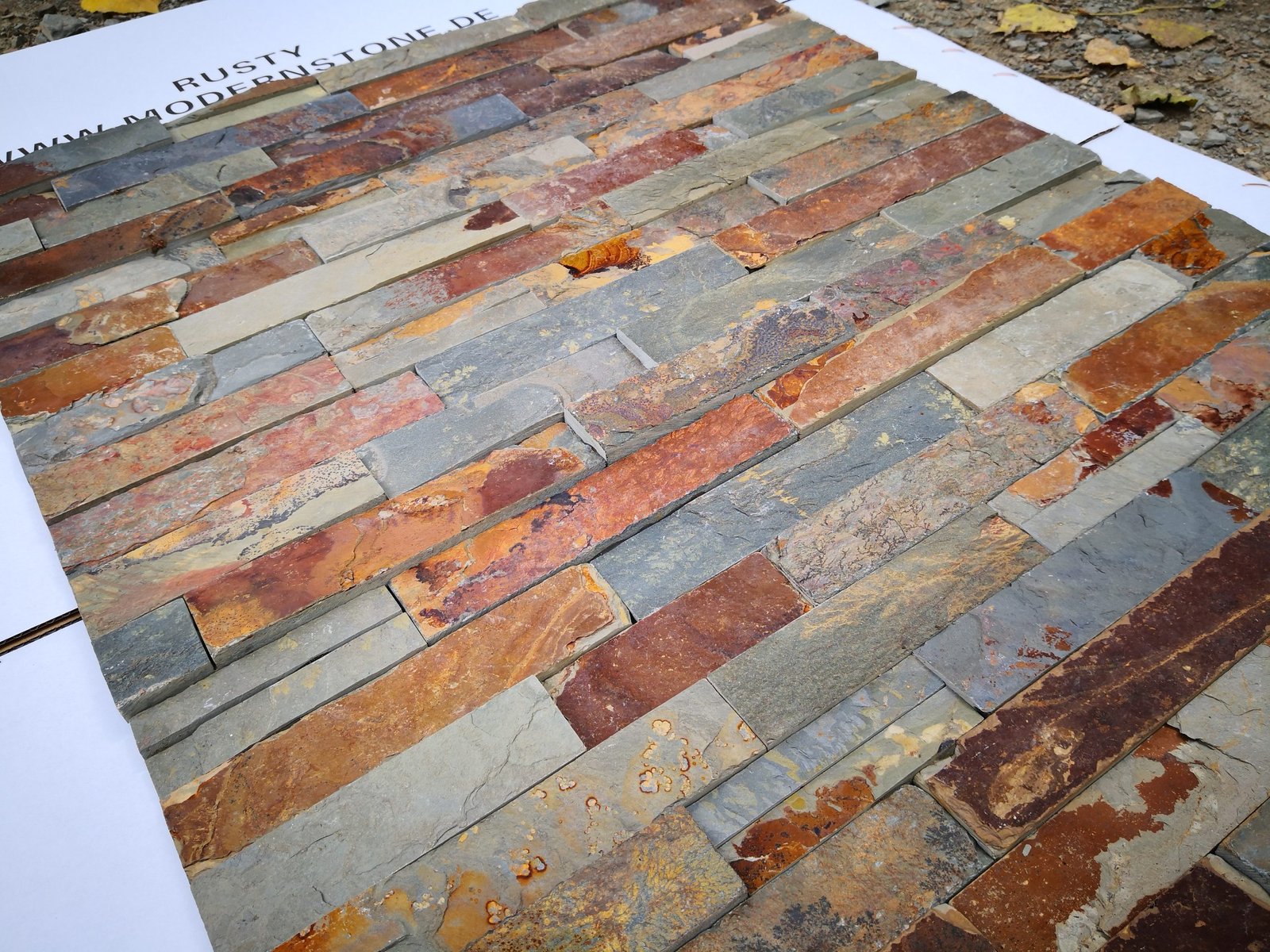
Thickness tolerance is the specification point most often left vague. A split face cannot be held to one nominal thickness the way a sawn tile can, so the honest way to buy it is to agree a band per SKU and verify it against the physical batch rather than a catalogue page. The factory runs that check in its design-for-manufacturability review on new projects, and on replacement projects it takes a physical sample and runs vein density comparison, cutting tolerance and backing reverse-analysis in its own lab within three days, then produces a 1:1 free sample. The procedure is set out in how stone panel thickness tolerance is checked and verified.
Colour is a structural specification once the order is a container. A panel is composed at the factory, so the mix inside each carton is fixed the moment it is packed. That is why batch-specific quarry vein selection matters: stone is drawn from one identified vein, sorted by experienced hands, and held to at least 95 percent colour harmony so a wall does not finish with patches where two veins met. Two test methods come up most often on the face stone itself. ASTM C97/C97M covers absorption and bulk specific gravity of dimension stone, and ASTM C880/C880M covers flexural strength. Absorption governs freeze-thaw duty and staining on an exposed facade; flexural strength matters on thin faces, because a thin piece of stone in transit is a bending problem before it is a crushing problem.
Not every face is composed into a panel. The thin stone veneer line ships as naturally split random loose stone, 100 percent natural quartzite and slate, with no carrier behind it. That construction has no bond layer and no backing, which is exactly why it can follow an irregular surface or a radius a rigid panel cannot.
Layer Two: The Bond Layer
The bond layer does one job continuously for the life of the wall: it transfers the weight of the stone, plus wind suction, plus every thermal movement the assembly goes through, into the carrier behind it. Nothing else in the panel is under permanent load, and when stone leaves a facade years after installation the failure is almost always here or at the wall interface, never in the rock.
Two systems appear in this range. Marine-grade epoxy is used on glued assemblies; a cementitious bed is used where the stone is fixed into a cement carrier, so face, bond and backing behave as one monolithic piece. The epoxy is the harder of the two to make well, because it must stay bonded to a stone surface that is naturally dusty, split and full of mineral variation, and hold that bond through a sea crossing and a decade of cycling.
Its rating is the number worth putting in a submittal: the marine-grade epoxy bond holds under 26.5-ton heavy-load sea freight and through thermal cycling from -30C to +50C, an 80C span, with zero pop-off. “Marine-grade” is not decoration. Container interiors sweat on a trans-ocean crossing, and a coastal or pool-surround project sees salt and humidity for years.
The second bond is the one the installer makes on site, and which adhesive it should be follows from the backing rather than from habit. A cement-backed panel wants a cement-based fixing that shares its movement characteristics; a mesh-back panel wants full mortar coverage, because the mesh is a skin and any void behind it is somewhere for water to sit and freeze. The systems are compared in epoxy bond versus cement backing for stone panels, and the factory-side sequence in how the marine-grade epoxy bond assembly is built.
Layer Three: The Backing Carrier
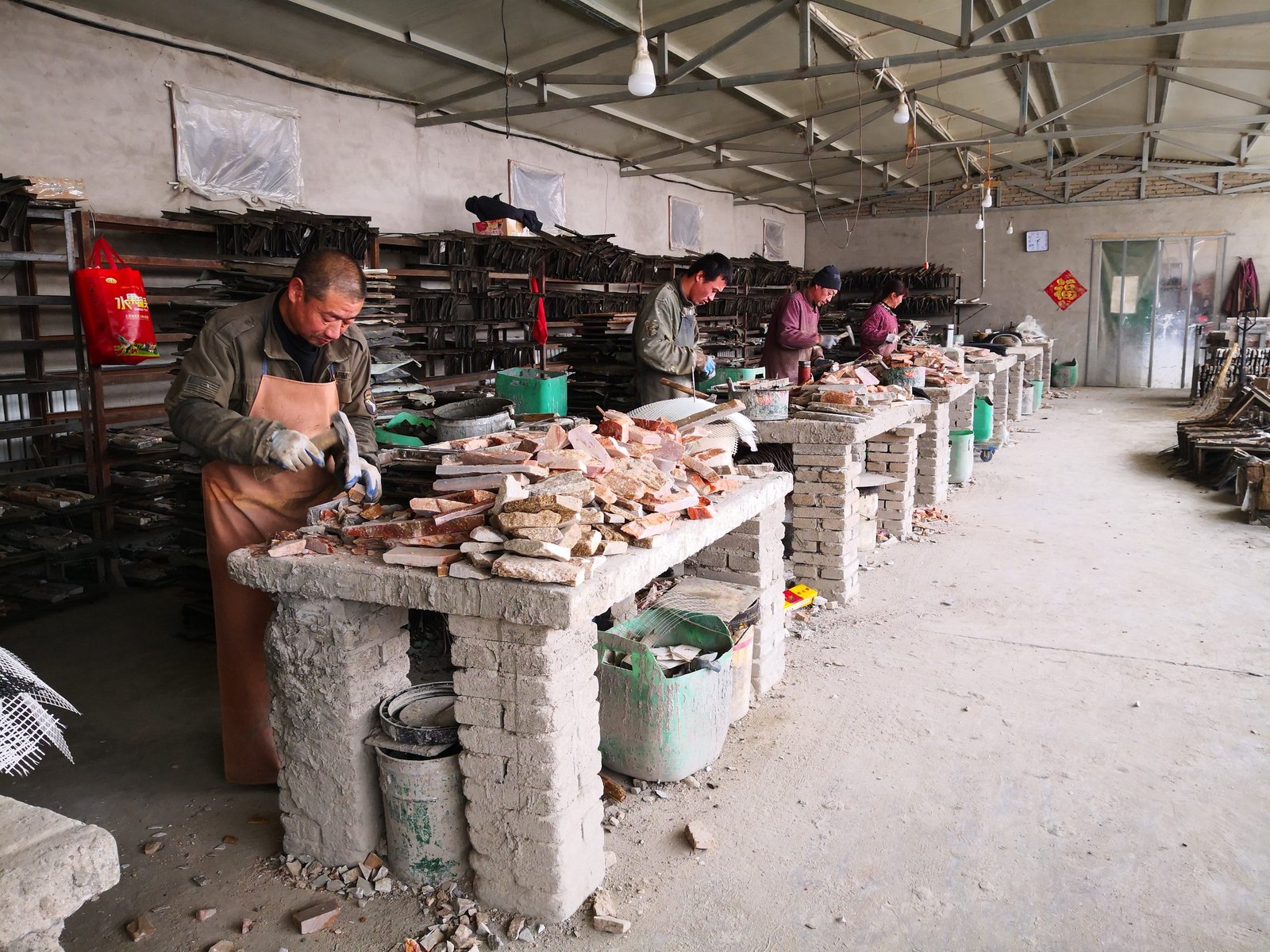
The backing is the layer buyers argue about, because it is where construction choices become visible in the quote. Three systems cover this range, and each changes rigidity, weight, install method and how many square metres fit in a container.
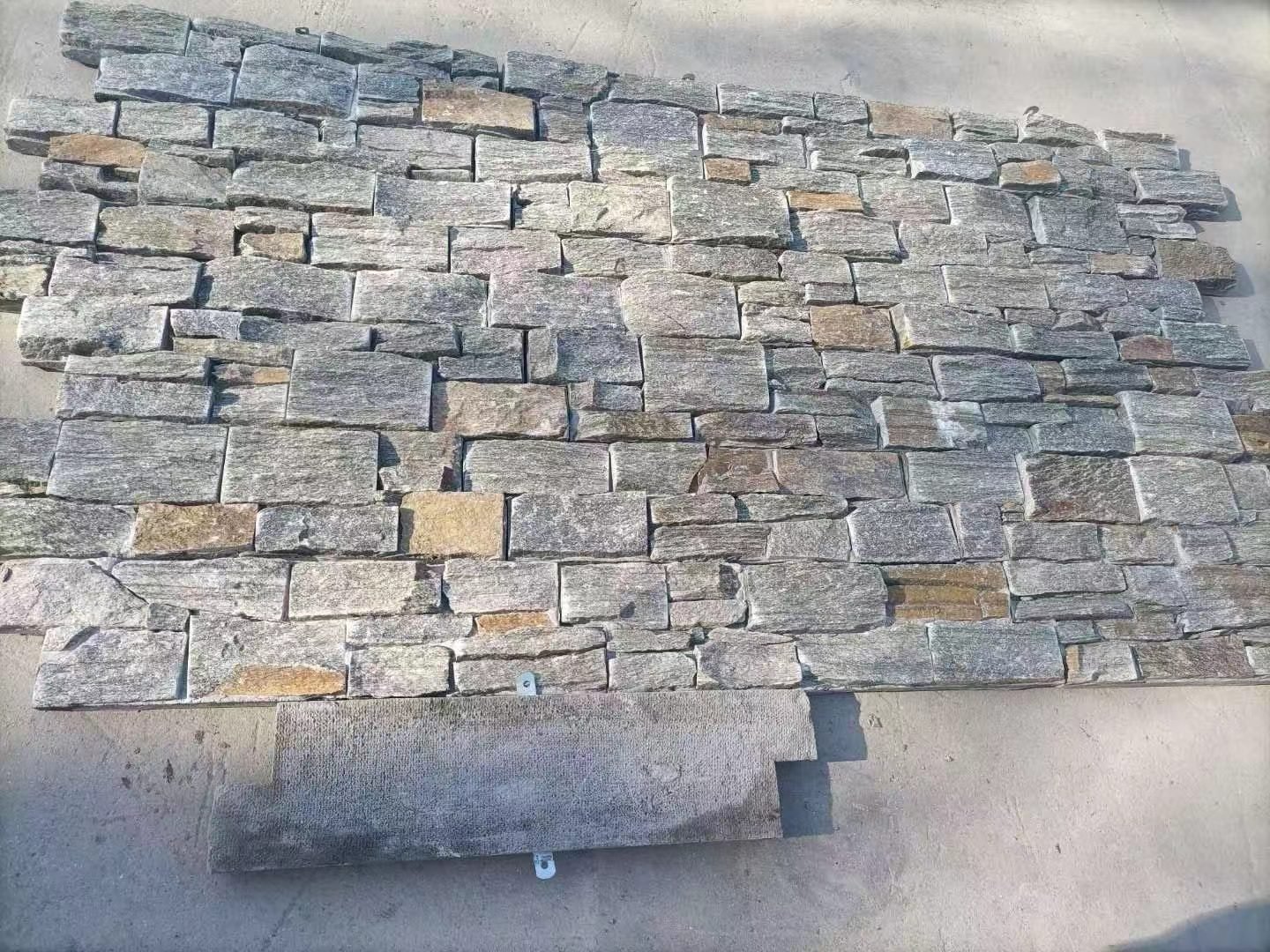
Cement-backed. The stone is fixed into a cement carrier that behaves like a rigid board. The panel stays flat in the crate and flat on the wall, and it gives the installer a predictable surface to fix through. It is the default for large commercial facades and cold-climate work, where the assembly must hold its shape through a freeze season. The trade is weight: more mass per square metre means more dead load, more strapping and fewer square metres per pallet.
Fibreglass mesh-back. The pieces are fixed to a flexible mesh skin. The panel is lighter, conforms to a gentle radius and packs far more coverage into a 20GP container, which is the whole reason the ultra-thin 36x10cm mini ledgestone format exists and why European importers buy it. The trade is that the mesh is a skin and not a slab: it has no independent rigidity, so the substrate has to be true and the installer has to achieve full coverage rather than spot-fixing.
Epoxy-bonded assembly. The pieces are bonded to each other with marine-grade epoxy so the panel behaves as one unit with no separate board behind it. This is the glued construction used on standard ledger panels, and it is why a pre-made corner can be shipped and set as a single piece instead of two loose returns bonded on site.
| Backing | Rigidity | Site fixing | Best applied to |
|---|---|---|---|
| Cement | Rigid, holds plane | Cement-based fixing over a true substrate | Large facades, cold climates, interlocking runs |
| Mesh-back | Flexible, no slab | Full mortar coverage behind the mesh | Ultra-thin ledgestone, gentle curves, interiors |
| Epoxy-bonded | Unitised, semi-rigid | Cement-based fixing, corners set whole | Glued ledger panels and L-corners |
The choice is not aesthetic and rarely a budget question. It is set by three inputs: what the substrate is, whether the wall has curvature in it, and whether the project sits in a freeze-thaw climate. A contractor who answers those before asking for a price gets a quote for the right product first time. Rigidity, thermal movement and install behaviour are compared in full in Z-panel backing systems explained.
Layer Four: Interlock Geometry on Z Panels
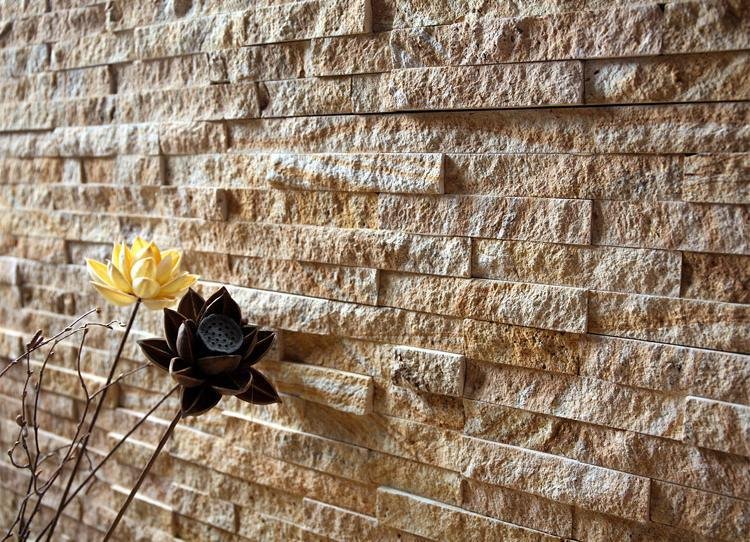
An interlocking panel is one whose perimeter is cut into a profile that mates with its neighbour. In this range the profiles are Z-shape, S-shape and puzzle, all male-female, on formats of 20x55cm and 15.2x61cm. The point of the geometry is not decoration: the joint stops being a gap the installer has to manage and becomes a location the panel finds for itself.
Three things follow. Alignment becomes mechanical rather than visual, because the male edge seats into the female edge and the course stays straight without a fiddler working down the line with a level. Vertical joints disappear, because the profile steps the meeting point back and forth instead of leaving two square ends butted together. And the panels resist lateral creep, since each unit is partly captured by the ones around it, which is why the system is specified for high-wind and cold-region commercial work and rated stable down to -30C.
The interlock also changes what the backing has to do. A male-female profile only seats if the panel has stayed in the plane it left the factory in, which is why cement backing is the standard pairing on large interlocking runs while mesh-back versions go where lighter weight or a gentle curve is the priority. Tolerance is the other half of it: a profile cut loose will seat but will not close, leaving a shadow line exactly where the joint was supposed to vanish. Install follows the geometry, so dry-fit the first course including the corner unit and never trim an interlock edge in the field, because cutting a male edge turns it into a plain butt joint. Profiles and layout are explained in what interlocking Z panels are and how they work.
Edges, Corners, and Pre-Made Corner Units
The outside corner is the hardest detail on any veneer wall and the most expensive to get wrong. Field-solving it means cutting two 45 degree miters in split-face stone on site, and split face chips when it is cut at an angle. The two miters then have to meet cleanly at the arris, which is the one line on the building everybody looks at.
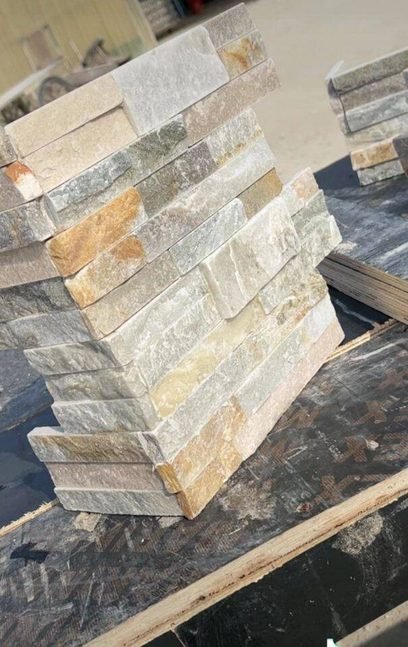
Two families are supplied for the stacked stone lines. The asymmetric set is the best seller and comes as a long leg plus a short leg, either 6x12in with 6x6in or 6x16in with 6x8in. Alternating which leg runs long from one course to the next staggers the vertical joint at the corner, which is what makes the return read as traditional laid masonry rather than a stack of identical L-shapes. The symmetric set is a 90 degree corner with equal legs, 6x12in plus 6x12in, and suits a cleaner, more regular course pattern. Interlocking systems get their own one-piece L-shape corner units so the turn keeps the same male-female continuity as the field.
The arithmetic turns the corner into a purchasing decision rather than a detail decision. Every outside corner is a cut, a fit and a risk of a broken piece. The factory puts the saving from pre-made corners at about 20 percent less material waste and more than 50 percent less on-site labour, because no miter is cut in the field: no chipped returns, no off-cuts, and no second trip to the saw for a crew already on a scaffold. The rest of the ledger panel construction is covered in what stacked stone panels are.
Which Product Line Uses Which Construction
The same quarry feeds every line, which is the advantage of buying from a direct-from-quarry factory rather than a trader assembling a mixed catalogue. What differs is how the stone is composed and carried.
| Product line | Formats | Backing and bond | Edges and corners |
|---|---|---|---|
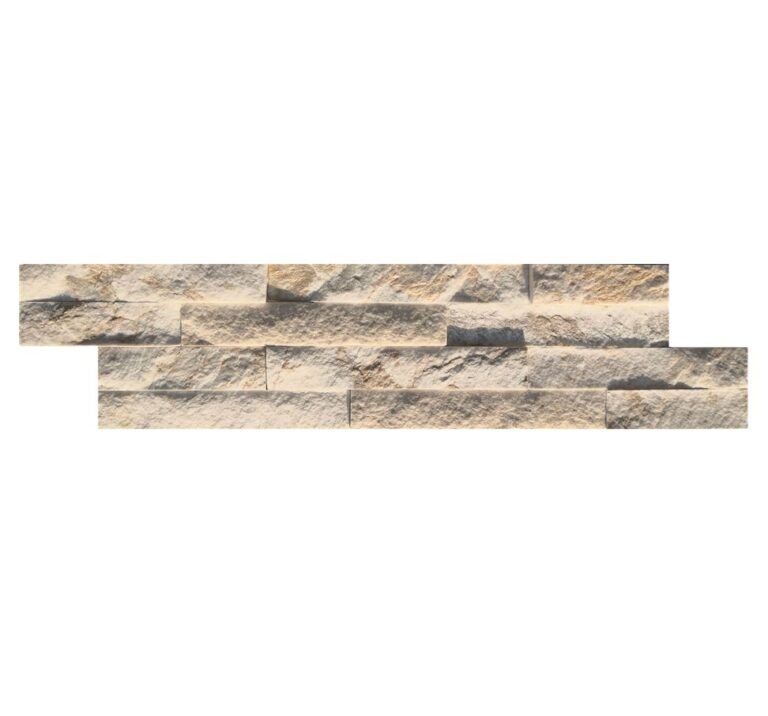
| Stacked Stone | 15x60cm (6x24in) and 15x55cm | Glued or mesh, marine-grade epoxy | Asymmetric and symmetric L-corners |
| Thin Ledgestone | 36x10cm mini ledgestone | Mesh-backed, lightweight build-up | Linear modern edge, no interlock |
| Interlocking Z-Panels | 20x55cm and 15.2x61cm | Cement-backed or mesh-back | Z, S and puzzle male-female; one-piece L corners |
| Thin Stone Veneer | Random loose pieces | No carrier; set into a site bed | Naturally split ends, no sawn arris |
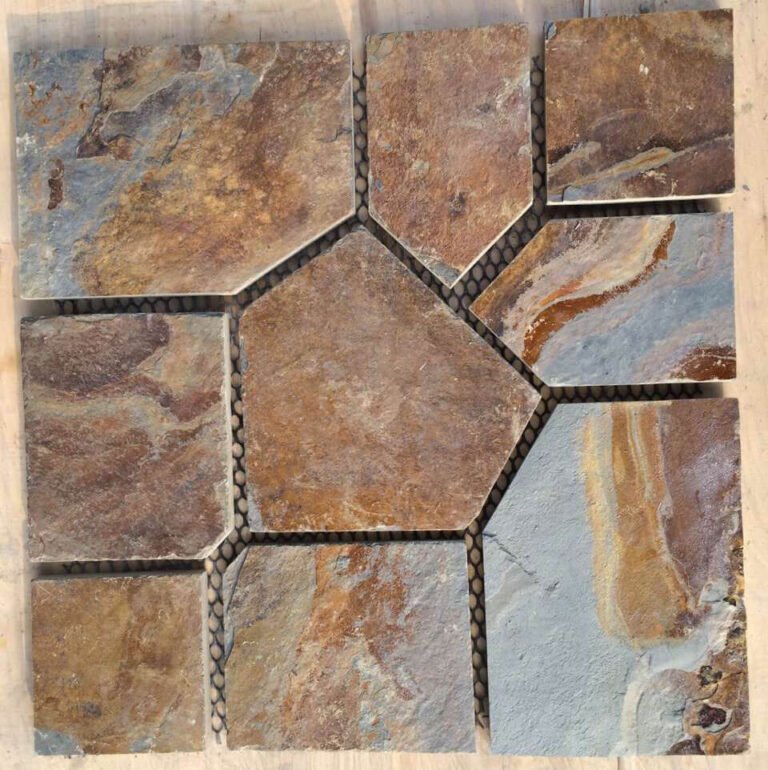
| Flagstone and Crazy Paving | Random flagstone and pavers | Mesh-backed | Random irregular edges |
| Stacked Stone Columns | Sections such as 40x40cm or 50x50cm | Pre-assembled kits with pillar caps | Snap-together modular sections |
The logic reads across the table. Where the wall is big, flat and exposed, the construction gets more rigid and the geometry more worked, because that is where joint visibility and freeze-thaw stress show. Where the priority is freight or curvature, the carrier gets lighter and the stone smaller. Where the surface is irregular or the design wants no repeating module, the carrier is removed and the stone ships loose.
How Construction Drives Weight and Freight
Construction decides logistics before it decides anything else on a wholesale order, and the coverage arithmetic is simple enough for any buyer to check.
| Format | Face area per unit (m2) | Units per m2 | Typical backing |
|---|---|---|---|
| 15x60cm ledger | 0.090 | 11.1 | Glued or mesh |
| 15x55cm ledger | 0.0825 | 12.1 | Glued or mesh |
| 20x55cm Z-panel | 0.110 | 9.1 | Cement or mesh |
| 15.2x61cm Z-panel | 0.0927 | 10.8 | Cement or mesh |
| 36x10cm ledgestone | 0.036 | 27.8 | Mesh |
The 36x10cm unit covers 0.036 square metres, which is 40 percent of a 15x60cm ledger panel’s 0.09. Pair that format with a mesh skin instead of a cement carrier and the same container carries materially more installed coverage, which is the commercial argument for ultra-thin ledgestone in markets where landed freight per square metre decides the margin. The trade lands on site: about 28 units per square metre instead of about 11 means more handling and more joints, so the saving has to be weighed against installed labour cost in the destination market rather than against ex-works price alone.
Weight per square metre is not a number to take from a catalogue, because it moves with rock density, face thickness and carrier type, and between batches of the same SKU. The correct process is the one the factory runs on new projects: send the drawing or the target-market sample, and the design-for-manufacturability review returns a 20GP loading rate and a per-square-metre weight calculation, checked against thickness tolerance and sea-freight weight limits. That is also where the heavy-load question is settled, since a dense cement-backed panel loaded to 26.5 tons is a different palletising problem from a mesh-backed one.
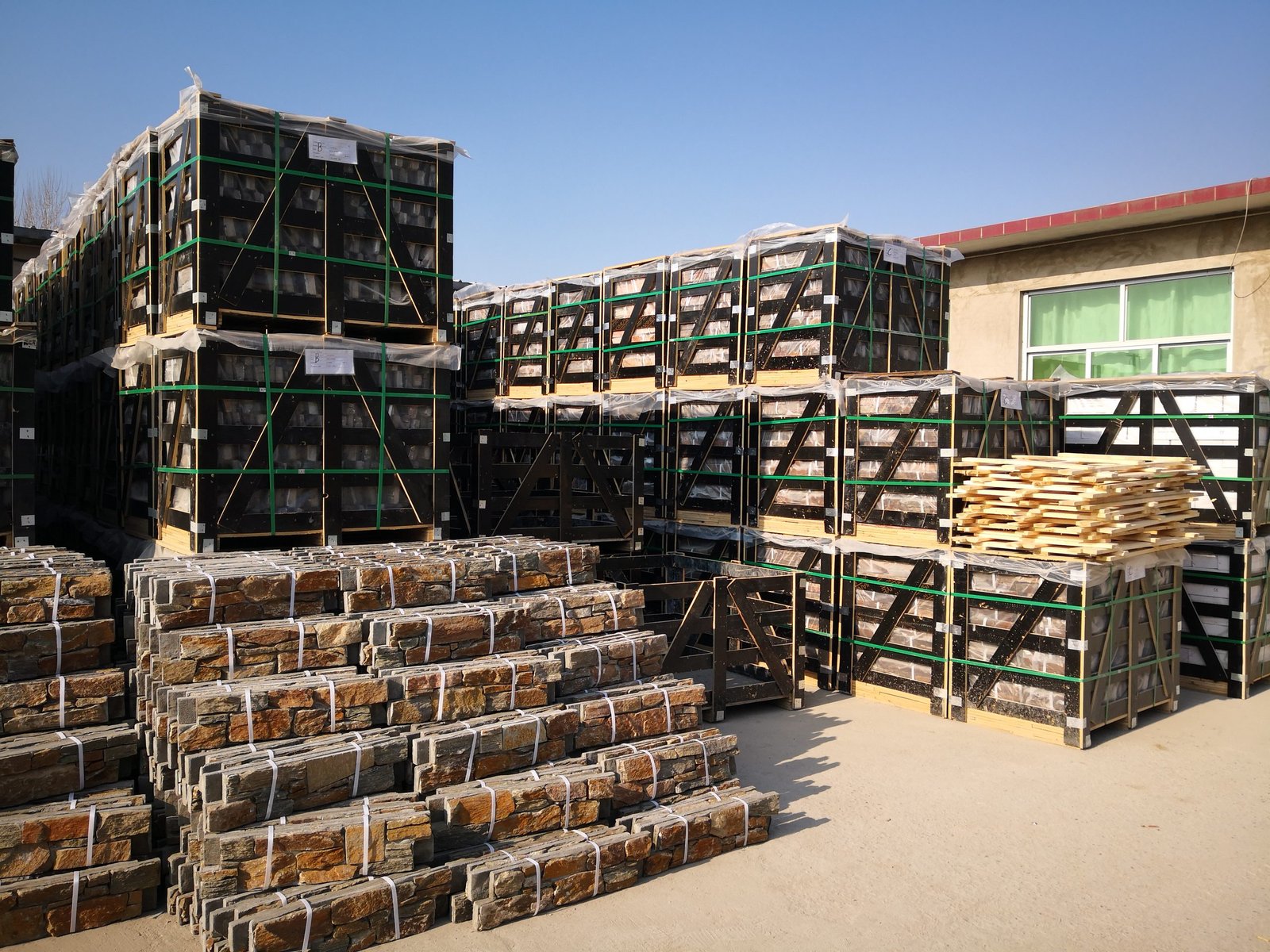
Packaging is part of the construction story because the panel is a bonded assembly with brittle edges. Pallets ship in thickened fumigated wooden crates under the Zero-Breakage Packaging Protocol, with 4-6 high-tensile strapping bands and container air bags, and reinforced strapped crating is used for the 26.5-ton configuration. Before the balance is released the buyer gets a Loading and Packaging Inspection Video, a pre-shipment photo package with pallet layout shots, and an Installation and Dieline Guide.
Commercially, the minimum order is one 20GP container and container-mix orders across product lines are supported, so a distributor can test a cement-backed Z-panel and a mesh-backed ledgestone in one shipment. Samples ship in one to three working days, stock and fast mass production in 20 working days from Tianjin Xingang, and a first order with custom printed cartons in 25 to 30 working days. Terms are FOB, EXW, CIF or DDP through Xingang, on 30 percent T/T deposit with the 70 percent balance released against the loading video and layout photos.
Specifying a Panel Construction Correctly
A construction specification is short, and most disputes on wholesale stone orders come from leaving one of these lines out of it.
- State the substrate first. Cement board, masonry, concrete, plywood or metal lath over sheathing each point to a different backing and site adhesive. Write the substrate into the order, then choose the panel against it, in the same sequence as substrate preparation for stone veneer on plywood, cement board and metal lath.
- Name the backing type explicitly. Cement-backed or mesh-back, on the quotation, per format. The same Z-panel size ships both ways.
- Specify face material and finish. Slate or quartzite, split-face or sawn, and the colour family or reference sample the batch must match.
- Agree a thickness band and a verification method. Split faces vary by nature; the control is a stated band checked against the physical batch.
- Count the corners. Take the outside-corner lengths off the elevation drawing, convert them into asymmetric or symmetric L-units, and order them in the same batch as the field panels.
- Lock the vein batch. Field panels, corner units and any loose stone on one project should come from a single identified quarry vein so colour harmony stays above the 95 percent the factory sorts to.
- Use the sample window. Samples ship in one to three working days, and on a replacement project the lab returns vein density, cutting tolerance and backing reverse-analysis within three days plus a 1:1 free sample.
Two of those lines are the ones most often skipped and most expensive to discover late. The substrate line, because a mesh-backed panel delivered to a site with an uneven framed wall turns into a levelling job nobody priced. And the corner count, because field-mitering split stone on a scaffold is where both the schedule and the breakage rate go wrong. Both are settled with a phone call before the container is committed rather than a claim after it lands.
The three-step QC protocol covers raw material, mid-production and final inspection before loading, and the pre-shipment photo package exists so the buyer approves the pallet layout before paying the balance. That is the point in the process where a construction mismatch is still cheap to fix.
Frequently Asked Questions
What are the layers of a stone veneer panel?
From the outside in: the natural stone face, the bond layer, and the backing carrier. Interlocking formats add a male-female edge profile, and corners are closed with a pre-made L-unit rather than a field cut. A glued ledger panel uses a marine-grade epoxy bond; a cement-backed panel fixes the stone into a cement carrier.
Is cement-backed or mesh-backed stone veneer better?
Neither, in the abstract. Cement backing is rigid, holds its plane and suits large flat facades and cold climates. Mesh-back is flexible, lighter, loads more coverage per container and is the right answer for ultra-thin ledgestone and gentle curves. The substrate and the wall geometry decide which you need.
What holds the stone pieces to the panel?
A marine-grade epoxy bond on glued assemblies and a cementitious bed on cement-backed panels. The epoxy is rated to hold under 26.5-ton heavy-load sea freight and through thermal cycling from -30C to +50C with zero pop-off, which is the specification to quote on an exterior or coastal project.
Do stone veneer panels need special corner pieces?
Outside corners should be ordered as pre-made L-units. The asymmetric best-sellers are 6x12in with 6x6in and 6x16in with 6x8in, and the symmetric set is a 90 degree 6x12in with 6x12in. Using them removes all field 45 degree miter cutting, worth about 20 percent less material waste and more than 50 percent less on-site labour.
How do I check a panel’s construction before ordering?
Order a physical sample, which ships in one to three working days, and check four things on it: face material and finish, carrier type by looking at the back, edge profile, and thickness across several pieces. On a replacement project the factory lab will run vein density comparison, cutting tolerance and backing reverse-analysis within three days and issue a 1:1 free sample.
Does panel construction affect container loading?
Substantially. A 36x10cm mesh-backed mini ledgestone unit covers 0.036 square metres against 0.09 for a 15x60cm ledger panel, and a mesh skin weighs less than a cement carrier, so the thin format exists to maximise installed square metreage per 20GP for importers whose landed freight decides their margin.
Conclusion
A stone veneer panel is a five-element assembly and each element answers a different question. The face decides appearance, density and how much thickness variation the batch will carry. The bond layer decides whether the stone stays on the panel through a 26.5-ton crossing and an 80C thermal span. The backing carrier decides rigidity, weight, whether the panel can follow a curve and which site adhesive the installer needs. The edge geometry decides whether vertical joints stay hidden across a large facade. The corner unit decides how much of the budget goes on a saw on a scaffold instead of on stone.
Once those five are separated, the confusing part of buying wholesale veneer disappears. Two quotes that look identical stop looking identical, because you can see which is a cement-backed interlocking module and which is a mesh-backed thin unit, and why one loads more square metres per container while the other survives a freeze season better.
Key takeaways:
- Three layers minimum: stone face, bond layer, backing carrier, with a male-female edge profile added on interlocking formats.
- Backing drives the specification: cement-backed for rigid flat facades, mesh-back for flexibility and freight efficiency, epoxy-bonded assembly for unitised ledger panels and corner pieces.
- The marine-grade epoxy rating, 26.5 tons and -30C to +50C with zero pop-off, belongs in the submittal.
- Pre-made L-corners cut about 20 percent of material waste and more than 50 percent of on-site labour by removing field miter cutting.
- Construction sets logistics: 0.036 square metres per 36x10cm unit against 0.09 per 15x60cm panel, confirmed by a per-SKU loading rate and weight calculation at DFM.
Top Stone Panels is a direct-from-quarry natural stone cladding factory with 18-plus years of quarrying and export experience and an annual capacity above 220 containers, supplying distributors, contractors and specifiers across North America, Europe, Oceania, the Gulf and Southeast Asia on B2B terms only. Send the elevation drawing, the substrate and the tightest radius on the job and get samples and a vein batch match before the container is committed.