Flagstone stepping stones look simple, but the moment you have to order them in quantity, the simplicity disappears. A garden path is not a pile of flat rocks; it is a spacing diagram, a thickness decision, and a sourcing problem. Get the spacing wrong and the path looks broken. Get the thickness wrong and the stones rock underfoot after one wet winter. Get the sourcing wrong and you wait a month for a shade that does not match the gate approach you ordered separately.
Top Stone Panels is the quarry-owning slate and quartzite exporter in Yixian County, Hebei, that ships flagstone and crazy paving at 30,000 m² a month. Over 18 years and more than 220 containers a year, the questions we answer most often from garden and hardscape distributors and contractors are the ones in this guide: how thick, what size, how far apart, and how to order enough without drowning in waste.
- Stepping stones work on a center-to-center spacing of roughly one adult stride, around 60-75 cm, with the open gaps filled so the path reads as connected.
- Residential path thickness lands in the 2.5-5 cm range; drive-over edges and heavy-traffic commercial walks move up from there.
- Natural split faces of slate and quartzite give the slip-resistant tread that wet-zone and pool-side paths need.
- A 30-60 cm footprint range covers most residential and commercial paths; match stone scale to the walkway width.
- Order color from one quarry vein for the whole site, or the path, pool surround, and gate approach arrive as three different greys.
- MOQ is one 20GP container and samples ship in 1-3 days, so spacing and shade can be settled before the container loads.
- 1. Why Flagstone Works as a Stepping Surface
- 2. Thickness Rules for Paths and Heavier Loads
- 3. Sizing: 30 to 60 cm Footprints That Read Well
- 4. Spacing Math: Stride, Gap, and Layout
- 5. Slate vs Quartzite for Stepping Stones
- 6. Finishes and Edge Quality That Reduce Field Work
- 7. Base and Installation Notes
- 8. Ordering Volume Without Waste
- 9. Sourcing From Top Stone Panels
- FAQ
- Conclusion
1. Why Flagstone Works as a Stepping Surface
Flagstone is flat stone, usually split from slate or quartzite, that breaks into natural, irregular layers. When those pieces are laid with gaps instead of tight joints, the result is a stepping path rather than a paved plane. The form has survived because it solves two problems at once: it drains wherever it sits, and it slows the walker to the rhythm of the stones themselves, which is why old garden paths feel like movement, not concrete.
The practical difference from a fully mortared patio matters on the order sheet. A continuous flagstone patio hides its gaps inside a joint system. Stepping stones expose their layout to the eye, so size consistency, edge quality, and spacing become visible design decisions. Buyers who treat them as leftover patio stone usually get a path that looks like a repair.
For a distributor, the category is also easier to stock than a full paver program. Stepping stones occupy less usable SKU variety once you standardize on a size window and a color range, and they ship densely because the pieces nest. That density is why the same container that carries a patio order can carry a stepping path and a gate approach without wasting volume.
2. Thickness Rules for Paths and Heavier Loads
Thickness is the first specification because it prices the order and decides what the base has to do. For a residential path on a compacted base, pieces around 2.5 to 5 cm thick sit flat, hold their grade, and survive the freeze-thaw cycles that destroy thinner fragile rock in cold climates. Dense slate and quartzite carry that range comfortably; the stone from Top Stone Panels is rated for the -30°C to +50°C span we publish because the material is low-water-absorption and splits into stable layers.
| Use | Typical thickness | Base reality |
|---|---|---|
| Garden path, light foot traffic | 2.5-4 cm | Compacted gravel or sand; individual setting beds |
| Main walkway, commercial or heavy use | 4-6 cm | Full compacted base; wider, more stable stones |
| Drive-over edge, equipment path | 6 cm and up | Engineered base; stone must sit proud with sound bedding |
The warning that belongs in every quote: thickness only matters if the base carries the stone. A 5 cm slab on soft ground rocks no matter how dense the rock is. The standard order of work is base, then bedding, then stone, and the stone thickness you choose should match the base you are willing to build. If a customer asks for thin stone and a road base, that specification fails for both reasons.
Distributors should also confirm thickness tolerance with the factory. Natural split faces vary by nature; what you want is a tight window, not identical slabs. The 3-step QC that Top Stone Panels runs at raw material selection, in-process re-check, and pre-shipment final check exists precisely so a reported thickness range in the quote matches what lands in the box.
3. Sizing: 30 to 60 cm Footprints That Read Well
Stepping stones read best when their footprint matches the walkway and the human rhythm on it. A 30 to 60 cm window covers the standard range: smaller pieces for bending paths and side routes, larger slabs for the main approach where the eye expects mass. Anything much smaller starts to look like gravel with pretensions; anything much larger stops being stepping stones and becomes a patio gap.
Think of each stone as a single step target. The walker should land on the stone, not between stones or on the corner of a stone. That single rule drives both size and spacing: the stone face has to be big enough to land on with confidence, and the gap has to be short enough that the next stone arrives where the foot expects it. For a 60 cm stride, a 40-50 cm stone with a 15-20 cm gap produces a comfortable, repeating rhythm.
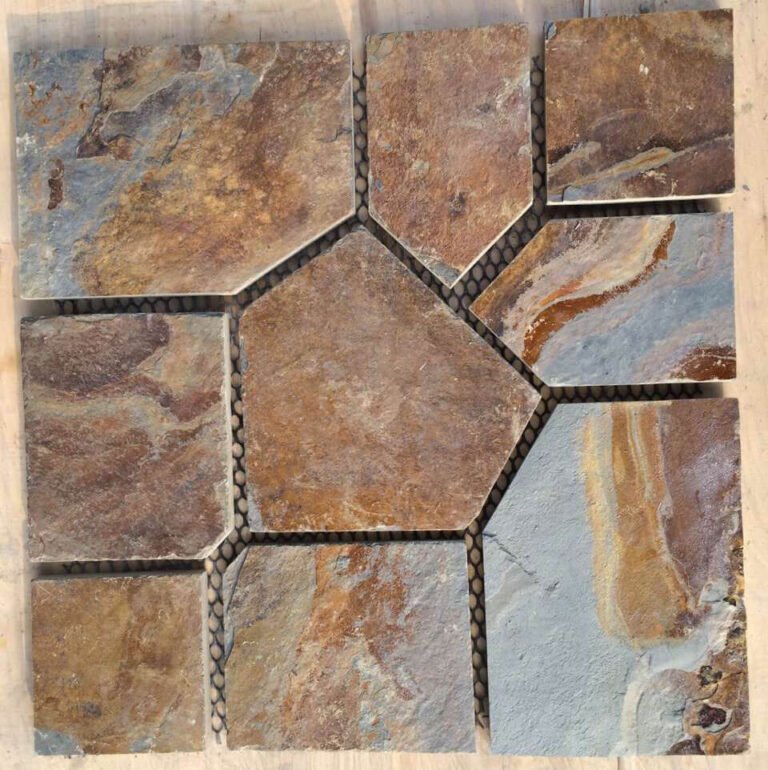
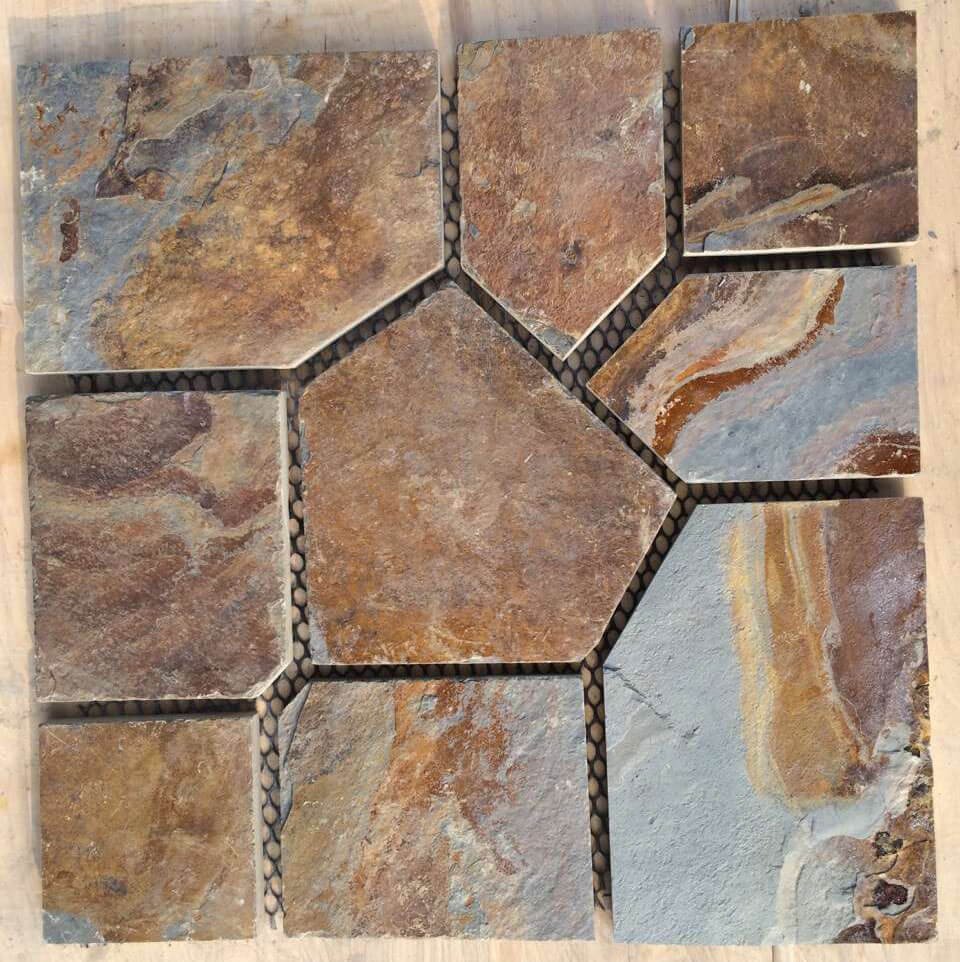
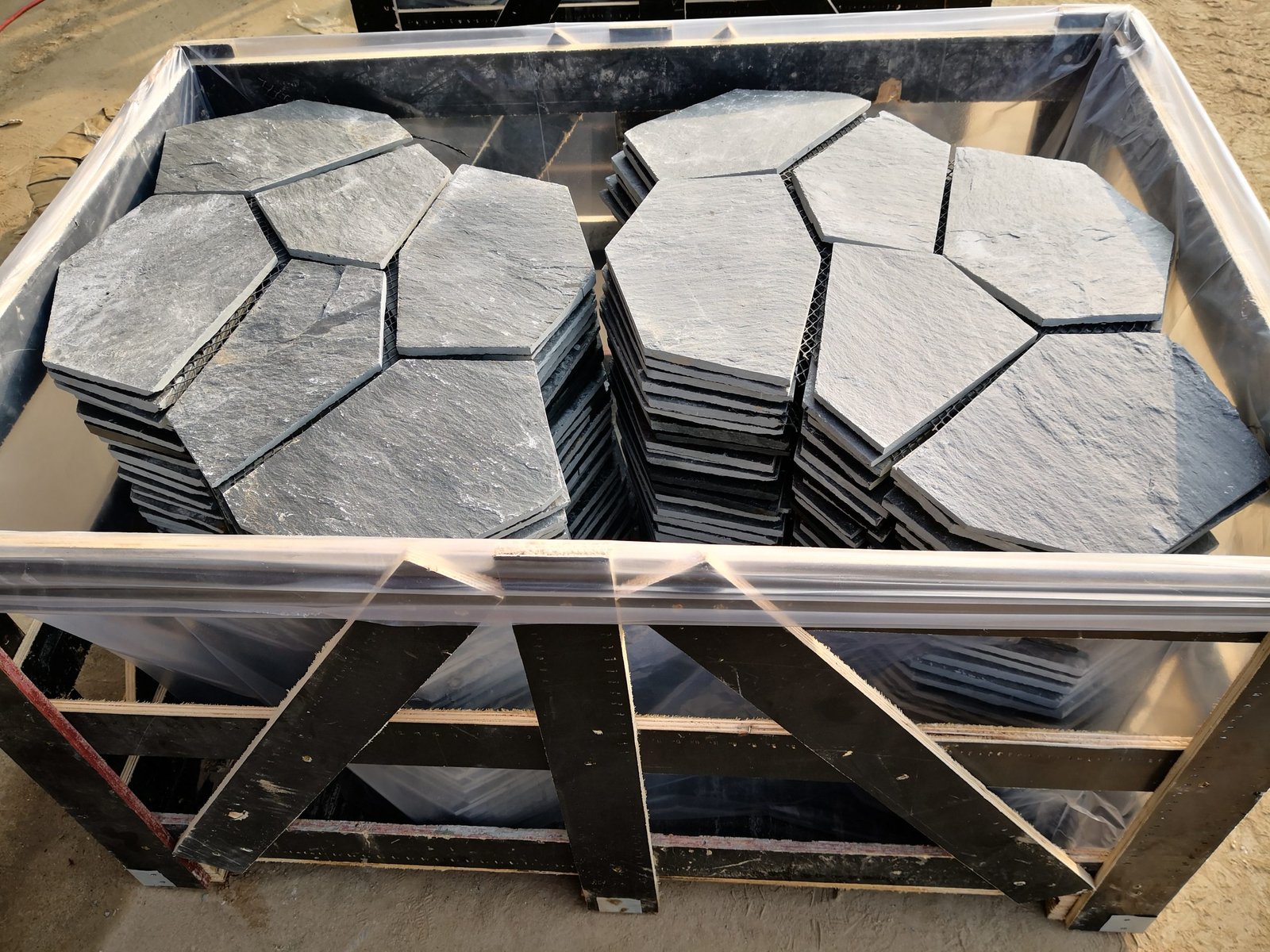
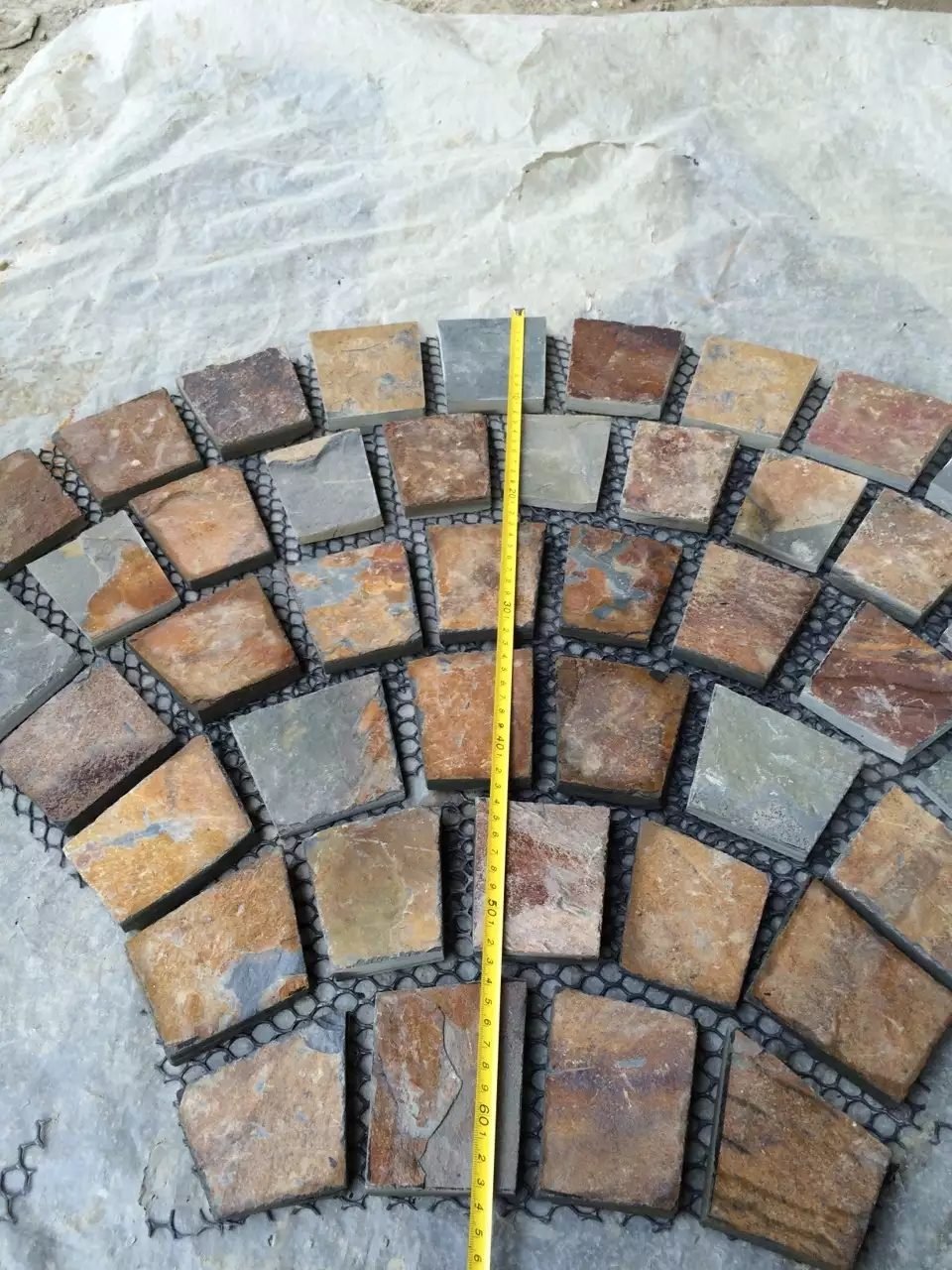
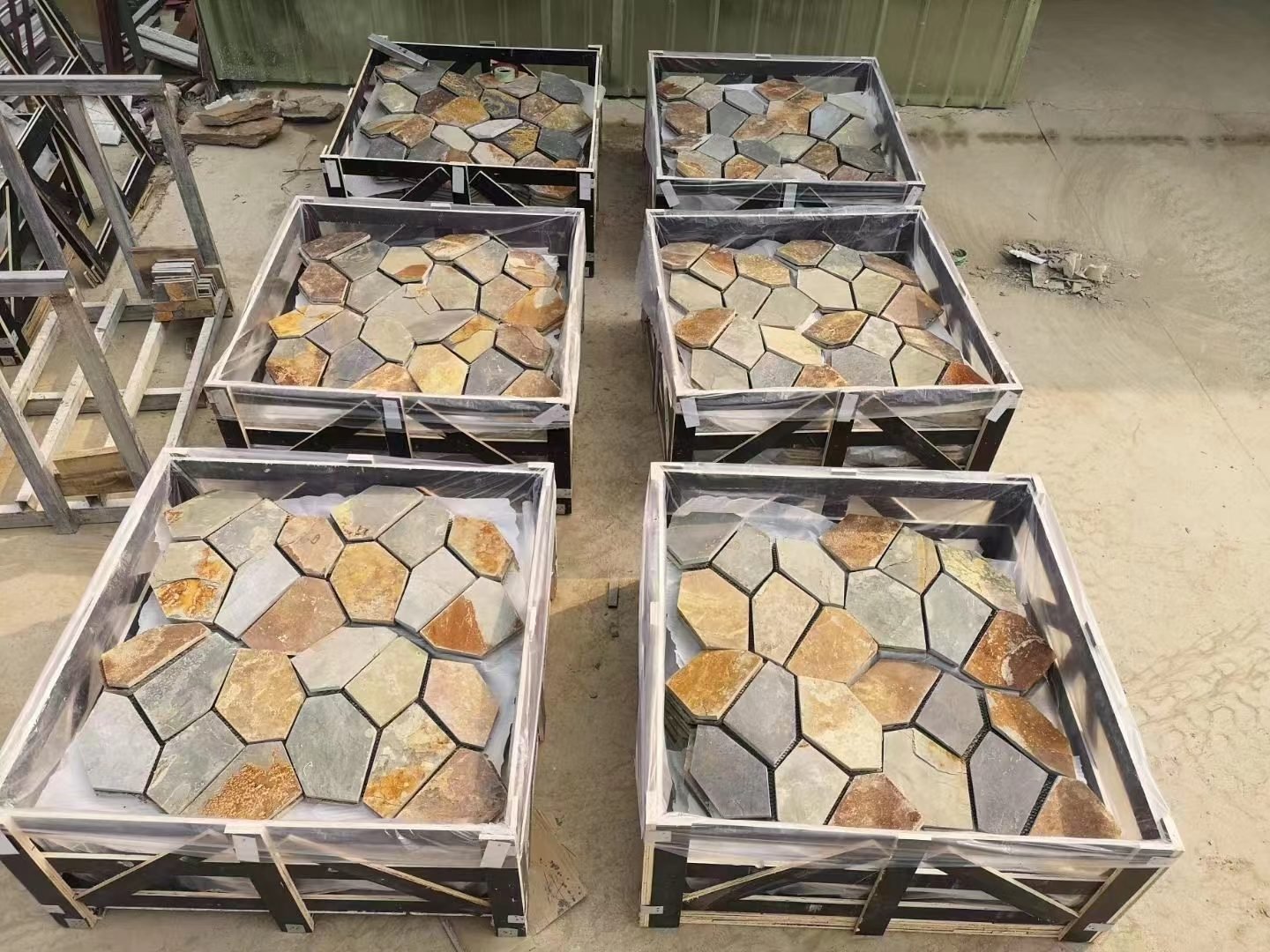
Irregular natural pieces complicate the math, which is why mesh-backed flagstone is worth a second look for distributors. Top Stone Panels ships random-geometry mesh-backed pieces that hold their relative pattern on a backing sheet. The installer lifts the sheet, drops it in place, and the layout controls itself. That converts an irregular natural product into something a crew can install without a designer on site.
4. Spacing Math: Stride, Gap, and Layout
Center-to-center spacing around one adult stride, roughly 60 to 75 cm, is the working number for a residential path. The visual gap between stones lands in the 5-10 cm range when you account for stone size, so a comfortable path is not a tight weave; it is a clear rhythm with a planted gap between each landing point.
The terrain changes the number. On a slope, shorten the spacing and set each stone into its own level bed so the top surface stays close to horizontal; a path that climbs needs shorter strides than a flat walk. For a family path used by children and older adults, bias to the shorter end of the range. For a show walk in a commercial garden design, keep the gaps wide and planted so the stones float in greenery.
- Measure the total path length first, then divide by the center-to-center distance to get the stone count for a straight run.
- Add about 10 percent for cuts, breaks, and layout adjustments at curves and transitions.
- Dry-lay the full path before setting anything; an hour of moving stones on the ground beats a day of resetting stones in mortar.
- Keep the top surfaces level across adjacent stones; a single tilted stone is a trip hazard, not a design detail.
For a quick quote, the count formula is simple: meters of path length divided by the spacing in meters, plus the waste factor. A 10-meter path at 0.7 meter spacing takes about 14 stones before waste, and about 15-16 after. Sending that arithmetic with the order also tells the factory the layout intent, which matters when pieces arrive with irregular geometry.
5. Slate vs Quartzite for Stepping Stones
The two stones that dominate stepping stone orders are slate and quartzite, and the honest answer is that both serve. Slate splits into flat, consistent layers with a strong non-slip character, which makes it the classic garden path material and the default for pool-side and coastal work where the surface will be wet. Quartzite brings more hardness and a broader color range, from pale creams to warm rusts, for projects where the color story drives the design.
| Property | Slate | Quartzite |
|---|---|---|
| Color range | Charcoal, grey, green, subtle rust | Cream, gold, brown, pale grey |
| Finish character | Split face, strong texture | Split face, higher hardness |
| Best use | Wet zones, pool surrounds, classic paths | Design-led paths, color-matched projects |
The buyer-side decision is rarely mineralogy; it is color and budget. If the project asks for “grey garden stone,” slate is the honest answer and it will match the flagstone color guide we publish. If the design brief calls for warm tones next to a limestone or terracotta facade, quartzite carries it. Either way, the stone and the cladding on the same property should come from the same quarry vein so the landscape reads as one material language.
6. Finishes and Edge Quality That Reduce Field Work
The surface finish decides how the stone feels underfoot and how it sheds water. A natural split face is the default for stepping stones because it adds slip resistance and keeps the organic look. A sawn or machine-finished face changes the story: cleaner lines, more formal paths, less traction when wet. Specify the finish as part of the product line, not as an afterthought, or the sample and the container can arrive looking like different materials.
Edge quality is the hidden labor saver. Jagged, brittle edges break in transit and in the installer’s hands, and every cracked edge means a replacement piece or a quiet field repair. Factory-processed pieces with infrared CNC diamond cutting hold their geometry, and the Zero-Breakage Packaging Protocol of 3-5 layer cartons, palletizing, steel strapping, and air bags is what lets a container of irregular stone arrive whole. Ask the factory for their loading and packaging method before you trust the breakage number in the quote.
For distributors building a stepping stone program, standardize on one finish and one edge treatment per color. That converts a natural, variable category into a repeatable SKU: same finish, same thickness window, same size range, delivered the same way every container. Repeatability is what lets you quote a path without a new sample cycle every time.
7. Base and Installation Notes
Stepping stones fail in three predictable places: the base, the bedding, and the leveling. The base carries the load, so dig below the frost line in cold climates, compact the subgrade, and add a stable gravel layer. The bedding is what locks each stone in place, so set each piece in a full bed of sand or stone dust rather than a thin smear. The leveling is the finish, so tap each stone to a consistent plane and re-check the course before you walk away.
For a formal path with tight joints, treat the stones like flagstone pavers and follow the full base and jointing procedure. For a casual stepping path in a lawn or garden, the stones sit individually on compacted soil or sand with no joint material needed. The deciding variable is traffic: the more load and the more regular the use, the closer you move to a full paver base.
Wet-zone paths deserve the same care as flagstone pool decking. Water finds the low stone, so each piece needs its own drainage and an angle that sheds water instead of pooling. The natural split face does the safety work, but the installer still has to set the grade.
8. Ordering Volume Without Waste
Ordering stepping stones by count is the fastest way to waste money. Ordering by calculated square meters with the spacing math baked in is the professional method. Work the path length, multiply by the average stone width to get the coverage area, apply the 10 percent waste factor, and convert to square meters at the factory’s standard pallet density.
| Container | Typical flagstone coverage | Best for |
|---|---|---|
| 20GP | ~430-500 m² of panel surface, less for thick pieces | Single project, sample program, mixed container with other lines |
| 40HQ | ~900-1000 m² of panel surface, depends on thickness and packing | Distribution stock runs, multi-phase projects |
Those coverage numbers are working estimates that shift with thickness, stone geometry, and packing method; the factory confirms exact cubic loading at quoting time. The point of putting the estimate on the sheet is to check the order against the project instead of guessing. Distributors should also plan the mixed-container option, because a stepping stone order often rides in the same 20GP as flagstone for the larger hardscape work on the same site.
Standard production runs 20-25 working days on repeat orders, 25-30 on first orders with custom printed cartons, and samples ship in 1-3 days. That timeline matters more for stepping stones than for panels because the color decision is usually made late, after the house or gate is already built.
9. Sourcing From Top Stone Panels
Top Stone Panels sources flagstone and crazy paving from natural slate and quartzite quarries in Yixian County, Hebei, running 30,000 m² of monthly capacity. The standard MOQ is one 20GP container, and the lines mix if you ask: stepping stones, crazing pieces, and mesh-backed walkway sheets can ride together with other product lines for the same site.
Color control is the part buyers underestimate. Flagstone varies by block within a quarry, so the path ordered in July can drift from the gate approach ordered in January unless the factory manages the batch. Top Stone Panels locks a single quarry vein per order with batch-specific vein selection, which is the mechanism behind the published color consistency claim. Put that requirement in writing when you request a quote.
Payments run 30 percent T/T deposit with 70 percent before shipment, confirmed against loading video and a production layout photo. Export terms cover FOB Xingang, EXW, CIF, and DDP, and the Zero-Breakage Packaging Protocol covers the whole shipment. For a first-time flagstone buyer, the fastest de-risking step is the 1-3 day sample order: confirm the split face, the thickness, and the color before a container is committed.
FAQ
How thick should flagstone stepping stones be?
About 2.5 to 5 cm works for a garden path with a proper compacted base. Use denser, thicker pieces for drive-over edges and heavy-traffic commercial walks.
How far apart should stepping stones be spaced?
Roughly one adult stride, about 60 to 75 cm from center to center, with the gap filled by ground cover, gravel, or sand. Shorten the spacing on slopes and for children or older users.
What size are typical flagstone stepping stones?
Common pieces range from 30 to 60 cm across, with larger slabs on main approaches and smaller pieces on side routes. Irregular natural pieces are also available mesh-backed for easier layout.
Is slate or quartzite better for stepping stones?
Both work outdoors. Slate splits into flat, non-slip layers and is the classic wet-zone choice; quartzite adds hardness and a wider color range for design-led projects.
How many stepping stones do I need for my path?
Divide the path length by the center-to-center spacing, then add about 10 percent for cuts, breaks, and layout adjustments at curves and transitions.
Conclusion
Flagstone stepping stones reward the same discipline as any other stone product: decide thickness against the load, size the pieces to the walkway, space them on a human rhythm, and source the color from one quarry vein. The path that reads as intentional is the one where each of those decisions was made on purpose instead of by accident.
Buyers who lock the specification early get a quote that matches the project, a shipment that arrives whole, and a path that does not need a rebuild. Top Stone Panels ships slate and quartzite flagstone stepping pieces, crazy paving, and mesh-backed walkway panels at 30,000 m² monthly capacity, one 20GP MOQ, with samples in 1-3 days and production in 20-30 working days.
Key Takeaways
- Specify thickness by traffic: 2.5-5 cm for paths, thicker for edges and heavy loads.
- Space centers about 60-75 cm and add 10 percent waste to the count.
- Order the whole site from one quarry vein so colors match across path and approach.
- Confirm breakage prevention and packaging policy before trusting the quote.