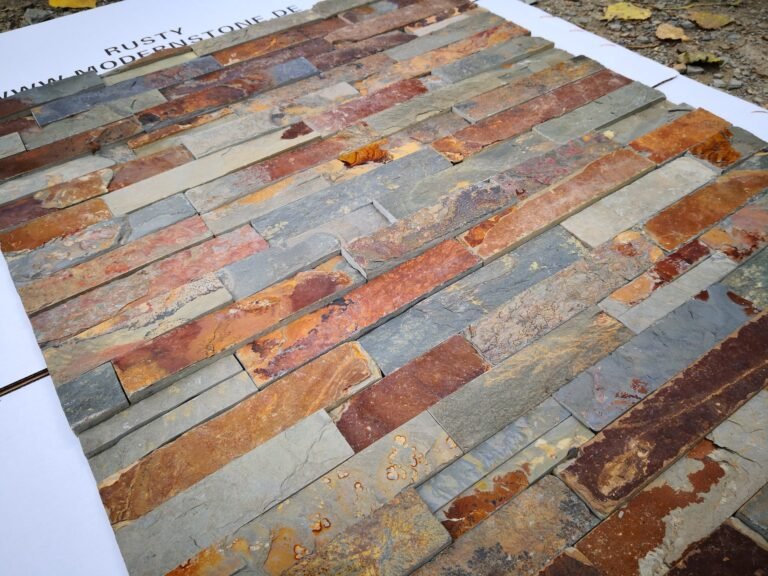
Slate and quartzite formed under immense heat and pressure over hundreds of millions of years. That origin story gives them physical properties no factory-replicated product can match: near-zero water absorption, interlocking crystal structures that resist micro-cracking, and thermal coefficients so low they barely register across an 80-degree swing. For B2B buyers specifying cladding in regions with real winters or punishing summers, those numbers translate into fewer callbacks, longer replacement cycles, and lower lifetime project costs.
This guide walks through exactly how natural stone panels behave at each temperature extreme, what the test data shows, and which installation practices keep performance intact from cold-soak to heat-soak conditions.
Why Natural Stone Handles Temperature Extremes Better Than Alternatives
Thermal performance in cladding starts with three material properties: porosity, density, and coefficient of thermal expansion. Get all three right and the panel survives decades of cycling. Get one wrong and failure is just a matter of time.
Natural slate typically measures between 0.1% and 0.6% water absorption by weight, while quartzite often sits below 0.5%. Those numbers matter because trapped water is the primary driver of thermal failure in any porous building material. When water freezes, it expands roughly 9% by volume. In a material with high porosity, that expansion generates internal pressure that exceeds the tensile strength of the matrix — resulting in spalling, delamination, or catastrophic cracking.
By contrast, here is how common cladding materials compare:
| Material | Water Absorption | Density (kg/m³) | Thermal Expansion (×10⁻⁶/°C) |
|---|---|---|---|
| Natural slate | 0.1–0.6% | 2,700–2,900 | 6–10 |
| Natural quartzite | 0.1–0.5% | 2,650–2,800 | 8–12 |
| Manufactured stone | 2–8% | 1,800–2,200 | 10–14 |
| Concrete masonry | 5–12% | 2,000–2,400 | 10–12 |
| Fiber cement board | 8–20% | 1,400–1,700 | 8–10 |
The density gap alone tells the story. At 2,700+ kg/m³, slate and quartzite carry almost no internal void space for water to occupy. Even under sustained moisture exposure, there is simply nowhere for freeze-thaw forces to act. That geological head start is why natural stone panels consistently outperform their manufactured counterparts in extreme climates.
Freeze-Thaw Performance: When Temperatures Drop to -30°C
The freeze-thaw cycle is the single most destructive force a cladding panel faces in cold climates. The mechanism is straightforward: water enters the material’s pore structure, freezes and expands, then thaws and contracts. Each cycle widens existing micro-cracks by a fraction of a millimeter. Over hundreds of cycles across a typical winter, those micro-cracks coalesce into visible damage.
For natural slate and quartzite panels, the cycle has minimal effect because the pore network is essentially closed. ASTM C97, the standard test method for absorption and bulk specific gravity of dimension stone, measures water absorption under vacuum saturation — far more aggressive conditions than any real-world exposure. Even under those conditions, high-grade slate from the Yixian formation in Hebei (where Top Stone Panels sources its raw material) returns values below 0.4%.
What 100 Freeze-Thaw Cycles Looks Like in Practice
EN 12371, the European standard for freeze-thaw resistance of natural stone, subjects test specimens to repeated cycles of freezing at -15°C and thawing in water at +20°C. After 100 cycles, the test measures loss of flexural strength. For most structural slates and quartzites, the strength reduction falls below 5% — well within the safety margin required for cladding applications.
By comparison, manufactured stone veneer products with higher porosity can lose 15-25% of flexural strength under identical testing. That gap is why you see manufactured stone facades spalling after five to eight winters in Minnesota or Alberta, while slate-clad buildings in Scandinavia routinely reach 50+ years without replacement.
The practical takeaway for specifiers: if you are sourcing cladding for projects in USDA Hardiness Zones 3-5 (minimum temperatures reaching -35°C to -40°C), natural stone panels built from low-absorption slate or quartzite are among the safest material choices available. The stacked stone panels line at Top Stone Panels uses stone from veins with documented absorption rates below 0.5%, selected specifically for cold-climate durability.
The Real Risk: Mortar and Adhesive Failure, Not Stone Failure
In extreme cold, the stone itself is rarely the weak point. The failure path almost always runs through the installation system. Standard thin-set mortar rated for interior use loses bond strength below -10°C. Metal lath contracts at a different rate than the substrate. And if the weather barrier behind the stone allows moisture migration, ice dams form at the wall-plane interface.
This is where material compatibility matters. Marine-grade epoxy bond — the adhesive system used in Z-panel stone cladding assemblies — retains structural integrity from -40°C to +80°C, well beyond the service range of the stone panels themselves. The epoxy bond is also impervious to water infiltration at the stone-to-backing interface, eliminating the freeze-thaw weak point that cement-based adhesives introduce.
High-Temperature Performance: Stability Up to +50°C and Beyond
On the hot end of the scale, stone panels face a different set of challenges. Surface temperatures on south-facing or west-facing exterior walls in Phoenix, Dubai, or Riyadh can exceed 65°C during peak summer. While ambient air temperatures stay below 50°C, solar gain on dark-colored cladding pushes surface readings well above that threshold.
For facades built around dark tones, our black stone exterior facade designs guide matches material choice to the performance data above.
Natural stone handles this without issue for two reasons:
Thermal mass. The density that protects against freeze-thaw also gives stone exceptional thermal mass. A 15-25mm thick stone panel absorbs heat slowly and releases it gradually, reducing the thermal shock that causes warping in lighter materials. The panel does not expand significantly during peak heat because its coefficient of thermal expansion (6-12 ×10⁻⁶/°C) is among the lowest of any cladding material.
UV stability. Unlike polymer-based claddings and some manufactured stone coatings, natural slate and quartzite contain no organic components that degrade under ultraviolet exposure. The color in natural stone comes from mineral content — iron oxides, chlorite, manganese — which are photochemically stable. A grey quartzite panel installed in Abu Dhabi will hold its original color profile indefinitely because the minerals in the stone are older than the sun’s current radiation spectrum.
For more detail on UV degradation mechanisms, the UV stability analysis covers why slate and quartzite specifically resist fading across decades of direct sun exposure.
Fire Rating at High Temperatures
Beyond thermal cycling, fire performance matters for any exterior cladding in wildfire-prone regions or commercial applications. Natural stone is classified as A1 (non-combustible) under EN 13501-1 and achieves equivalent ratings under ASTM E84. At temperatures exceeding 1,000°C, slate may undergo metamorphic recrystallization but does not contribute fuel, smoke, or flaming droplets to a fire event.
This is a meaningful differentiator against manufactured stone (which often contains polymer-modified mortars and organic binders) and fiber cement (which can spall explosively under rapid heating). The fire rating guide provides the full building-code context for specifiers in jurisdictions that mandate non-combustible cladding.
Comparing Stone Performance Across Temperature Zones
The table below summarizes how natural stone panels behave across the climate zones most relevant to North American and European projects:
| Climate Zone | Temperature Range | Primary Stress | Stone Panel Response | Installation Consideration |
|---|---|---|---|---|
| Subarctic (Zones 1-3) | -40°C to +25°C | Freeze-thaw cycling (200+ cycles/year) | Negligible degradation; <5% strength loss after 100 cycles | Use epoxy bond; allow 3mm expansion joints |
| Cold continental (Zones 4-5) | -30°C to +35°C | Seasonal extremes + freeze-thaw | No measurable impact on slate/quartzite | Standard thin-set acceptable with vapor barrier |
| Temperate (Zones 6-7) | -15°C to +40°C | Moderate cycling, humidity | Full performance; no special accommodation | Standard installation methods |
| Hot-dry (desert) | +5°C to +50°C (surface 65°C+) | UV exposure, thermal mass load | No color change; minimal expansion | Allow 2-3mm panel gaps; light-colored stone preferred |
| Hot-humid (tropical) | +20°C to +45°C | Moisture + heat, salt spray (coastal) | Resistant; salt does not penetrate low-porosity stone | Stainless steel or non-corrosive fasteners |
The data makes clear that the stone panel itself is rarely the limiting factor. Performance gaps emerge at the system level — the adhesive, the substrate, the fastener selection, and the weather barrier. Those are the variables specifiers should focus on when adapting a standard installation to an extreme climate.
Installation Practices That Preserve Performance in Extreme Climates
A stone panel rated for -30°C to +50°C only delivers that range if the installation system is designed to match. Three practices consistently separate installations that last decades from those that fail within five years.
1. Match the Adhesive to the Temperature Range
Standard cementitious thin-set mortar works well in temperate zones but loses flexibility below -10°C and can become brittle under sustained freezing. For projects in Zone 4 and below, switch to a polymer-modified mortar rated for freeze-thaw exposure, or use marine-grade epoxy bond systems. Epoxy maintains bond strength from -40°C to +80°C and eliminates water infiltration at the bond line — the primary driver of freeze-thaw delamination.
The epoxy vs. cement comparison breaks down exactly when each adhesive system outperforms the other, with cost and performance data for different climate zones.
2. Account for Thermal Expansion at the System Level
Even with a low coefficient of thermal expansion (6-12 ×10⁻⁶/°C), a 600mm-wide stone panel will expand approximately 0.07mm across a 10°C swing and up to 0.58mm across an 80°C swing. That movement is small, but it accumulates across a wall system. On a 10-meter facade run, total expansion can approach 10mm.
Best practice: include control joints every 3-4 meters vertically and horizontally. Use compressible backer rod with a high-quality sealant rated for the full temperature range. On thin stone veneer installations, the lighter panel weight reduces dead-load stress but does not eliminate thermal movement — plan joints accordingly.
3. Protect the Substrate from Temperature-Driven Moisture
In cold climates, warm interior air migrates toward cold exterior surfaces. If the wall assembly lacks a proper vapor barrier on the warm side, condensation forms at the sheathing plane. That moisture has nowhere to go and eventually saturates the substrate behind the stone panels — even if the stone itself is impervious.
Specify a vapor-permeable weather-resistive barrier (WRB) on the exterior side and a Class I or II vapor retarder on the warm-in-winter side. The goal is to let the wall dry to the exterior while blocking interior moisture from reaching the cold plane. For detailed substrate prep guidance, the substrate preparation guide covers plywood, cement board, and metal lath options for each climate zone.
4. Verify Stone Density Before Installation
Not all natural stone is created equal. A slate panel from a low-grade vein with 2-3% absorption will fail in freeze-thaw conditions even if it looks identical to a 0.3% absorption panel from a premium quarry. Before specifying stone for extreme-temperature projects, request the supplier’s ASTM C97 absorption test data.
Top Stone Panels sources slate and quartzite exclusively from the Yixian formation in Hebei province — a geological formation known for consistently low-porosity metamorphic rock. Every production batch undergoes a 3-step quality control process that includes density spot-checks to verify absorption stays below the 0.6% threshold required for freeze-thaw rated cladding.
Real-World Performance: What 18 Years of Export Data Shows
Top Stone Panels has shipped stone cladding to projects in climates ranging from northern Canada (-35°C winters) to the UAE (+50°C summers) since 2005. Across 220+ containers per year, the return rate attributable to thermal performance failure has been negligible. The most common field issues trace back to installation errors — wrong adhesive, missing expansion joints, inadequate weather barriers — rather than stone panel degradation.
That track record is why the company’s standard recommendation for extreme-climate projects remains unchanged: low-absorption slate or quartzite panels, bonded with marine-grade epoxy, installed over a properly detailed weather-resistive barrier with control joints at regular intervals. The material handles the temperature. The system handles the transition.
For a deeper look at how stone holds up specifically against freeze-thaw cycling, the freeze-thaw resistance guide explains the density-to-durability relationship in detail. And for coastal projects where salt spray compounds the temperature challenge, the salt spray resistance analysis addresses that specific interaction.
Frequently Asked Questions
What is the operating temperature range for natural stone panels?
High-density slate and quartzite stone panels perform reliably from -30°C to +50°C in standard exterior cladding applications. The stone itself can withstand temperatures well beyond this range; the practical limit is set by the installation system (adhesive, fasteners, weather barrier) rather than the panel material.
Do stone panels crack in freezing temperatures?
Low-absorption stone panels (below 0.6% water absorption) do not crack under freezing conditions because there is insufficient water within the stone matrix to generate freeze-thaw damage. Cracking in stone facades during cold weather almost always traces to the mortar, adhesive, or substrate — not the stone panel itself.
Can stone cladding handle direct sun in desert climates?
Yes. Natural stone panels handle surface temperatures exceeding 65°C without structural degradation or color change. The mineral pigments in slate and quartzite are UV-stable and do not fade. Lighter-colored stone is preferred in desert applications to reduce heat transfer into the building envelope.
Is natural stone better than manufactured stone for cold climates?
For freeze-thaw performance, natural stone consistently outperforms manufactured stone. The key differentiator is water absorption: natural slate typically measures 0.1-0.6% while manufactured stone can range from 2-8%. Lower absorption means less internal water to freeze and expand, resulting in dramatically longer service life in cold climates.
What adhesive should I use for stone panels in extreme temperatures?
For installations in climates ranging from -30°C to +50°C, marine-grade epoxy bond adhesive is the most reliable choice. Epoxy maintains bond strength across the full temperature range and is impervious to water at the bond line. Standard cementitious thin-set is acceptable in moderate climates (Zones 6-7) but becomes a failure risk in sustained freezing conditions.
Key Takeaways for B2B Buyers
Natural stone panels built from high-density slate or quartzite deliver reliable performance across the -30°C to +50°C range that covers virtually every inhabited climate zone on the planet. The stone itself is not the vulnerability — the installation system is. Specifying the right adhesive, accounting for thermal expansion, and protecting the substrate from moisture migration are the three variables that determine whether a stone-clad facade lasts 10 years or 50.
For distributors sourcing stone panels for extreme-climate markets, the practical path is straightforward: verify absorption rates below 0.6%, pair the panels with temperature-rated adhesives, and provide installers with climate-specific guidance documents. Top Stone Panels supplies ASTM C97 absorption data with every order and can recommend installation specifications calibrated to your target market’s climate zone. Contact the team to discuss project-specific requirements or request physical samples for your own freeze-thaw or heat-resistance testing.