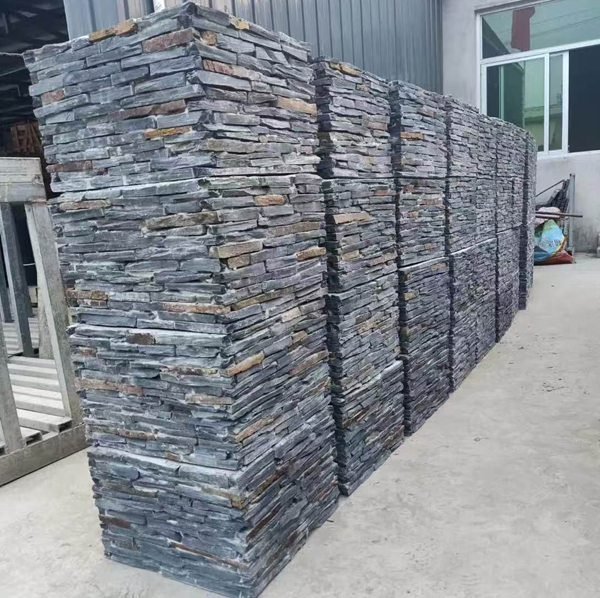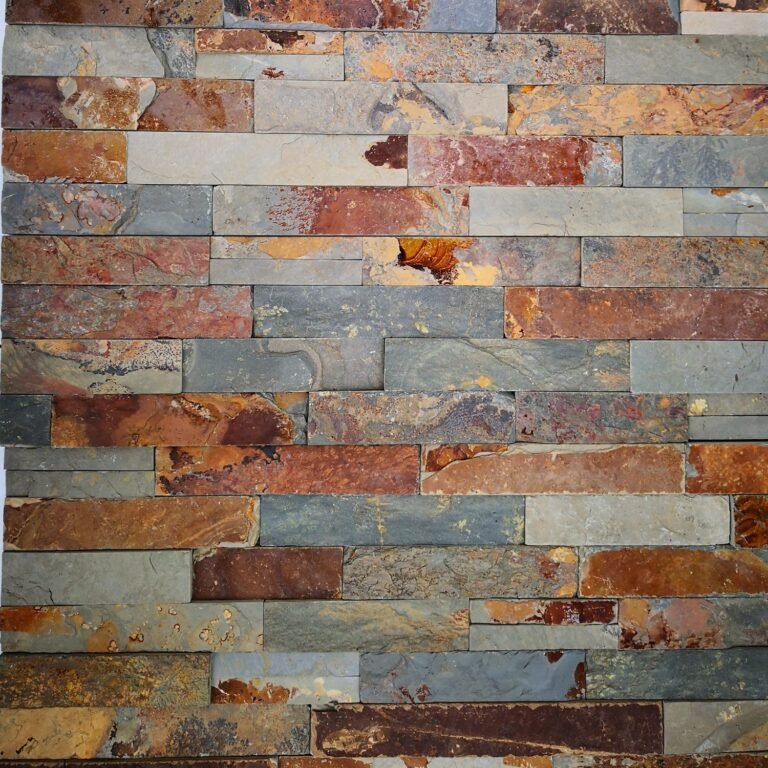
The distributor behind the counter has about thirty seconds to explain why the second sample is the better buy. Stacked stone siding panels are the product category that makes or breaks that conversation. Get the story right and the margin follows. Get it wrong and the homeowner walks out with a product that fades in five years and a complaint that comes back in seven.
This guide is the reference document for that thirty-second pitch — and for every conversation after it. It covers what stacked stone siding panels actually are, which stone types perform where, how the backing system determines the product’s lifespan, what quality looks like at the factory gate, and how a distributor prices and positions natural stone against the manufactured alternatives that dominate the middle of the market.
Key Takeaways
- Stacked stone siding panels are pre-assembled natural stone strips bonded to a backing — they cut installation time by roughly 50% versus individual stone.
- Three stone types cover the market: slate (cool tones, fine grain), quartzite (dense, freeze-thaw champion), and sandstone (warm tones, protected applications).
- Backing choice is the hidden quality variable: marine-grade epoxy bond outlasts cement backing in high-moisture and freeze-thaw environments.
- Natural stone does not fade, carries Class A fire rating without additives, and survives -30°C to +50°C — claims manufactured stone cannot match without pigment stabilizers.
- Standard MOQ is one 20GP container from Xingang (Tianjin); mixed containers across panel types and stone colors are routine.
- Factory-direct pricing supports a premium retail margin while undercutting branded manufactured stone lines at wholesale cost.
- What Stacked Stone Siding Panels Are
- Stone Types: Slate, Quartzite, and Sandstone
- Panel Formats and Sizes
- Backing Systems: The Hidden Quality Variable
- Quality Markers a Distributor Can Verify
- Installation Substrates and Methods
- Pricing Logic and Competitive Positioning
- Order Logistics: MOQ, Lead Time, Documents
- FAQ
What Stacked Stone Siding Panels Are
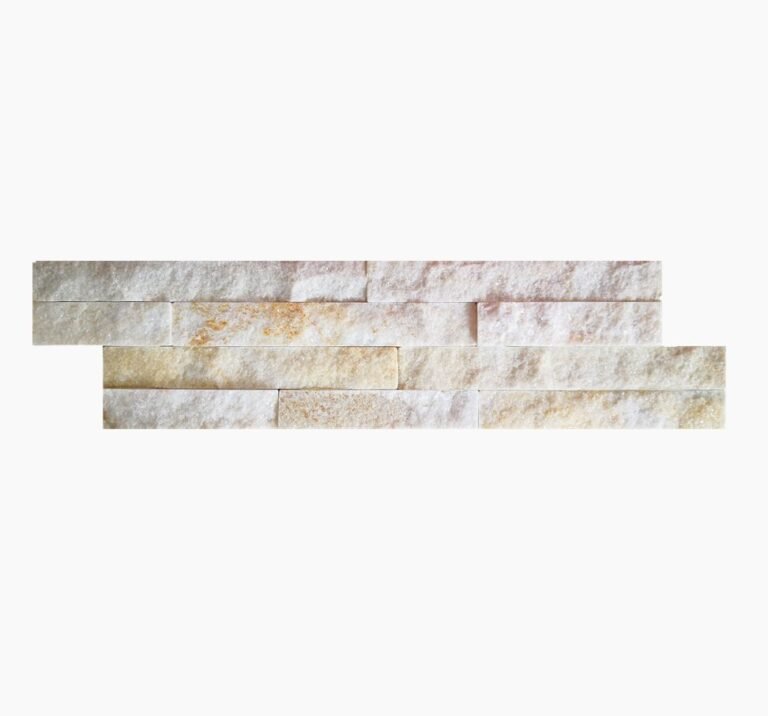
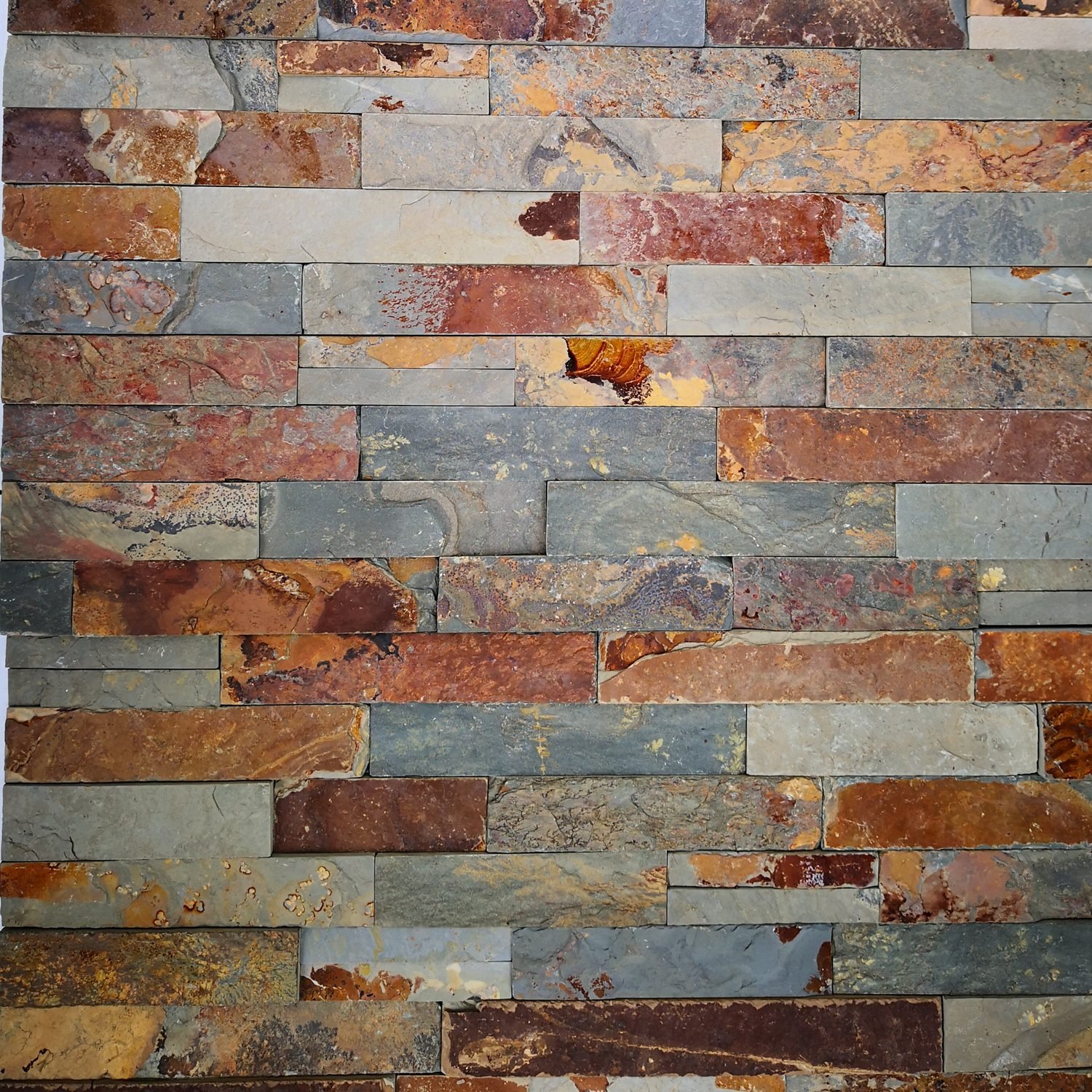
Stacked stone siding panels are factory-assembled cladding units. Multiple strips of natural stone — cut to uniform width and length — are bonded to a backing material in a horizontal ledger pattern. The result is a single panel that installs as one piece and, when placed next to its neighbor, creates the visual rhythm of a hand-laid dry-stack stone wall.
The word “stacked” describes the visual effect, not the installation method. Individual stones are not stacked on site. They are pre-positioned and pre-bonded at the factory, so the installer handles one panel at a time. This is the core productivity claim: a wall that would take a skilled mason a full day to lay stone by stone can be clad in panels in roughly half the time. The labor math alone is often enough to win the contractor over, before the homeowner has even chosen a color.
The term “siding” places the product in the exterior cladding family. In North American construction, siding is any material applied to the outside wall of a building to protect it from weather. Stacked stone siding panels serve that function — they shield the structural wall from rain, wind, and UV — while delivering a natural stone appearance that vinyl, fiber cement, and manufactured stone all attempt to imitate. A full comparison of the product category sits in our guide to what stacked stone panels are.
For the distributor, the important distinction is between real stone panels and manufactured stone panels. Real stone panels contain quarried rock — slate, quartzite, or sandstone sliced from a geological formation. Manufactured stone panels contain cast concrete with surface pigment. Both categories sell. The distributor who stocks both needs to know which claim belongs to which product, because confusing them in front of a contractor erodes trust faster than any pricing mistake. The full breakdown is in our comparison of natural stone veneer vs cultured stone.
Stone Types: Slate, Quartzite, and Sandstone
Three stone families cover the commercial range for stacked stone siding. Each has a distinct performance profile, and matching stone to application is the first decision a distributor helps a buyer make.
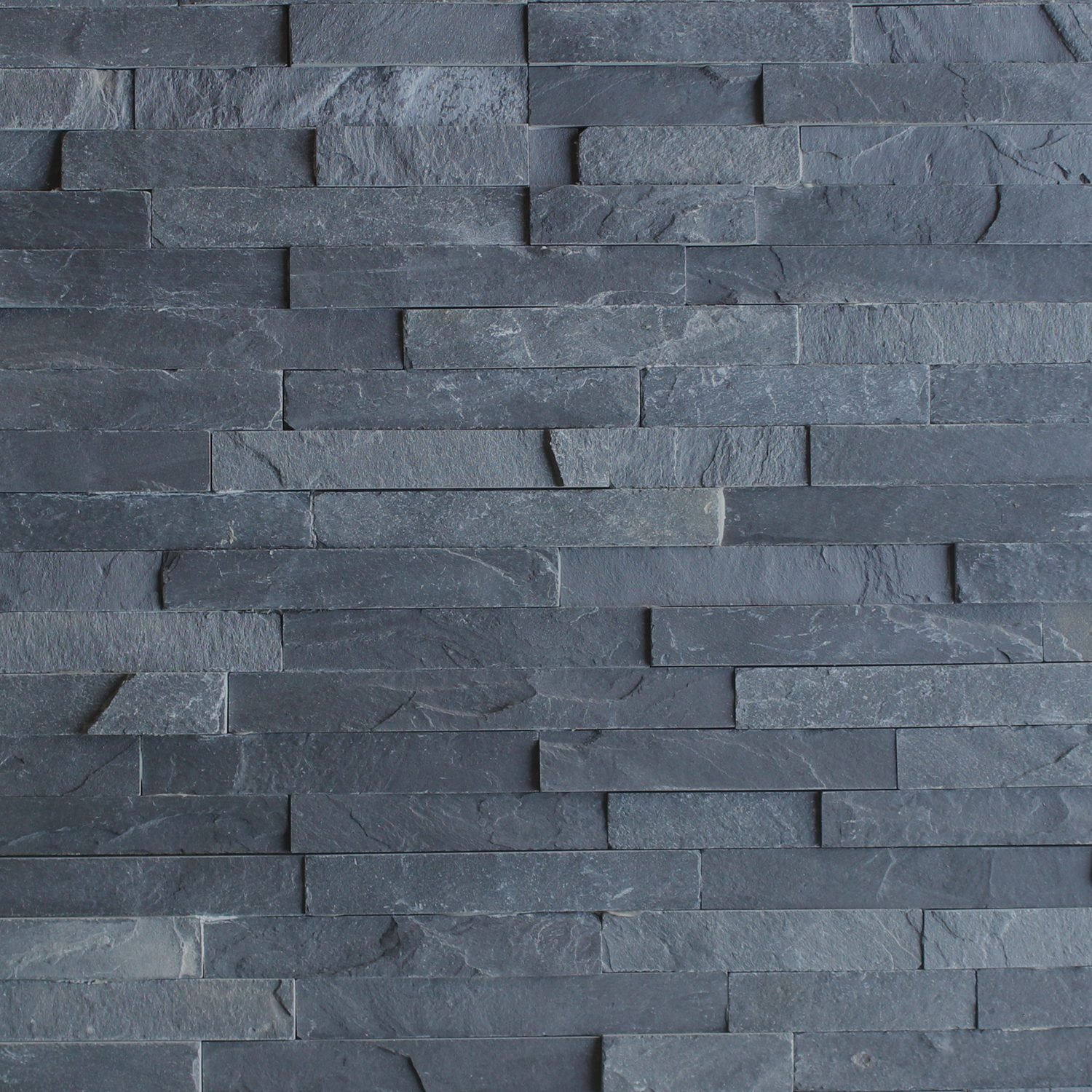
Slate is fine-grained metamorphic rock with excellent natural cleavage — it splits along planes, which is exactly the property a stone panel factory exploits. Slate panels show smooth cleft faces, cool grey and black tones with occasional rusty iron-oxide banding, and a flat profile that reads as modern and minimal. Water absorption is low (typically below 0.4%), which makes slate the default choice for exterior siding in temperate and cold climates. The color range is narrow compared to quartzite, and that narrowness is an advantage: slate facades are consistent by nature, which reduces the batch-matching anxiety on large projects.
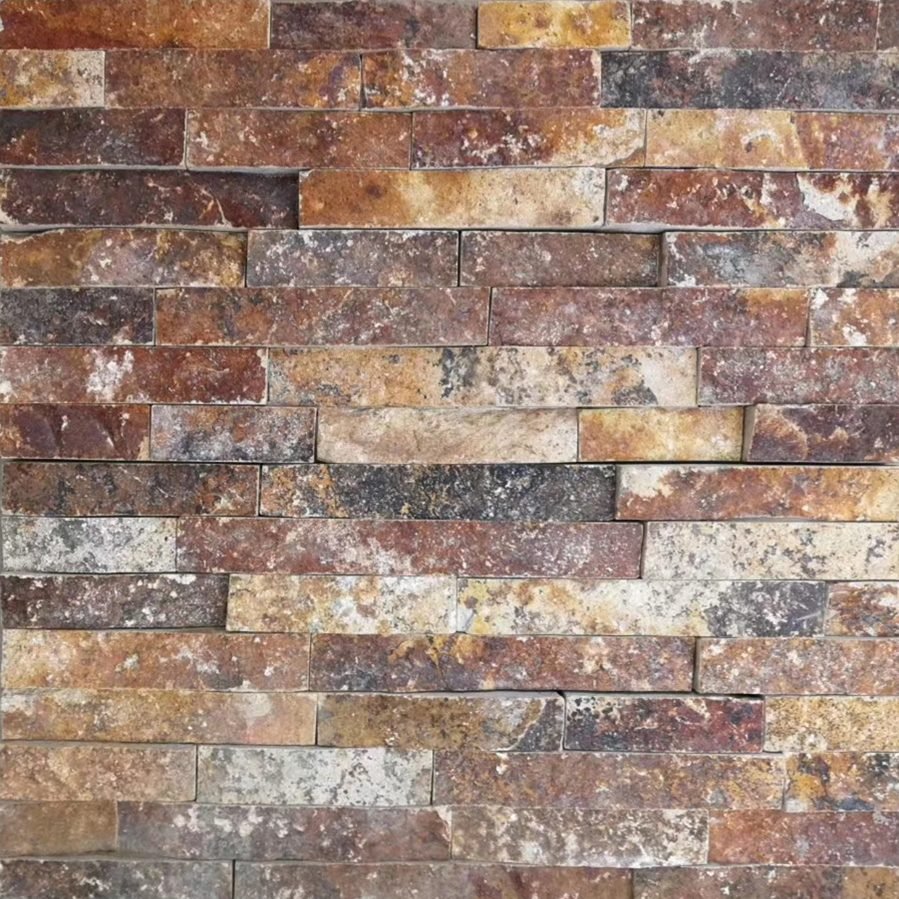
Quartzite is metamorphosed sandstone, recrystallized into interlocked quartz grains. It is denser than slate, harder to cut, and substantially more resistant to freeze-thaw cycling. Quartzite panels show a split-face texture — rougher, more three-dimensional than slate — and a mineral sparkle that catches direct sunlight. Colors range from silver-grey through gold and rusty brown to near-white. Quartzite is the premium exterior choice for projects in northern climates where the stone will see repeated freezing and thawing across a thirty-year facade life. The performance data behind this claim is covered in our guide to exterior stacked stone veneer vs manufactured stone.
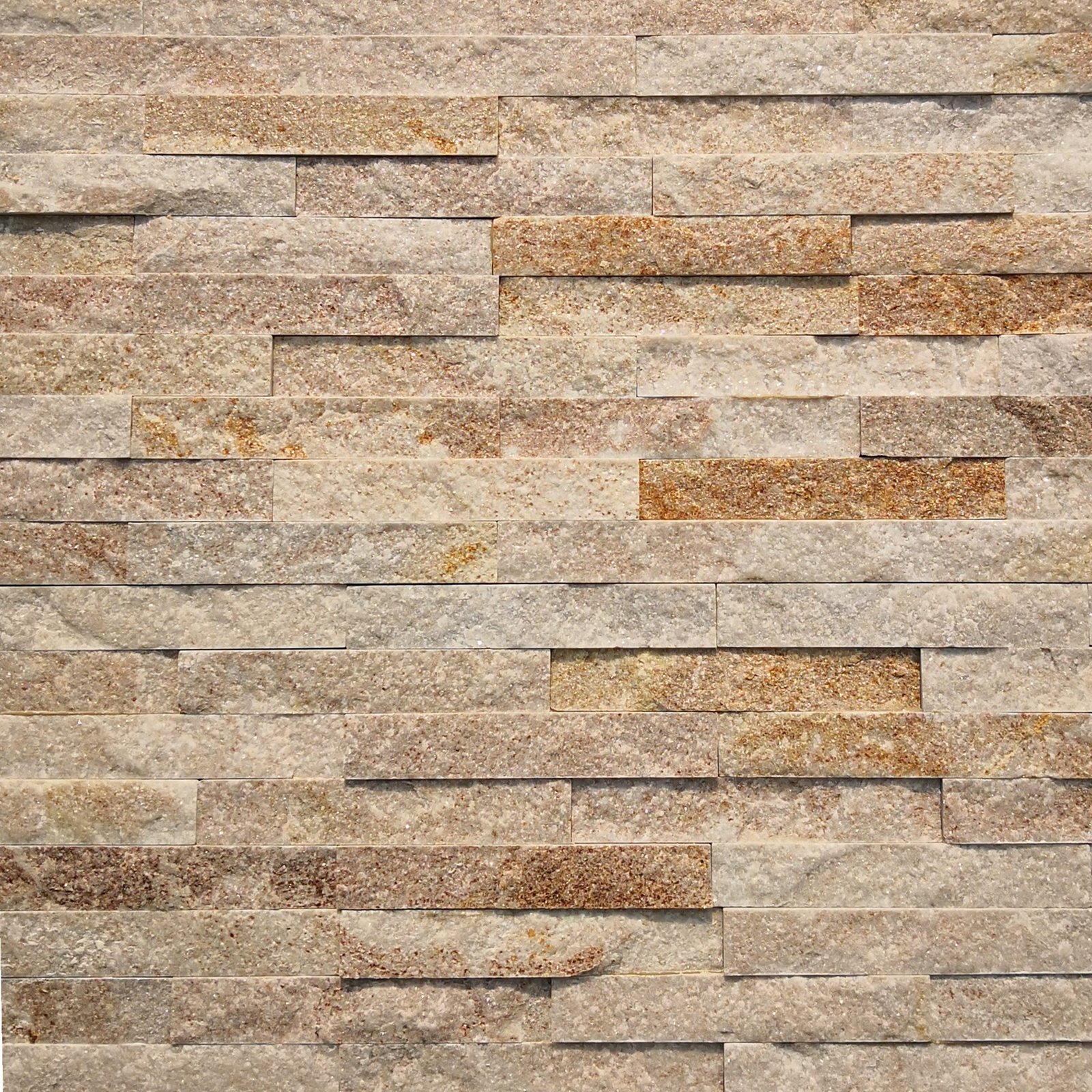
Sandstone is sedimentary rock, cemented sand grains. It is warmer in tone — beige, yellow, brown, and soft red — and more porous than slate or quartzite. Sandstone panels absorb more water, which makes them a risk for unprotected exteriors in freeze-thaw zones. They are the right choice for warm-climate siding, interior feature walls, and protected applications like covered porches and entryways. Where sandstone fits the project, it delivers a warm, approachable appearance that slate and quartzite do not. The porosity-performance relationship is explained in our exterior stone cladding specification guide.
| Property | Slate | Quartzite | Sandstone |
|---|---|---|---|
| Water absorption | < 0.4% | < 0.2% | 1–4% |
| Freeze-thaw rating | Excellent | Excellent | Moderate |
| Color range | Grey, black, rusty | Silver, gold, brown, white | Beige, yellow, red, brown |
| Surface texture | Smooth natural cleft | Split-face, mineral sparkle | Grainy, warm tactile feel |
| Best application | Exterior siding, cold climates | Exterior siding, harsh climates | Interior, warm climates, protected |
| Relative cost (FOB) | Mid | Premium | Budget-friendly |
Panel Formats and Sizes
Stacked stone siding panels come in two standard formats that cover the majority of the North American and European market.
The 15×60 cm panel is the workhorse format. Six hundred millimeters of length gives the installer a long horizontal line that reads as continuous across a wide facade, and 150 mm of height keeps each course proportional to the scale of a residential or commercial building. This format dominates exterior siding projects and is the default specification in most distributor catalogs.
The 15×55 cm panel is the European-market variant. The slightly shorter length suits the smaller facade dimensions and tighter coursing patterns common in European residential construction. The performance and installation characteristics are identical to the 60 cm panel; the choice is aesthetic and regional.
Thickness is the third dimension, and it is where the product segments into price tiers. The range runs from roughly 10 mm (ultra-thin, for interior applications and weight-sensitive exteriors) through 15–20 mm (standard exterior) to 30–40 mm (full-thickness, for projects that want a heavier, more three-dimensional appearance). The full thickness-to-application mapping is in our stone veneer thickness guide.
Beyond the standard panel, the product family includes corner pieces — L-shaped units that wrap around external corners without a visible cut edge — and cap stones for the top of a wall or column. A distributor stocking the panel should also stock the corner and the cap, because the contractor who cannot find a matching corner piece will either cut the panel (which shows the cut edge) or switch to a competing line that has the full system in stock. The installation technique for corners is covered in our guide to cutting and fitting stacked stone corner pieces.
Backing Systems: The Hidden Quality Variable
The stone strips on the face of a stacked stone siding panel are thin — 10 to 20 mm of natural rock. What holds them together as a single installable unit is the backing system, and this is where the product’s long-term performance is actually determined. Two panels can look identical on the showroom wall and diverge completely on the facade five winters later, based on what is behind the stone.
There are three backing systems in commercial production.
Mesh backing is a fiberglass or polymer mesh adhered to the back of the stone strips with a thin-set adhesive. It is the lightest and least expensive option, and it is adequate for interior feature walls and protected applications where the panel will not see freeze-thaw cycling or sustained moisture. Mesh-backed panels are flexible, which makes them easier to handle but also means the stone strips can delaminate under repeated thermal expansion if used on an exposed exterior.
Cement backing is a thin layer of Portland cement mortar troweled onto the back of the stone assembly. It adds weight, adds rigidity, and bonds well to a mortar bed on site. Cement backing is the traditional choice and it performs adequately in moderate climates. Its weakness is moisture: if water penetrates behind the panel and soaks the cement layer, repeated freezing can crack the bond between the cement and the stone. This is the failure mode that gives stone veneer a bad name in cold climates — and it is a backing problem, not a stone problem.
Marine-grade epoxy bond is the premium system. A two-part epoxy resin bonds the stone strips to a structural carrier, and the resulting panel is waterproof, freeze-thaw stable, and substantially more resistant to impact during handling and shipping. Epoxy-bonded panels cost more at the factory gate and weigh slightly less than cement-backed panels of the same face stone. For exterior siding in any climate that sees freezing temperatures, epoxy bond is the specification that separates a twenty-year facade from a five-year callback. The full technical comparison is in our analysis of epoxy bond vs cement backing in stone panels.
A distributor who stocks panels for exterior siding should default to epoxy bond and carry cement-backed panels as a budget option for interior and protected applications only. The product description should make the backing system explicit — “epoxy-bonded stacked stone siding” versus “cement-backed stacked stone siding” — because the installer who does not know the difference will use the wrong panel in the wrong location and blame the product, not the specification.
Quality Markers a Distributor Can Verify
Quality in stacked stone siding panels is measurable before the container leaves the factory. The five markers below are what a distributor should request in the product specification and verify on receipt of the shipment.
Thickness tolerance. The industry standard is ±1 mm across the panel face. A panel specified at 15 mm should measure between 14 and 16 mm at any point. Thicker variations cause the installer to shim adjacent panels; thinner variations create a visible step in the coursing line. Ask the factory for a batch thickness report — a spreadsheet of caliper readings taken at the pre-shipment inspection. Factories that control thickness to ±1 mm publish this data willingly; factories that do not will resist the request.
Flatness and warpage. Place the panel on a flat surface. Rock it. A panel that rocks has warp, and warped panels create a wall that is not flat. The acceptable gap under a straightedge is 2 mm or less across the panel length. Warpage comes from uneven drying of the backing material or inconsistent epoxy application, and it is a factory-process problem, not a stone problem.
Color consistency across the batch. Natural stone varies. That is the point — variation is what makes real stone look real. But the variation within a single project order should be controlled, not random. The factory achieves this through batch-specific vein selection: all panels for one project are cut from stone blocks quarried from the same vein, and the face strips are sorted by color tone before assembly. Panels from different veins on the same wall create a patchwork effect that reads as a quality failure, even though each individual panel is within specification. The process behind batch consistency is detailed in our guide to batch color consistency and vein selection.
Edge quality. Cut edges should be clean, without chipping or breakout along the stone face. Chipped edges show as white marks on the installed wall and are visible from across the street. Edge quality is a function of the cutting tool: infrared CNC diamond blades produce clean edges; manual cutting or worn blades produce chips. Request a close-up photo of the panel edge in the pre-shipment inspection report.
Bond strength. For epoxy-bonded panels, the bond between the stone strip and the backing carrier should withstand a pull test without delamination. Ask the factory for the bond strength test result (measured in MPa) and the test standard used. A reputable factory will have this number on file and will provide it without negotiation.
Installation Substrates and Methods
Stacked stone siding panels bond to the substrate through a mortar bed or a polymer-modified adhesive. The substrate must be flat, clean, structurally sound, and — for exterior walls — protected by a weather-resistive barrier behind it.
The approved substrates are:
- Cement board (Durock, HardieBacker, or equivalent) over wood or metal stud framing — the default exterior substrate in North American construction.
- Concrete block (CMU) — common in commercial and multi-family construction. Panels bond directly to the block face with thin-set mortar.
- Plywood with waterproof membrane — acceptable when the membrane is rated for stone veneer adhesion. The plywood must be exterior grade (CDX or better) and properly fastened to the framing.
- Metal lath over building paper — the traditional substrate, still specified in some regions. A scratch coat of mortar is applied to the lath before the panels are set.
The substrate flatness tolerance is 3 mm per meter. Any deviation greater than this transfers to the finished wall as a visible wave, because stone panels are rigid and do not conform to an uneven surface the way flexible tile might. The installer who skips the flatness check on the substrate will spend more time shimming panels than they would have spent correcting the substrate before starting. The full substrate preparation guide is in our article on preparing substrates for stone veneer.
For exterior installations, the weather-resistive barrier (WRB) behind the substrate is a code requirement in most jurisdictions, independent of the cladding material. The WRB stops any water that penetrates the stone and mortar from reaching the structural wall. Stacked stone siding panels are a drainage cladding, not a waterproof membrane — water can and will get behind them, and the building envelope must be designed to manage that water. The waterproofing detail behind the panel is covered in our guide to waterproofing behind stone veneer on exterior walls.
Pricing Logic and Competitive Positioning
Stacked stone siding panels sit in the premium tier of the exterior cladding market. The distributor’s pricing conversation has two parts: the wholesale cost to stock the product, and the retail margin the product supports at the counter.
Wholesale cost is driven by four variables: stone type (quartzite commands a premium over slate, which commands a premium over sandstone), panel thickness (thicker panels use more raw stone and cost more), backing system (epoxy bond adds cost over cement backing), and order volume (a single container is the base price; recurring monthly orders earn volume discounts). FOB Xingang pricing is the reference point; the landed cost at the distributor’s warehouse adds ocean freight, customs duty, and inland transport. The full cost breakdown is in our guide to natural stone cladding cost.
Retail margin is where natural stone outperforms manufactured stone in the distributor’s P&L. A homeowner who walks in asking for “stone siding” has already decided to pay more than vinyl or fiber cement. The question is whether they pay that premium to a branded manufactured stone line (with a thin margin for the distributor) or to a natural stone panel (with a wider margin, because the product’s perceived value is higher and the wholesale cost from a factory-direct source is competitive). The distributor’s role is to make the value case visible: put a real stone panel and a manufactured stone panel next to each other on the showroom wall, and let the geology speak.
The competitive positioning rests on four claims that manufactured stone cannot match without qualification:
- No fade. Natural stone’s color is geological. There is no pigment layer to degrade under UV exposure. Thirty years on a south-facing facade and the stone looks the same as the day it was installed.
- Class A fire rating. Slate and quartzite achieve Class A (the highest) fire performance without chemical additives. This is a material property, not a coating. For projects in wildfire-prone regions, this claim is not marketing — it is a code compliance advantage.
- Freeze-thaw survival. Dense slate and quartzite panels survive repeated cycling between -30°C and +50°C without spalling or delamination, provided the backing system is epoxy bond rather than cement.
- Weight-to-thickness ratio. Thin natural stone panels (15 mm) deliver the appearance of full-thickness masonry at a fraction of the weight, which reduces structural loading on the building and shipping cost per square meter.
The distributor who can articulate these four claims with confidence — and back them with the factory’s test documentation — sells stacked stone siding panels on value rather than competing on price against a product category (manufactured stone) that was designed to be cheaper.
Order Logistics: MOQ, Lead Time, and Documents
The standard minimum order quantity for stacked stone siding panels from Top Stone Panels is one 20GP container, loaded at Xingang (Tianjin) port. A 20GP container holds approximately 400–600 m² of 15×60 cm stacked stone panels, depending on panel thickness and backing system. Heavier panels (quartzite, epoxy bond) reach the container’s weight limit before filling its volume; lighter panels (sandstone, mesh backing) fill the volume first.
Mixed containers are standard practice. A distributor can combine stacked stone siding panels with stone column kits, flagstone pavers, thin ledgestone panels, and corner pieces in a single 20GP load. Weight distribution is planned at the loading stage — heavier items on the bottom, lighter cartons on top — and the factory provides a loading plan before the container is sealed. The mixed-container strategy is detailed in our guide to MOQ and mixed container ordering.
Lead times are:
- Samples: 1–3 working days from request.
- Standard production: 20–25 working days after the 30% T/T deposit is received.
- First orders: 25–30 working days, because initial vein selection and color matching require additional quarry coordination.
Payment terms are 30% T/T deposit with the balance (70%) paid before shipment. Incoterms available include FOB Xingang (the standard reference), EXW (ex-works for buyers with their own logistics), CIF (cost, insurance, freight to the destination port), and DDP (delivered duty-paid to the buyer’s warehouse). The full Incoterms breakdown is in our guide to Incoterms for stone exports.
Documents provided with every shipment include a Certificate of Origin (COO), an ISPM 15 fumigation certificate for the wood packaging, and a pre-shipment inspection report (with video on request). Established buyers receive these as routine documentation; new buyers should request them explicitly in the purchase order to set the expectation. The documentation standards for stone export are covered in our guides to batch color consistency and quality compliance.
Frequently Asked Questions
What are stacked stone siding panels?
Stacked stone siding panels are pre-assembled sections of natural stone — typically slate, quartzite, or sandstone — bonded to a backing in a horizontal ledger pattern. Standard sizes are 15×60 cm and 15×55 cm, with thickness from 10 to 40 mm. They install as exterior or interior cladding using mortar or mechanical adhesive, and interlock to create a continuous dry-stack appearance with no visible grout lines.
How do stacked stone siding panels differ from individual stone pieces?
Panels are factory-assembled: multiple stone strips are bonded to a backing (mesh, cement, or epoxy) in the correct pattern before shipping. This cuts installation time by roughly 50% compared to laying individual stones, reduces on-site waste, and produces a consistent visual rhythm across the facade. Individual stones require a skilled mason; panels can be installed by a general contractor with basic tile-setting tools.
What stone types are used for stacked stone siding?
The three commercial grades are natural slate (fine-grained, cool grey/black/rusty tones, excellent cleavage), quartzite (dense, sparkles in light, best freeze-thaw performer), and sandstone (warm beige/yellow/brown, softer texture). Slate and quartzite dominate cold-climate exteriors because of their low water absorption. Sandstone suits protected or warm-climate applications.
What is the minimum order for stacked stone siding panels from China?
Standard MOQ is one 20GP container loaded at Xingang (Tianjin) port. A container holds approximately 400-600 m² of 15×60 cm stacked stone panels depending on thickness. Buyers can mix panel formats, stone types, and complementary products like stone columns or flagstone in a single container to reach the MOQ efficiently.
Can stacked stone siding panels be installed on any substrate?
Panels bond to cement board, concrete block, properly prepared plywood with a waterproof membrane, or metal lath. The substrate must be flat (within 3 mm per meter), clean, and structurally sound. For exterior walls, a weather-resistive barrier behind the substrate is required by most building codes regardless of the cladding material.
How should a distributor position stacked stone siding against manufactured stone?
Lead with performance facts: natural stone does not fade (no pigment to lose), carries Class A fire rating without additives, and survives freeze-thaw cycling between -30°C and +50°C. Then lead with margin: factory-direct natural stone panels carry a higher perceived value and support a premium retail price while offering comparable or better wholesale cost than branded manufactured stone lines.